
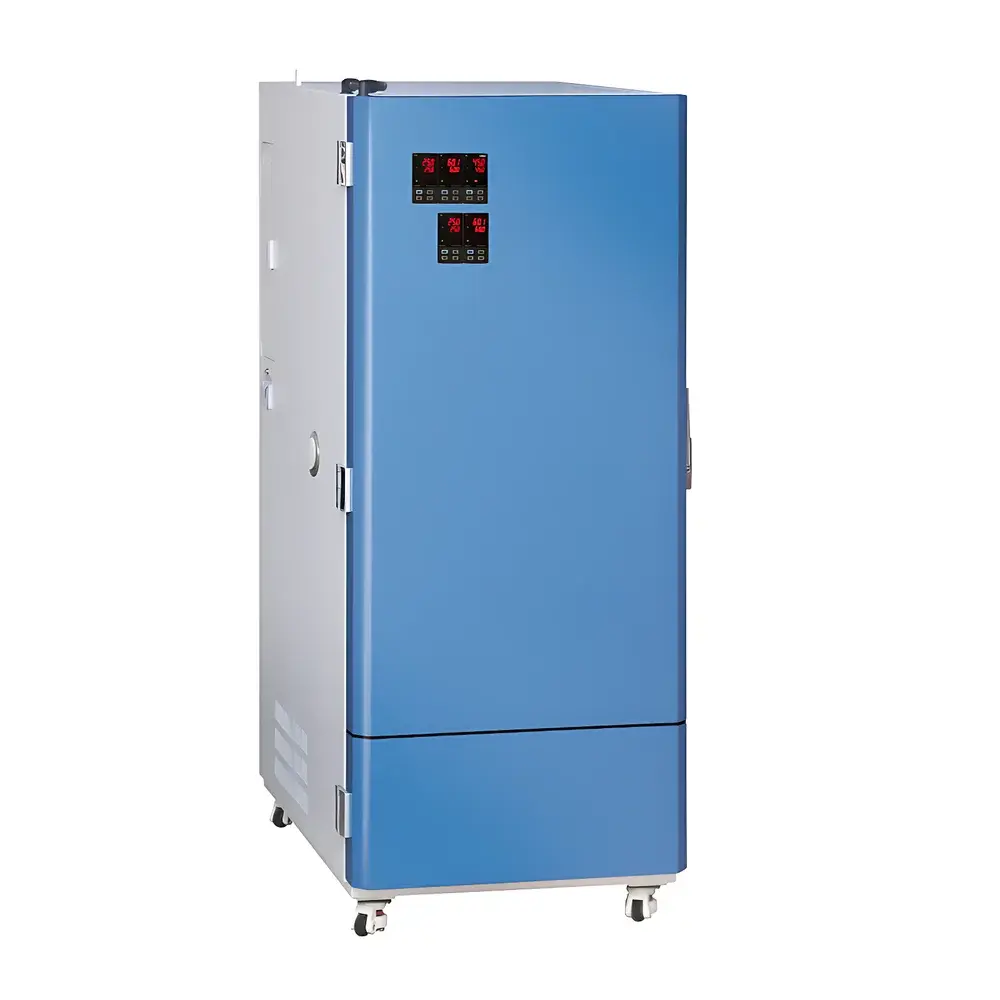
YSEI SHH-400GD-2 Pharmaceutical Photostability Testing Chamber
| Brand | YSEI |
|---|---|
| Origin | Chongqing, China |
| Manufacturer Type | Direct Manufacturer |
| Product Origin | Domestic (China) |
| Model | SHH-400GD-2 |
| Pricing | Upon Request |
| Chamber Dimensions (D×W×H) | 600 × 600 × 1200 mm |
| Illumination Uniformity | ±5% across sample zone |
| Light Source | UV-A + Visible LED Array (320–800 nm) |
| Total Illuminance | ≥1.2 × 10⁶ lux·hr (ICH Q1B compliant) |
| Near-UV Energy Dose | ≥200 W·hr/m² (λ = 320–400 nm) |
| Reference Illuminance Level | 4500 ± 500 lux (ChP 2015 General Chapter 9001) |
| Operating Temperature Range | 25 ± 2°C (ambient-controlled) |
| Ambient Conditions | 5–35°C, ≤85% RH |
| Power Consumption | 1.8 kW (at 25°C steady state) |
| Safety Protections | Independent chamber overtemperature cutoff, compressor overload protection |
| Data Logging | Dual-channel — real-time RS485 digital export + thermal micro-printer (adjustable interval) |
| Remote Capability | TCP/IP-based Ethernet interface |
| Compliance | ICH Q1B, USP <1191>, ChP 2015 Vol. II 9001, FDA Guidance for Industry: Photosensitivity Testing (2022), ISO/IEC 17025-aligned validation support |
Overview
The YSEI SHH-400GD-2 Pharmaceutical Photostability Testing Chamber is an engineered environmental simulation system designed exclusively for photostability assessment of drug substances and products in accordance with ICH Q1B, USP , and the Chinese Pharmacopoeia (ChP) 2015 edition General Chapter 9001. It operates on the principle of controlled irradiation exposure under standardized visible and near-ultraviolet (320–400 nm) spectral conditions, enabling quantitative evaluation of photochemical degradation pathways—including oxidation, hydrolysis, isomerization, and bond cleavage—under accelerated yet pharmacologically relevant lighting profiles. The chamber integrates a spectrally balanced LED array calibrated to deliver uniform illuminance (±5% spatial variation) across the entire sample plane, eliminating hotspots common in fluorescent or xenon-based systems. Its thermally stabilized air-circulation architecture maintains temperature constancy at 25 ± 2°C independent of ambient fluctuations, ensuring that photolytic effects—not thermal artifacts—are isolated and measured.
Key Features
- ICH Q1B-compliant illumination delivery: total visible dose ≥1.2 × 10⁶ lux·hr and near-UV energy ≥200 W·hr/m² within the 320–400 nm band, verified via NIST-traceable radiometric calibration.
- Dual-mode data recording: synchronized real-time digital logging via RS485 interface (Modbus RTU protocol) plus optional thermal micro-printer output with user-defined print intervals (1 min to 24 h).
- Centralized remote supervision: Ethernet-enabled TCP/IP communication allows one host PC to monitor and configure up to 30 SHH-400GD-2 units simultaneously, supporting distributed lab networks and cross-site stability programs.
- Independent safety architecture: redundant overtemperature cutoff circuitry isolates the test chamber from control electronics; dedicated compressor overload relay prevents refrigeration system failure during extended operation.
- Validation-ready design: preconfigured IQ/OQ documentation package provided, aligned with ASTM E2500-13 and FDA 21 CFR Part 11 requirements for electronic records and signatures.
Sample Compatibility & Compliance
The SHH-400GD-2 accommodates standard pharmaceutical packaging formats—including blister cards, amber vials, HDPE bottles, and aluminum foil pouches—within its 600 × 600 × 1200 mm internal chamber volume. A removable light-diffusing panel ensures consistent irradiance distribution regardless of sample height or opacity. All optical and thermal performance criteria meet the acceptance thresholds defined in ICH Q5C (stability testing of biotechnological/biological products), ICH Q1A(R2), and the European Pharmacopoeia 2.2.29. The system’s photometric traceability conforms to ISO/IEC 17025:2017 requirements when operated with certified reference sensors. It supports GLP-compliant study execution through audit-trail-enabled software interfaces and timestamped dual-record retention.
Software & Data Management
Data acquisition is managed via YSEI’s proprietary StabilityLink™ Control Suite (v3.2+), a Windows-based application supporting automated alarm escalation, email/SMS notifications upon deviation events, and CSV/PDF report generation compliant with ALCOA+ principles (Attributable, Legible, Contemporaneous, Original, Accurate, Complete, Consistent, Enduring, Available). Raw sensor logs include illuminance (lux), UV irradiance (W/m²), chamber temperature (°C), and runtime (hr:min:sec), all time-stamped to UTC and signed using SHA-256 cryptographic hashing. Exported datasets are compatible with LIMS platforms via ODBC drivers and support direct import into statistical analysis tools including JMP and SAS.
Applications
- ICH Q1B forced degradation studies for new molecular entities (NMEs) and generic drug products.
- Comparative photostability screening of alternative packaging configurations (e.g., amber vs. clear glass, desiccant inclusion, secondary overwraps).
- Stability protocol development per USP Annex 1 for photosensitive APIs such as nifedipine, chlorpromazine, and riboflavin.
- Regulatory submission support for ANDA, NDA, and MAA dossiers requiring documented photostability data under GxP conditions.
- Root cause analysis of field failures linked to light-induced degradation observed during distribution or retail storage.
FAQ
Does the SHH-400GD-2 comply with FDA 21 CFR Part 11 for electronic records?
Yes—the StabilityLink™ software includes role-based access control, electronic signature workflows, and immutable audit trails meeting Part 11 technical and procedural requirements.
Can the system be integrated into an existing laboratory network infrastructure?
Yes—it features standard Ethernet (RJ45), RS485 (DB9), and USB 2.0 ports, and supports DHCP, static IP, and VLAN tagging for secure enterprise deployment.
Is third-party calibration certification available?
Yes—YSEI partners with ISO/IEC 17025-accredited calibration laboratories to provide annual irradiance and temperature verification reports with measurement uncertainty budgets.
What is the recommended maintenance schedule?
LED light source output is rated for 15,000 hours; annual verification of illuminance uniformity and thermal stability is advised. Compressor oil and air filter replacement is required every 24 months under continuous operation.
How is photometric uniformity validated across the sample zone?
A 5-point grid mapping procedure (center + four corners) is performed during factory commissioning and re-verified during OQ; results are documented in the validation report with spatial deviation ≤ ±5%.






