
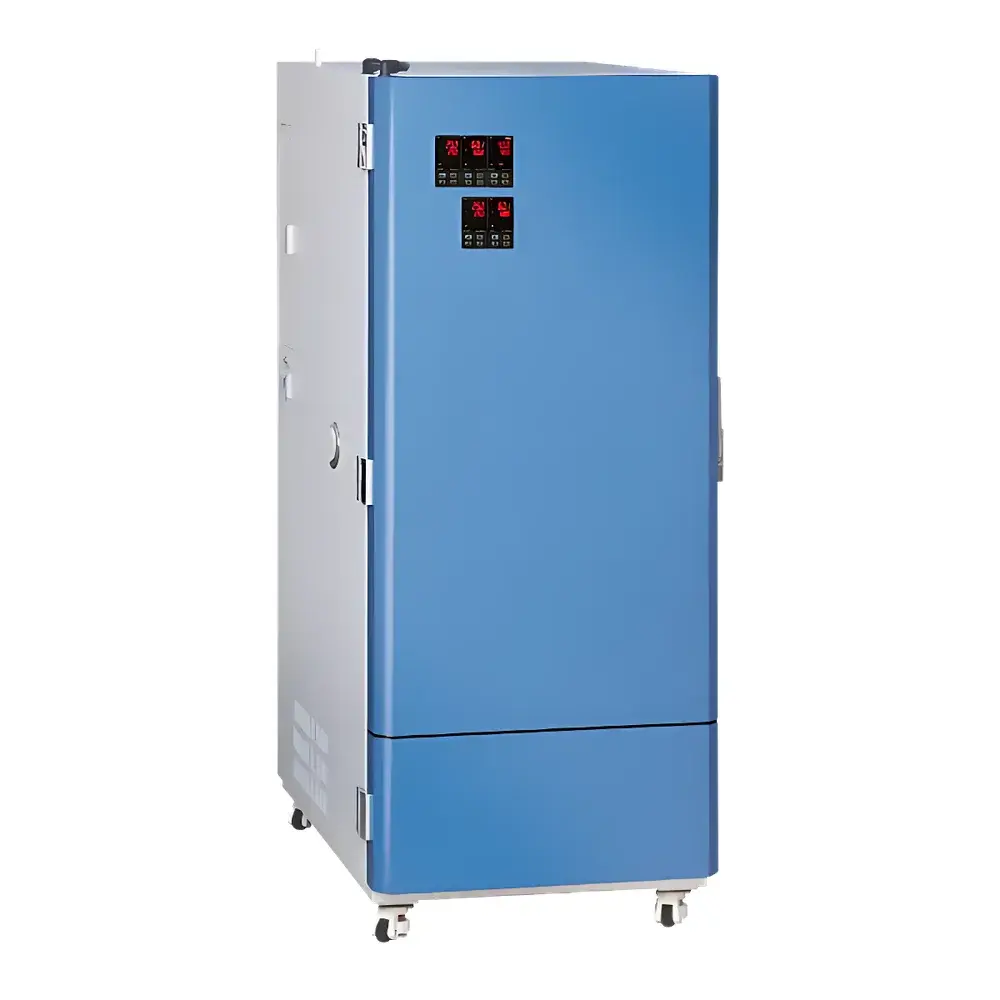
YSEI SHH-GD-2 Drug Photostability Testing Chamber
| Brand | YSEI |
|---|---|
| Origin | Chongqing, China |
| Manufacturer Type | Direct Manufacturer |
| Product Category | Domestic |
| Model | SHH-GD-2 |
| Pricing | Upon Request |
| Illuminance Range | ≥4500 ± 500 lx (per Chinese Pharmacopoeia 2015) |
| Total Illuminance Dose | ≥1.2 × 10⁶ lx·h |
| Near-Ultraviolet Energy | ≥200 W·h/m² (per ICH Q1B) |
| Chamber Dimensions (D×W×H) | As specified per configuration (with optional light-sensitive shelf ×1) |
| Operating Power | Measured at stable 25°C setpoint |
| Ambient Operating Conditions | 5–35°C, ≤85% RH |
| Data Logging | Dual-mode — thermal printer (adjustable print interval) + real-time PC recording via RS485 |
| Remote Monitoring | TCP/IP-enabled, supports up to 30 units per host PC |
| Safety Protections | Independent chamber overtemperature cutoff, refrigeration compressor overload protection |
| Warranty | 12 months from commissioning |
| Qualification Support | IQ/OQ documentation and on-site execution available |
Overview
The YSEI SHH-GD-2 Drug Photostability Testing Chamber is an engineered environmental simulation system designed explicitly for photostability assessment of pharmaceutical products in compliance with international regulatory frameworks. It operates on the principle of controlled, high-intensity visible and near-ultraviolet (UV-A, 320–400 nm) irradiation under thermally stabilized conditions—mimicking accelerated light exposure scenarios defined in ICH Q1B, U.S. FDA Guidance for Industry (Photostability Testing of New Drug Substances and Products), and the Chinese Pharmacopoeia (2015 Edition, General Chapter 9001). The chamber integrates a calibrated broad-spectrum light source array, precision temperature control (typically maintained at 25 ± 2°C per protocol), and uniform irradiance distribution across the test zone to ensure reproducible degradation kinetics. Unlike generic climate chambers, the SHH-GD-2 is purpose-built for photochemical stress testing: its optical architecture minimizes spectral drift, maintains spatial illuminance homogeneity (>90% uniformity per ICH-defined test area), and delivers quantifiable radiant exposure metrics traceable to NIST-traceable lux meters and UV radiometers.
Key Features
- Regulatory-aligned illumination delivery: Achieves ≥4500 ± 500 lx (visible range) and ≥200 W·h/m² near-UV energy dose (320–400 nm), satisfying both Chinese Pharmacopoeia and ICH Q1B requirements.
- Dual-path data integrity: Simultaneous real-time digital logging (via RS485 to PC-based acquisition software) and physical hard-copy output using integrated thermal printer with user-configurable print intervals (e.g., every 15 min, hourly, or event-triggered).
- Scalable remote supervision: Ethernet-enabled architecture supports centralized monitoring and parameter adjustment across up to 30 SHH-GD-2 units from a single host workstation—enabling lab-wide consistency and audit-ready operational continuity.
- Thermal-mechanical robustness: Hermetically sealed refrigeration circuit with independent overtemperature cut-off circuitry and compressor overload protection ensures uninterrupted operation during extended stability campaigns (e.g., 10-day continuous exposure).
- Modular test chamber design: Includes one removable light-sensitive shelf (standard configuration) optimized for sample positioning under uniform irradiance; optional multi-tier configurations available for high-throughput screening.
Sample Compatibility & Compliance
The SHH-GD-2 accommodates standard pharmaceutical packaging formats—including amber glass vials, blister packs, aluminum pouches, and HDPE bottles—without requiring sample reconfiguration. Its interior geometry and lamp placement are validated to minimize shadowing effects and edge attenuation, ensuring all samples receive statistically equivalent radiant exposure per ICH Q1B Annex recommendations. The system conforms to Good Laboratory Practice (GLP) and current Good Manufacturing Practice (cGMP) documentation expectations: all operational parameters (illuminance, chamber temperature, runtime) are timestamped, non-editable in raw log files, and exportable in CSV or PDF formats suitable for regulatory submission. Full qualification packages—including Installation Qualification (IQ), Operational Qualification (OQ), and associated test protocols—are provided and can be executed on-site by YSEI-certified engineers in accordance with ASTM E2500 and ISO/IEC 17025 principles.
Software & Data Management
Data acquisition is managed through YSEI’s proprietary PhotostabControl™ software (Windows-based), which provides real-time visualization of illuminance (lx), near-UV irradiance (W/m²), chamber temperature (°C), and cumulative exposure doses (lx·h, W·h/m²). The software enforces role-based access control (RBAC), audit trail logging per FDA 21 CFR Part 11 requirements (electronic signatures, change history, user activity logs), and automated report generation compliant with ALCOA+ principles (Attributable, Legible, Contemporaneous, Original, Accurate, Complete, Consistent, Enduring, Available). Raw data exports retain full metadata—including instrument ID, calibration expiry dates, operator ID, and environmental timestamps—to support traceability in regulatory inspections.
Applications
- ICH Q1B-compliant photostability studies for new drug substances and products (NDS/NDP)
- Forced degradation testing to identify light-induced degradation pathways and impurity profiles
- Comparative evaluation of primary packaging light-barrier efficacy (e.g., amber vs. clear glass, opaque vs. translucent films)
- Stability protocol development for ANDA submissions and marketing authorization applications (MAA)
- Internal quality control release testing of batch-to-batch photostability consistency
FAQ
Does the SHH-GD-2 meet ICH Q1B requirements for near-ultraviolet energy measurement?
Yes—the system incorporates calibrated UV-A sensors (320–400 nm) and delivers ≥200 W·h/m² cumulative dose, verified using traceable spectroradiometric methods.
Can the chamber operate continuously for 10 days without manual intervention?
Yes—its dual safety architecture (independent overtemperature cutoff and compressor protection) and stable thermal management enable unattended 240-hour operation under validated conditions.
Is electronic record retention compliant with FDA 21 CFR Part 11?
Yes—PhotostabControl™ software includes full Part 11 functionality: electronic signatures, immutable audit trails, and secure user authentication.
What documentation is included for regulatory validation?
Standard delivery includes IQ/OQ protocols, calibration certificates (illuminance & temperature), and a complete validation report package; PQ support is available upon request.
How is illuminance uniformity verified across the test area?
Uniformity is mapped per ICH Q1B Annex using a 5×5 grid of NIST-traceable lux meter readings; typical results show ≥90% spatial uniformity within the designated sample zone.





