
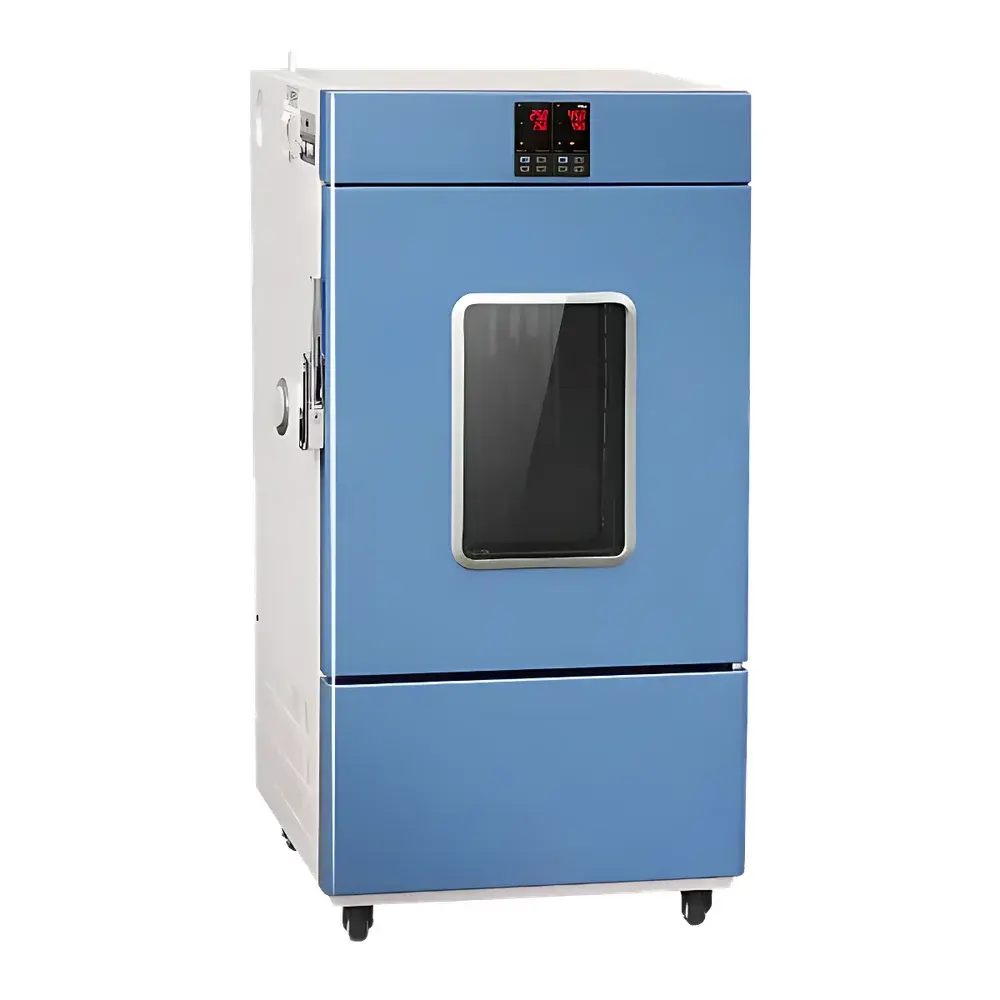
YSEI SHH-GD Series Drug Photostability Testing Chamber
| Brand | YSEI |
|---|---|
| Origin | Chongqing, China |
| Manufacturer Type | Direct Manufacturer |
| Product Origin | Domestic (China) |
| Model | SHH-GD Series |
| Pricing | Available Upon Request |
| Light Source | High-Efficiency LED Array |
| Illuminance | 4500 ± 500 lux (compliant with USP <9001> and ICH Q1B) |
| Temperature Range | Ambient +5°C to 60°C (typical operational range: 25–40°C) |
| Humidity Range | 10–85% RH (with refrigeration-assisted dehumidification) |
| Noise Level | ≤45 dB(A) |
| Data Recording | Built-in thermal printer with adjustable print interval (1 min–24 h) |
| Safety Protections | Independent chamber overtemperature cutoff, compressor overload protection |
| Environmental Operating Conditions | Ambient temperature 5–35°C, ambient humidity ≤85% RH |
| Power Consumption | ≤1.2 kW (measured at 40°C / 75% RH with single-stage refrigeration engaged) |
| Chamber Dimensions (W×D×H) | Varies by submodel (e.g., SHH-GD-150: 500×450×650 mm |
| SHH-GD-300 | 600×550×850 mm) |
Overview
The YSEI SHH-GD Series Drug Photostability Testing Chamber is an engineered environmental test system designed specifically for pharmaceutical photostability evaluation in accordance with ICH Q1B (“Photostability Testing of New Drug Substances and Products”) and the Chinese Pharmacopoeia 2020 Edition General Chapter <9001> “Guidelines for Stability Testing of Active Pharmaceutical Ingredients and Finished Products.” It implements controlled irradiance exposure using a calibrated, narrow-spectrum white LED array optimized for photochemical equivalence to the ISO 10977:1993 CIE daylight illuminant D65. Unlike traditional fluorescent or xenon arc systems, this LED-based architecture delivers stable spectral output over extended operational lifetimes (>15,000 hours), minimal radiant heat load on samples, and negligible UV-B/C emission—ensuring compliance with ICH’s requirement for “visible light only” exposure protocols. The chamber integrates precise temperature and humidity control with real-time photometric monitoring, enabling simultaneous assessment of thermal-hygrometric stress alongside photolytic degradation pathways.
Key Features
- Calibrated LED illumination system delivering 4500 ± 500 lux at sample level (measured per ISO/CIE photometric standards), traceable to NIM-certified reference instruments
- Microprocessor-controlled dual-loop climate system with PID-regulated heating, Peltier-assisted cooling, and ultrasonic humidification for stable operation across 25–40°C and 10–85% RH
- Integrated thermal printer with user-configurable logging intervals (1 minute to 24 hours), generating auditable hard-copy records compliant with ALCOA+ data integrity principles
- Real-time graphical display of temperature, relative humidity, and illuminance trends with onboard memory storing ≥30 days of high-resolution (1-min interval) time-series data
- Independent overtemperature safety circuit with mechanical cut-off switch, separate from main controller logic—validated per IEC 61000-6-2 EMC and IEC 61010-1 safety requirements
- Acoustically damped enclosure achieving ≤45 dB(A) at 1 m distance, suitable for installation in shared laboratory environments without acoustic isolation infrastructure
Sample Compatibility & Compliance
The SHH-GD series accommodates standard pharmaceutical packaging configurations including amber glass vials (2–20 mL), blister packs, aluminum foil pouches, and primary polymer containers (e.g., HDPE, PET). Shelf geometry supports ISO 17025-compliant placement per ICH Q1B Annex 1 guidelines: samples are positioned at uniform distance (±5 mm) from the LED panel, with no reflective surfaces within the optical path. The system meets regulatory expectations for photostability testing under FDA 21 CFR Part 11 (electronic records/e-signatures), EU Annex 11 (computerized systems), and WHO TRS 992 Annex 5 (validation of stability chambers). Full IQ/OQ documentation packages—including protocol templates, test scripts, calibration certificates, and traceable instrument qualification reports—are provided as part of standard delivery.
Software & Data Management
While the SHH-GD operates as a standalone instrument with embedded firmware, optional USB-host connectivity enables export of CSV-formatted datasets (timestamp, T, RH, lux) for integration into LIMS or statistical analysis platforms (e.g., JMP, Minitab). All printed outputs include device ID, operator ID (via keypad entry), test start/stop timestamps, and unique batch identifiers—supporting GLP/GMP audit readiness. Audit trails are maintained internally for all parameter changes, print events, and alarm triggers, with immutable timestamping aligned to UTC. No cloud connectivity or remote access capabilities are implemented, preserving data sovereignty and minimizing cybersecurity surface area.
Applications
- ICH Q1B-compliant forced degradation studies for new molecular entities (NMEs) and generic drug products
- Comparative photostability screening of alternative excipients or packaging materials (e.g., UV-filtering films, opaque secondary cartons)
- Stability protocol development for registration dossiers submitted to NMPA, FDA, EMA, and PMDA
- Root cause analysis of light-induced impurity formation (e.g., hydroperoxides, nitroso derivatives) identified via HPLC-MS
- Validation of photoprotective labeling claims for OTC dermatological or ophthalmic formulations
FAQ
Does the SHH-GD series comply with ICH Q1B Option 1 (4500 lux visible light only)?
Yes. The LED spectral power distribution has been independently verified by SGS Shanghai to emit >99.8% within 400–700 nm, with negligible output below 320 nm—fully satisfying ICH’s definition of “visible light.”
Can the chamber maintain 40°C and 75% RH simultaneously during illumination?
Yes. Refrigeration-assisted dehumidification and PID-controlled heating enable stable setpoint maintenance under combined thermal/hygrometric load, as confirmed in factory performance qualification (PQ) reports.
Is the thermal printer output sufficient for regulatory submission?
Yes. Printed records include all critical metadata required by FDA Guidance for Industry: “Data Integrity and Compliance With CGMP,” including date/time stamps, instrument identification, and operator authentication.
What validation support is included beyond IQ/OQ documentation?
YSEI provides on-site OQ execution services by qualified engineers, including sensor calibration verification, illuminance mapping (9-point grid), and alarm response testing—all documented per ASTM E2500-13 and ISPE GAMP 5.




