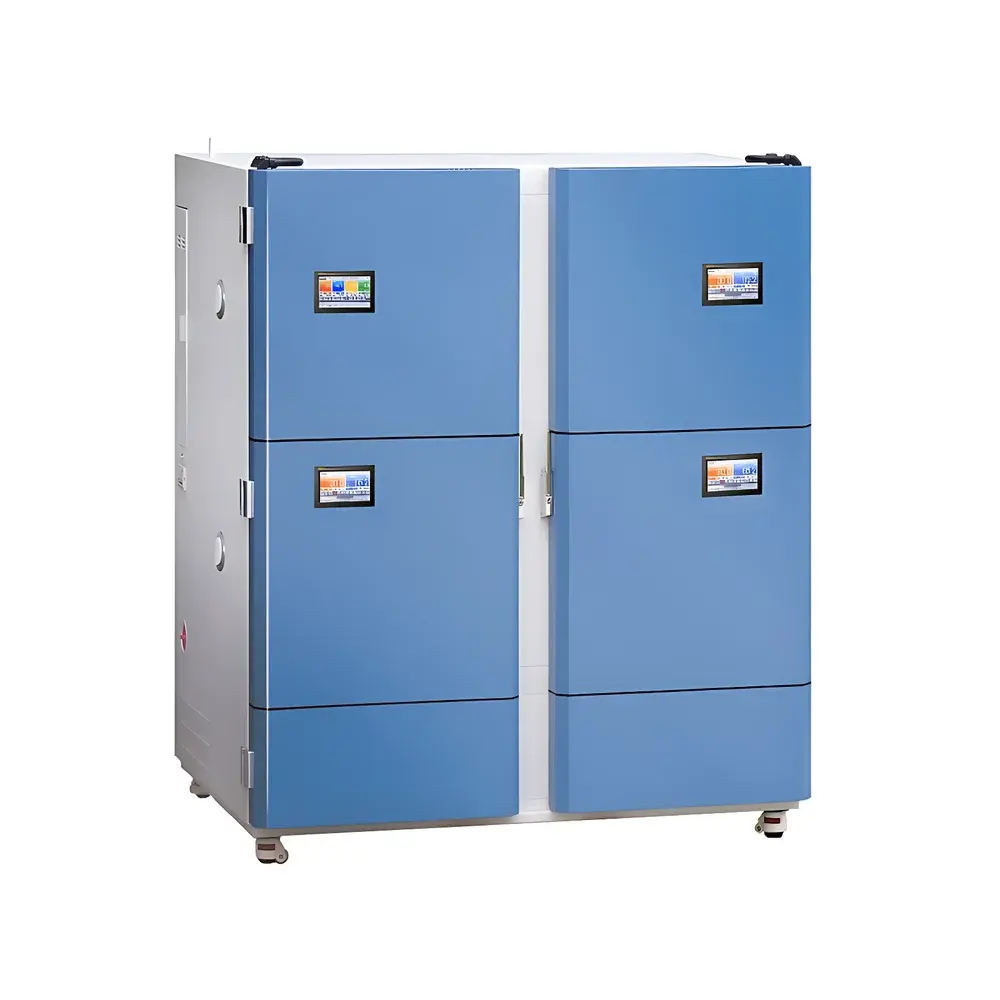
YSEI SHH-SSD-2TA Multi-Chamber Drug Stability Testing System
| Brand | YSEI |
|---|---|
| Origin | Chongqing, China |
| Manufacturer Type | Direct Manufacturer |
| Country of Origin | China |
| Model | SHH-SSD-2TA |
| Price Range | USD 21,000 – 28,000 (FOB) |
Overview
The YSEI SHH-SSD-2TA Multi-Chamber Drug Stability Testing System is an engineered platform designed to meet the stringent requirements of pharmaceutical stability testing under ICH Q1–Q5, USP , and Chinese Pharmacopoeia Chapter 9001. It implements a multi-compartment architecture—comprising two independently controlled environmental chambers—to simultaneously execute long-term, accelerated, intermediate, and stress-condition studies (e.g., low-humidity 40 °C/20 %RH for large-volume parenterals) within a single footprint. Each chamber operates with independent temperature (range: 0–60 °C) and humidity (range: 10–95 %RH) control, leveraging PID-regulated refrigeration, steam-based humidification, and dual-wall insulation to maintain ±0.5 °C temperature uniformity and ±3 %RH humidity stability over time. The system adheres to GLP-compliant operational principles, supporting regulatory submissions through deterministic environmental control, audit-ready data integrity, and traceable parameter history.
Key Features
- Independent dual-chamber configuration: Enables concurrent execution of distinct ICH protocols (e.g., 25 °C/60 %RH long-term vs. 40 °C/75 %RH accelerated) without cross-contamination or thermal/hygrometric interference.
- Centralized supervisory control: One Windows-based host PC manages up to 30 units via RS485 daisy-chain topology; supports remote access over secure HTTPS or VPN for real-time parameter adjustment and alarm acknowledgment.
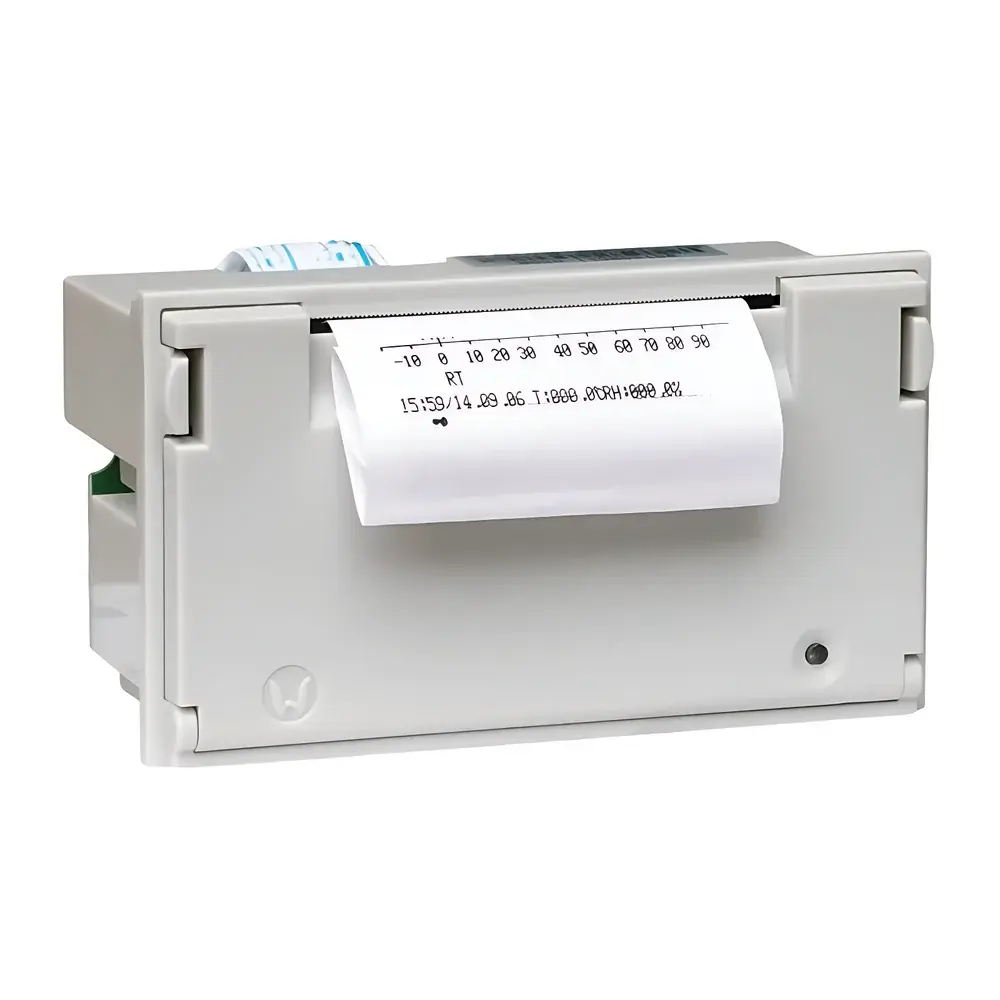
- Triple-layer data recording architecture: (1) Thermal printer output with configurable interval (1 min–24 h); (2) Onboard 64 MB circular buffer storing setpoints, measured values, timestamps, and real-time clock data; (3) Continuous PC logging via Modbus RTU over RS485, exportable as CSV or PDF for audit review.
- Energy-optimized operation: Variable-speed compressors, high-efficiency PTC heaters, and intelligent defrost cycling reduce average power consumption by ≥35% versus legacy constant-load systems; acoustic noise level ≤52 dB(A) at 1 m.
- Dual-door safety interface: Tempered glass inner door enables non-intrusive visual monitoring; outer keyed mechanical lock prevents unauthorized access per 21 CFR Part 11 physical security expectations.
- Redundant safety interlocks: Independent overtemperature cutoff per chamber, dry-run protection for humidifier reservoirs, compressor overload sensing, and optional GSM-based SMS alerting for power loss, sensor deviation (>±2 °C / ±5 %RH), or door breach events.
Sample Compatibility & Compliance
The SHH-SSD-2TA accommodates standard stability storage configurations—including open trays, sealed vials, blister packs, and IV bags—within its internal volume (per chamber: 520 × 600 × 720 mm D×W×H). Its environmental fidelity satisfies ICH Q1A(R2) zone classification requirements (Zone IVb: 30 °C/75 %RH; Zone III: 30 °C/65 %RH), while the low-humidity capability (20 %RH at 40 °C) complies with specifications for moisture-sensitive biologics and lyophilized formulations. All firmware and controller logic are validated per ASTM E2500-13 and ISO 13485:2016 design controls. IQ/OQ documentation packages—including test protocols, acceptance criteria, calibration certificates, and electronic signature logs—are provided pre-validated and editable for site-specific execution.
Software & Data Management
The embedded controller runs YSEI StabilityLink™ firmware (v3.2+), supporting configurable sampling intervals from 1 minute to 24 hours. Data records include full metadata: operator ID (via login), instrument serial number, chamber ID, parameter type (T/RH), raw sensor ADC values, and CRC-verified checksums. Exported SD card files conform to ASTM E2500 Annex B structured naming conventions. PC-side software (StabilityView Pro) enables trend analysis, deviation flagging against ICH limits, and automated report generation compliant with FDA 21 CFR Part 11—featuring role-based access control, electronic signatures, and immutable audit trails for all configuration changes and manual overrides.
Applications
- ICH-compliant stability protocol execution: Long-term (25 °C/60 %RH), accelerated (40 °C/75 %RH), intermediate (30 °C/65 %RH), and photostability (per ICH Q5C) using optional UV/visible lamp modules.
- Forced degradation studies: Controlled exposure to oxidative, hydrolytic, thermal, and photolytic stress conditions to identify degradation pathways and validate analytical methods.
- Excipient compatibility screening: Simultaneous evaluation of multiple API-excipient blends under varied humidity profiles to assess hygroscopicity and physical stability.
- Biologics and sterile product qualification: Low-humidity validation for lyophilized monoclonal antibodies and large-volume parenterals requiring strict moisture control during shelf-life assessment.
- Academic and contract research: Modular scalability supports teaching labs and CROs managing diverse client protocols across shared infrastructure.
FAQ
Does the SHH-SSD-2TA support 21 CFR Part 11 compliance for electronic records?
Yes—the system includes role-based user authentication, electronic signatures with biometric or token options, and immutable audit trails for all critical operations including parameter changes, data exports, and alarm acknowledgments.
Can humidity be maintained at 20% RH continuously at 40°C?
Yes—this configuration is factory-validated and supported by dedicated desiccant-assisted dehumidification circuitry, meeting ICH Q1B stress condition requirements.
What is the maximum data retention capacity of the onboard memory?
At 1-minute sampling frequency, the 64 MB internal flash stores approximately 10 years of timestamped T/RH data per chamber, with automatic overwrite upon buffer saturation.
Is IQ/OQ documentation included with shipment?
Yes—a complete, editable IQ/OQ package aligned with ASTM E2500 and ISO 13485 is delivered with each unit, including calibrated reference sensors, test scripts, and blank execution worksheets.
What ambient conditions are required for installation?
Operating environment must be maintained between 5–35 °C ambient temperature and ≤85 %RH; no external cooling water or compressed air supply is required.