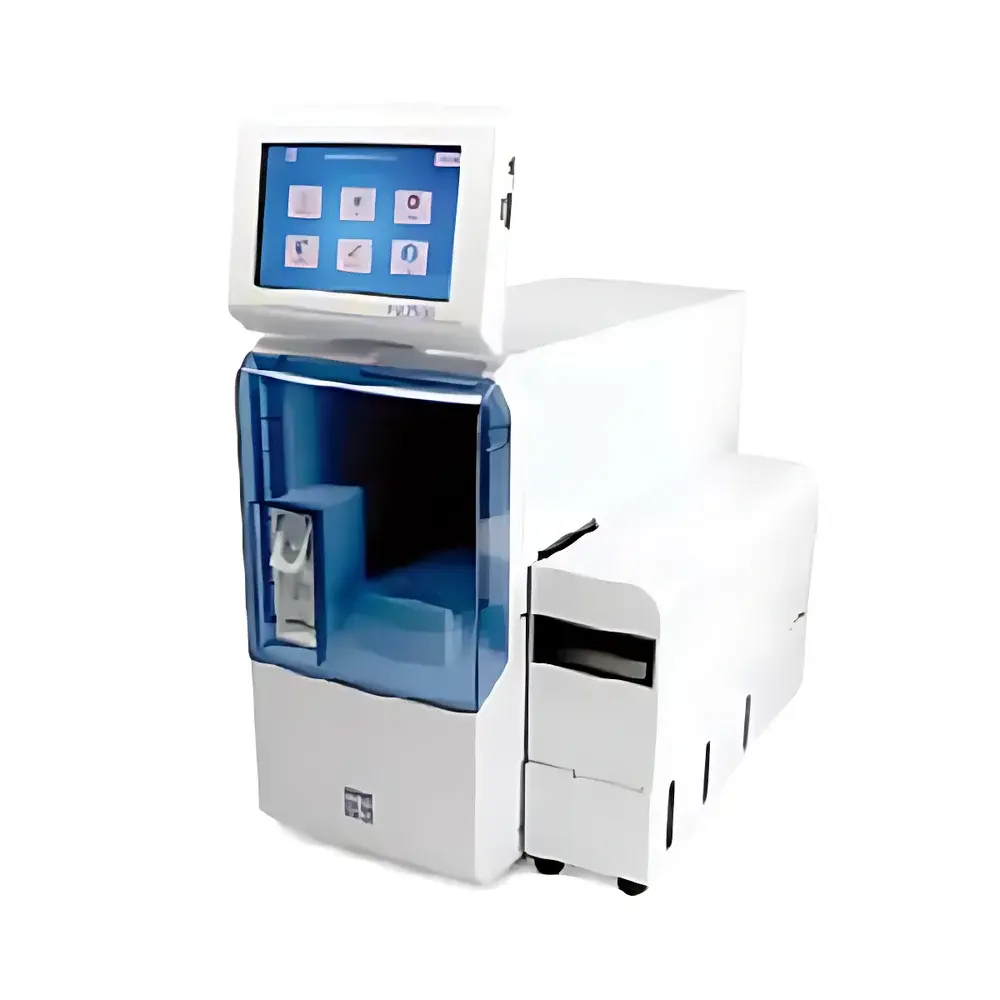
YSI 2500 Cell Culture Biochemical Analyzer
| Brand | INFORS |
|---|---|
| Origin | Switzerland |
| Model | YSI 2500 |
| Measurement Volume | 10–50 µL |
| Analysis Time | 60 s |
| Precision | CV < 2% |
| Linearity Deviation | ±5% |
| Temperature Range | 15–35 °C |
| Relative Humidity | 10–90% RH |
| Power Supply | 220–240 VAC, 50–60 Hz, 50 W |
| Dimensions | 20.3 cm (W) × 52.1 cm (D) × 40.0 cm (H) |
| Weight | 12.7 kg (excl. bottle rack) |
| Compliance | CE, RoHS |
| Sample Formats | Single samples, 8-tube strips, 24-well & 96-well microplates |
| Automation Capacity | Up to 96 samples per run |
| Auto-calibration | Yes |
| Temperature Compensation | Yes |
| Liquid Level Detection | Yes |
| Sensor Principle | Enzyme-membrane amperometry (glucose, lactate, glutamine, etc.) + ion-selective electrodes (NH₄⁺, K⁺) |
Overview
The YSI 2500 Cell Culture Biochemical Analyzer is a benchtop enzymatic biosensor system engineered for rapid, precise, and multiplexed quantification of key metabolites and ions in complex biological matrices—particularly mammalian cell culture supernatants, fermentation broths, and clinical biofluids. Unlike conventional HPLC or spectrophotometric methods, the YSI 2500 employs immobilized enzyme membrane amperometry: analyte-specific enzymes (e.g., glucose oxidase, lactate oxidase, glutaminase) catalyze substrate conversion at the sensor surface, generating stoichiometric hydrogen peroxide (H₂O₂), which is electrochemically detected by a platinum working electrode. For ammonium (NH₄⁺) and potassium (K⁺), ion-selective electrodes (ISEs) provide direct potentiometric measurement. This dual-sensing architecture enables simultaneous, independent quantification of up to 15 analytes—including glucose, lactate, glutamine, glutamate, ammonium, potassium, xylose, ethanol, methanol, sucrose, galactose, lactose, choline, glycerol, and hydrogen peroxide—with full assay completion in ≤60 seconds per sample. The instrument’s design prioritizes robustness in bioprocess environments: its anti-clogging chamber-based fluidics tolerate high-cell-density suspensions (>10⁷ cells/mL) without filter fouling or flow interruption.
Key Features
- Enzyme-membrane amperometric detection with integrated ion-selective electrodes for NH₄⁺ and K⁺
- Single-sample analysis time of 60 seconds, with coefficient of variation (CV) < 2% across clinically relevant ranges
- Sample volume flexibility: user-defined aspiration from 10 µL to 50 µL—optimized for precious bioreactor harvests
- Anti-fouling hydrodynamic chamber geometry, validated for continuous operation with undiluted CHO, HEK, and microbial fermentation supernatants
- Automated calibration routines with real-time temperature compensation and liquid-level sensing
- Full compliance with CE marking and RoHS directives; designed to support GLP/GMP-aligned workflows
- Compact footprint (20.3 × 52.1 × 40.0 cm) and low power draw (50 W), suitable for Class II biosafety cabinets and shared lab spaces
Sample Compatibility & Compliance
The YSI 2500 accepts raw, unclarified, and non-sterile samples—including spent media from perfusion bioreactors, microbial fermentations, and primary human serum/plasma—without pre-filtration or dilution. Its enzyme membranes exhibit high specificity: cross-reactivity with structurally analogous compounds (e.g., fructose vs. glucose, acetate vs. lactate) is minimized via selective diffusion-limiting layers (polycarbonate pore size control) and optimized enzyme kinetics. The system meets ISO 13485 design control principles for in vitro diagnostic (IVD)-adjacent instrumentation and supports audit-ready data integrity through timestamped, encrypted result storage. While not an FDA-cleared IVD device, it is routinely deployed in process analytical technology (PAT) frameworks compliant with ICH Q5, Q8, and Q9 guidelines—and its calibration traceability aligns with NIST-traceable reference standards for glucose and lactate.
Software & Data Management
The YSI 2500 operates via embedded firmware with USB-host connectivity to Windows-based workstations running YSI BioData Manager v4.x software. This platform provides audit-trail-enabled data acquisition, including operator ID logging, calibration history, and instrument parameter versioning—fully compatible with 21 CFR Part 11 requirements when deployed with electronic signature validation modules. Raw amperometric current traces, calibration curves, and QC reports are exportable in CSV, PDF, and XML formats. Batch processing supports multi-well plate mapping (24-/96-well), automatic outlier flagging based on user-defined acceptance criteria (e.g., %RSD < 3%), and integration with LIMS via HL7 or OPC UA protocols. No cloud dependency: all data reside locally unless explicitly exported.
Applications
- Real-time monitoring of fed-batch and perfusion mammalian cell cultures for metabolic flux analysis and feeding strategy optimization
- High-frequency sampling in microbial fermentation (E. coli, yeast, Pichia) for ethanol, glycerol, and ammonium tracking during scale-up
- Metabolite profiling in organoid and 3D scaffold cultures where conventional sampling volumes are prohibitive
- Quality control of raw materials (e.g., glucose syrup, yeast extract) in biopharmaceutical excipient manufacturing
- Academic research in cancer metabolism, immunometabolism, and mitochondrial dysfunction using primary lymphocyte or macrophage supernatants
- Bioprocess validation studies requiring concurrent measurement of ≥10 analytes under GMP Annex 1 environmental constraints
FAQ
Does the YSI 2500 require daily recalibration?
No—sensor cartridges are factory-calibrated and stable for ≥7 days under continuous use. A single-point verification check is recommended before each batch; full recalibration is required only after cartridge replacement or if QC failure thresholds are exceeded.
Can the YSI 2500 measure analytes in whole blood or viscous samples?
It is validated for clarified supernatants and filtered fermentation broths. Whole blood requires centrifugation and plasma separation prior to analysis; viscosity >15 cP may impair aspiration accuracy and is not supported.
How is sensor lifetime defined, and what determines end-of-life?
Each enzyme cartridge has a nominal lifespan of 300–500 assays or 14 days of continuous operation. End-of-life is triggered automatically when signal-to-noise ratio degrades below 10:1 or linearity deviation exceeds ±5% across the dynamic range.
Is method transfer possible between YSI 2500 and YSI 2950 platforms?
Yes—analyte-specific calibration files, QC templates, and plate mapping configurations are fully interoperable across the YSI 2500/2900/2950 family, enabling seamless migration to higher-throughput or multi-analyte configurations.
Does the system support remote diagnostics or predictive maintenance?
Embedded diagnostics log sensor health metrics (baseline drift, response time, membrane impedance) and transmit alerts via email or SNMP trap upon deviation from operational baselines—enabling proactive service dispatch.
Related Products