
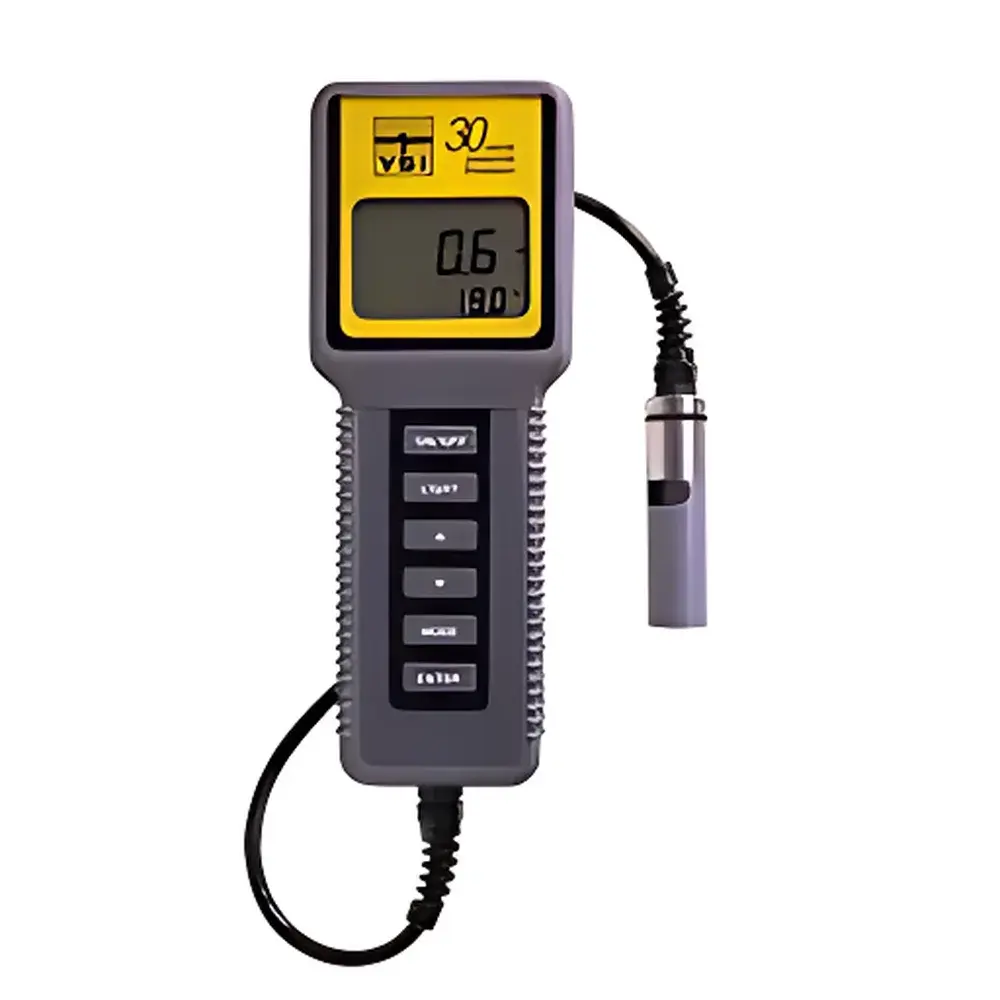
YSI Model 30 Conductivity, Salinity, and Temperature Meter
| Brand | YSI |
|---|---|
| Origin | USA |
| Model | YSI 30 |
| Type | Handheld, Battery-Powered, Waterproof Conductivity/Salinity/Temperature Meter |
| Electrode | Four-Pure-Nickel Electrode (Platinum-Black-Free) |
| Calibration | Factory-Calibrated (No Field Calibration Required) |
| Temperature Compensation | Automatic, Adjustable Reference Temperature (e.g., 25°C) and Temperature Coefficient (β) |
| Display | Large Backlit LCD |
| Enclosure Rating | IP67 Submersible |
| Battery Life | Up to 100 hours (Alkaline AA batteries) |
| Cable Options | 3 m, 7.5 m, 15 m |
| Data Logging | None (YSI 30) |
| Compliance | Designed for field-deployable environmental monitoring per ASTM D1125, ISO 7888, and US EPA Method 120.1 |
Overview
The YSI Model 30 is a field-grade, handheld conductivity, salinity, and temperature meter engineered for high-reliability environmental water quality assessment. Based on the four-pure-nickel electrode principle, it measures electrical conductivity via the two-electrode AC conductometric method—eliminating polarization errors common in DC-based systems and enabling stable operation without platinum-black plating or frequent recalibration. Conductivity data are automatically converted to practical salinity (PSU) using the PSS-78 algorithm (UNESCO Technical Papers in Marine Science), while temperature is measured with a precision thermistor embedded in the probe tip. The instrument operates across a wide thermal range (−5 to +45 °C) and is optimized for estuarine, coastal, freshwater, and wastewater applications where ruggedness, portability, and measurement consistency are critical.
Key Features
- Factory-calibrated four-pure-nickel electrode system: Delivers long-term stability and minimal maintenance—no platinization, no reconditioning required.
- True automatic ranging: Dynamically selects optimal measurement range (0–199.9 mS/cm) without manual intervention, ensuring accuracy across low-conductivity freshwater (e.g., 50 mS/cm).
- Intelligent temperature compensation: Supports user-adjustable reference temperature (typically 25 °C) and linear temperature coefficient (β = 0.019–0.025 °C⁻¹), conforming to ISO 7888 and ASTM D1125 standards.
- IP67-rated polycarbonate housing: Fully submersible to 1 meter for 30 minutes; buoyant design ensures recovery if dropped into open water.
- Ergonomic dual-mount configuration: Compatible with wrist strap, shoulder harness, or belt clip—optimized for extended one-handed operation in boat-based or wade-in sampling.
- Backlit large-format LCD: 12.7 mm character height with adjustable illumination for legibility under low-light or high-glare field conditions.
- Stress-relieved cable interface: Strain relief boot minimizes flex fatigue at the probe-to-cable junction, extending service life in repetitive deployment scenarios.
- Long-life alkaline battery operation: Rated for ≥100 hours of continuous use; low-battery indicator provides advance warning prior to voltage drop affecting measurement integrity.
Sample Compatibility & Compliance
The YSI Model 30 is validated for direct immersion measurements in natural waters—including rivers, lakes, wetlands, tidal creeks, aquaculture ponds, and wastewater effluents. Its electrode geometry and cell constant (K = 1.0 cm⁻¹) meet the performance criteria defined in ASTM D1125 (Standard Test Methods for Electrical Conductivity and Resistivity of Water) and ISO 7888 (Water Quality — Determination of Electrical Conductivity). While not intended for aggressive chemical solvents or highly suspended solids (>100 mg/L TSS), the stainless-steel probe sheath resists biofouling and mechanical abrasion. The instrument supports GLP-aligned field documentation when paired with standardized log sheets; optional YSI 30M variant adds non-volatile memory compliant with basic data integrity requirements for routine environmental monitoring programs.
Software & Data Management
The base YSI 30 model does not include onboard data storage or digital communication interfaces. All measurements are displayed in real time and must be manually recorded. For traceable workflows, users commonly integrate readings into electronic lab notebooks (ELNs) or LIMS platforms via standardized entry templates. The YSI 30M variant incorporates EEPROM-based memory capable of storing up to 50 timestamped records (conductivity, salinity, temperature, date/time), with data retained indefinitely without power. Neither model supports USB, Bluetooth, or RS-232 output—consistent with its design philosophy as a dedicated, low-complexity field tool rather than a networked sensor node.
Applications
- Regulatory surface water monitoring (EPA Region-specific NPDES and TMDL programs)
- Coastal zone management and salinity intrusion mapping
- Aquatic ecosystem health assessments (e.g., conductivity as proxy for total dissolved solids)
- Wastewater treatment plant influent/effluent screening
- Groundwater-surface water interaction studies
- Academic field hydrology and limnology coursework
- Marine biology deployments requiring rapid, repeatable spot checks
FAQ
Does the YSI Model 30 require periodic calibration in the field?
No. It is factory-calibrated using NIST-traceable standards and designed for zero-user calibration. Verification against a certified KCl standard solution (e.g., 1413 µS/cm at 25 °C) is recommended annually or after physical impact.
Can the instrument measure resistivity directly?
No. Resistivity is the mathematical inverse of conductivity and must be calculated externally using ρ = 1/σ (where σ is in S/m). The display shows only conductivity (µS/cm or mS/cm), salinity (PSU), and temperature (°C).
Is the probe compatible with YSI’s newer ProDSS or EXO platforms?
No. The YSI 30 uses a proprietary analog probe interface and is not electrically or mechanically interoperable with multi-parameter sondes.
What is the minimum detectable conductivity?
The lower limit of quantitation is 1 µS/cm, with a resolution of 0.1 µS/cm below 100 µS/cm and 0.01 mS/cm above 10 mS/cm.
How does the auto-ranging function maintain accuracy across orders of magnitude?
The internal analog front-end dynamically adjusts gain and excitation frequency to optimize signal-to-noise ratio—ensuring ±1% full-scale accuracy across all ranges without user intervention.



