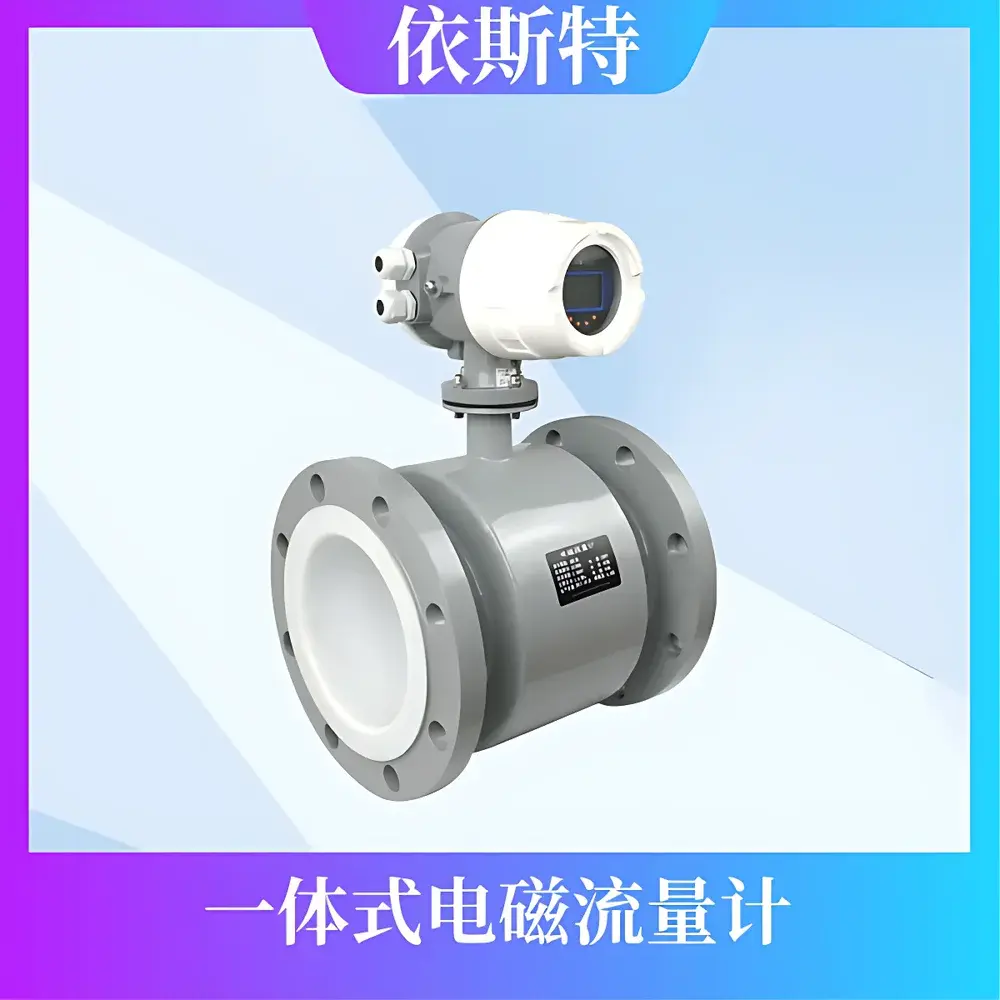
YST Electromagnetic Flow Meter DN2000 Pipe-Type Model YST183F-A50XL
| Brand | YST |
|---|---|
| Origin | Liaoning, China |
| Model | YST183F-A50XL |
| Nominal Diameter | DN2000 mm |
| Flow Velocity Range | 0.1–15 m/s |
| Minimum Fluid Conductivity | ≥5 μS/cm |
| Accuracy Class | ±1.0% of reading |
| Lining Materials | PTFE or rubber (selectable) |
| Electrode Materials | 316L stainless steel or Hastelloy (selectable) |
| Rated Working Pressure | ≤0.6 MPa |
| Temperature Range | –20 to +60 °C (rubber lining) |
| Protection Rating | IP65 (IP68 optional) |
| Power Supply | AC 220 V / DC 24 V |
| Output Signals | 4–20 mA analog output |
| Connection | Flanged, compliant with GB/T 11988 |
| Straight Pipe Requirements | ≥5DN upstream, ≥2DN downstream |
Overview
The YST Electromagnetic Flow Meter DN2000 Pipe-Type Model YST183F-A50XL is an industrial-grade volumetric flow measurement instrument engineered for large-diameter pipeline applications in municipal water supply, wastewater treatment, and process industries. Operating on the principle of Faraday’s Law of Electromagnetic Induction, the meter induces a voltage proportional to the average velocity of electrically conductive fluids flowing through a magnetic field. This voltage—detected by electrodes mounted diametrically across the pipe—is converted into a linear flow signal after digital signal processing. Designed specifically for pipelines with nominal diameters up to DN2000 mm, the device delivers stable, non-intrusive measurement without pressure loss, mechanical wear, or moving parts. Its low-frequency rectangular wave excitation system minimizes polarization effects and enhances immunity to electromagnetic interference from variable frequency drives, welding equipment, and other industrial noise sources.
Key Features
- Full-digital signal processing architecture ensuring high reproducibility and long-term zero stability under fluctuating load conditions.
- Modular design enabling field-replaceable components—including sensor, converter, and communication modules—reducing downtime and lifecycle maintenance cost.
- Configurable excitation frequency and waveform optimization to accommodate varying conductivity levels and flow regimes, supporting reliable operation across heterogeneous media including slurry, corrosive effluents, and suspended solids-laden wastewater.
- Backlit LCD display with intuitive menu navigation in English (default), supporting real-time parameter configuration, calibration verification, and diagnostic status monitoring without PC dependency.
- Optional infrared handheld operator interface for contactless commissioning and troubleshooting at distances up to 3 meters—ideal for confined or hazardous locations where direct access is restricted.
- Integrated self-diagnostic functionality continuously monitors electrode integrity, lining condition, magnetic coil resistance, and signal-to-noise ratio, triggering configurable alarms upon deviation thresholds.
Sample Compatibility & Compliance
The YST183F-A50XL is validated for use with liquids exhibiting electrical conductivity ≥5 μS/cm, covering municipal potable water, activated sludge effluent, acid/alkali process streams, pulp suspensions, and desalination brine. Material selection adheres to ISO 21872-1 for corrosion-resistant wetted parts: PTFE-lined variants meet ASTM D1711 requirements for chemical inertness, while Hastelloy C-276 electrodes comply with NACE MR0175/ISO 15156 for sour service environments. The flanged connection conforms to GB/T 11988 (equivalent to EN 1092-1 Type B1), facilitating seamless integration into existing piping systems. For regulatory traceability, the device supports audit-ready data logging with time-stamped events and user-access logs—compatible with GLP/GMP-aligned workflows when paired with compliant SCADA or DCS platforms.
Software & Data Management
The embedded firmware supports dual-mode communication: standard 4–20 mA analog output with HART protocol overlay for legacy system integration, plus optional RS485 Modbus RTU for bidirectional data exchange with PLCs, HMIs, or cloud-based IIoT platforms. Firmware version 2.3+ enables secure over-the-air (OTA) updates via USB or Ethernet interface. Optional NB-IoT wireless telemetry module provides LTE-M/NB-IoT Cat-NB1 connectivity for remote deployments, transmitting flow rate, totalized volume, diagnostic flags, and battery status at user-defined intervals. All digital outputs support timestamped data packets compliant with IEC 62443-3-3 security profiles, and optional encryption keys may be provisioned during device provisioning to meet GDPR or local data sovereignty mandates.
Applications
- Municipal wastewater influent and effluent monitoring at treatment plants exceeding 50,000 m³/day capacity—supporting regulatory reporting under EPA 40 CFR Part 136 and EU Urban Wastewater Treatment Directive (91/271/EEC).
- District-level smart water networks requiring leak detection, demand forecasting, and hydraulic model validation using synchronized flow telemetry across multiple trunk mains.
- Industrial pretreatment systems handling aggressive chemical effluents—particularly in electroplating, petrochemical, and pharmaceutical manufacturing where material compatibility and measurement repeatability are critical for environmental compliance audits.
- Desalination plant intake and product water distribution lines where low-flow sensitivity (<0.1 m/s) and wide turndown ratio (up to 100:1) ensure accurate billing and energy optimization.
FAQ
What minimum fluid conductivity is required for stable operation?
The meter requires a minimum conductivity of 5 μS/cm. Below this threshold, signal-to-noise ratio degrades significantly, compromising measurement linearity and repeatability.
Can the device operate submerged or in outdoor rain-exposed environments?
Standard units carry IP65 ingress protection. For permanent submersion or underwater installation, specify IP68-rated housing with epoxy-sealed cable entries and extended temperature-rated PTFE lining.
Is the flow meter compatible with FDA 21 CFR Part 11 requirements for electronic records?
While the base unit does not include built-in electronic signature or audit trail features, its Modbus-enabled data export supports integration with validated third-party SCADA or MES systems that implement full 21 CFR Part 11 compliance—including role-based access control, change history, and electronic signatures.
How is calibration traceability maintained over time?
Each unit ships with a factory calibration certificate traceable to CNAS-accredited standards (equivalent to ISO/IEC 17025). Field recalibration can be performed using dry-calibration simulation mode or wet calibration against master meters per ISO 4185 guidelines.
Does the device support pulse output for mechanical counter interfacing?
Yes—optional open-collector pulse output (0–10 kHz, programmable scaling) is available for integration with mechanical totalizers or legacy batch controllers.