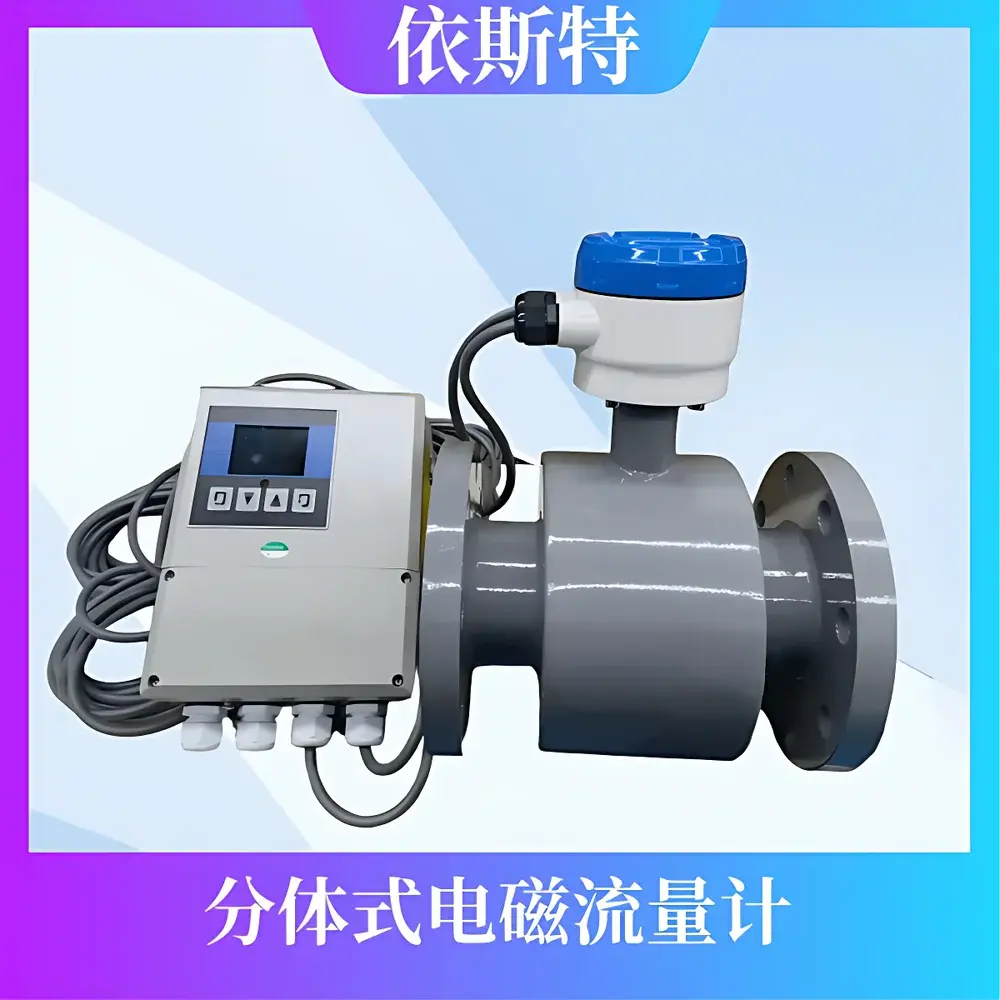
YST Electromagnetic Flow Meter YST183F-A50XL
| Brand | YST |
|---|---|
| Origin | Liaoning, China |
| Model | YST183F-A50XL |
| Pipe Size Range | DN10–DN3000 |
| Flow Velocity Range | 0.1–10 m/s |
| Accuracy | ±0.5% FS (standard), ±1.0% FS (challenging conditions) |
| Operating Pressure | PN1.0 MPa / PN1.6 MPa (customizable) |
| Medium Temperature | −20°C to +180°C (standard liner) |
| Minimum Conductivity | ≥5 µS/cm |
| Electrode Materials | 316L stainless steel, Hastelloy C, titanium |
| Liner Materials | PTFE, neoprene, polyurethane |
| Output Signals | 4–20 mA analog, RS485 (Modbus RTU) |
| Sensor Protection Rating | IP67/IP68 |
| Converter Protection Rating | IP65 |
| Power Supply | AC 220 V ±10% 50/60 Hz or DC 24 V ±10% |
Overview
The YST Electromagnetic Flow Meter YST183F-A50XL is a robust, inline electromagnetic flow measurement instrument engineered for continuous, non-intrusive volumetric flow monitoring of conductive liquids in wastewater treatment, industrial effluent management, and municipal water infrastructure applications. Based on Faraday’s law of electromagnetic induction, the device measures flow velocity by detecting the voltage induced across a conductive fluid moving through a magnetic field generated perpendicular to the pipe axis. This principle ensures immunity to variations in fluid density, viscosity, temperature, and pressure—making it especially suitable for heterogeneous, abrasive, or chemically aggressive wastewater streams where mechanical flow meters would suffer from clogging, wear, or calibration drift.
Key Features
- Full-bore, no-moving-parts design: Eliminates pressure loss and mechanical wear; supports long-term reliability with minimal maintenance intervals.
- Flexible installation configuration: Compatible with horizontal, vertical, or inclined piping—provided the pipe remains fully filled during operation; low straight-pipe requirement (≥5D upstream, ≥2D downstream) reduces retrofit complexity.
- Multi-material electrode and liner options: Enables chemical compatibility across diverse wastewater matrices—including chlorinated, acidic, alkaline, or solids-laden effluents—via selectable electrode alloys (316L SS, Hastelloy C, titanium) and liners (PTFE, neoprene, polyurethane).
- Dual-output interface: Simultaneous 4–20 mA analog output for legacy PLC integration and isolated RS485 serial communication (Modbus RTU protocol) for digital SCADA, DCS, or cloud-based data acquisition systems.
- High environmental resilience: Sensor rated IP67/IP68 for submersion-capable operation in wet or submerged manholes; converter rated IP65 for indoor/outdoor mounting in control cabinets or outdoor enclosures.
- Low-power operational profile: Dual power input support (AC 220 V or DC 24 V) facilitates deployment in both grid-connected and solar-powered remote monitoring stations.
Sample Compatibility & Compliance
The YST183F-A50XL is validated for use with liquids exhibiting minimum electrical conductivity of 5 µS/cm—covering most municipal, hospital, food processing, pharmaceutical, and light industrial wastewaters. It complies with general-purpose electromagnetic flowmeter performance expectations aligned with IEC 60534-2-1 (flow measurement uncertainty methodology) and EN 14154-2 (water metering standards for non-domestic applications). While not certified to specific regulatory frameworks such as EPA Method 1609 or ISO 4064-1, its accuracy class (±0.5% FS under standard conditions) meets typical requirements for billing-grade and process control-level wastewater flow monitoring in GLP-aligned facilities. For installations subject to regulatory reporting (e.g., U.S. EPA NPDES permits or EU Urban Wastewater Treatment Directive compliance), users are advised to implement periodic verification per ASTM D1129 or ISO/IEC 17025-accredited calibration protocols.
Software & Data Management
The YST183F-A50XL operates as a field-level sensor node without embedded firmware-based analytics. Its Modbus RTU interface enables seamless integration into third-party supervisory platforms—including Ignition SCADA, Siemens Desigo CC, Schneider EcoStruxure, or open-source solutions like Node-RED and Grafana—supporting real-time visualization, alarm thresholding (e.g., flow deviation >10% over baseline), and automated log export. The 4–20 mA output is compatible with analog input modules in programmable logic controllers (PLCs) conforming to IEC 61131-3. For remote telemetry, the device may be interfaced with cellular gateways (e.g., Teltonika RUT955 or Sierra Wireless AirLink RV50) supporting MQTT or HTTP(S) push to cloud dashboards. Audit trails, data integrity, and user access control are managed at the system level—not within the meter itself—ensuring alignment with FDA 21 CFR Part 11 and EU Annex 11 principles when deployed in regulated environments requiring electronic record retention.
Applications
- Municipal wastewater influent and effluent flow monitoring at pumping stations and treatment plants
- Hospital and pharmaceutical facility effluent discharge tracking for environmental compliance reporting
- Industrial pretreatment flow verification prior to municipal sewer entry
- Rural smart water network metering with low-bandwidth telemetry integration
- Chemical dosing line flow verification in coagulation/flocculation processes
- Leak detection and hydraulic balance analysis in distribution networks
FAQ
What minimum conductivity is required for reliable measurement?
The meter requires a minimum liquid conductivity of 5 µS/cm. Most domestic and industrial wastewaters meet this criterion; deionized water or hydrocarbon-based fluids do not.
Can the device be installed in partially filled pipes?
No. Electromagnetic flowmeters require full pipe cross-section occupancy to maintain field uniformity and signal integrity. Installation must ensure continuous full-pipe flow conditions.
Is factory calibration traceable to national standards?
Calibration is performed using master meters traceable to CNAS-accredited laboratories in China. Full calibration certificates—including K-factor, zero stability, and repeatability data—are available upon request.
How often should field verification be performed?
Annual verification is recommended for regulatory or fiscal applications; biannual checks suffice for process control where redundancy or cross-validation with other instrumentation is available.
Does the meter support pulse output or HART communication?
No. The YST183F-A50XL provides only 4–20 mA analog and RS485 Modbus RTU outputs. Pulse output and HART are not supported in this model variant.