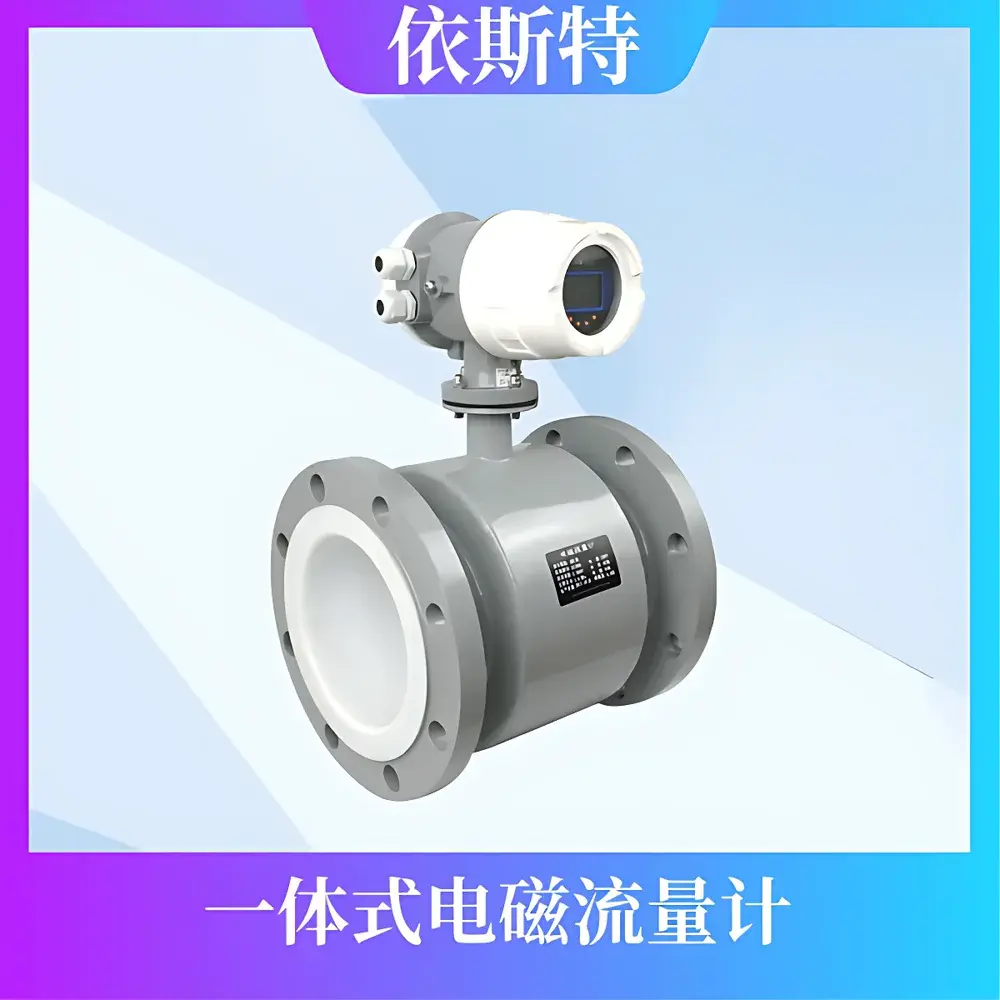
YST Electromagnetic Flow Meter YST183F-A50XL (DN800 Integrated Type)
| Brand | YST |
|---|---|
| Origin | Liaoning, China |
| Model | YST183F-A50XL |
| Nominal Diameter | DN800 |
| Measurement Principle | Faraday’s Law of Electromagnetic Induction |
| Flow Velocity Range | 0.01–10 m/s |
| Accuracy | ±0.5% FS (optional ±1.0% FS) |
| Medium Conductivity | ≥5 µS/cm |
| Temperature Range | –20 to +180 °C (dependent on liner material) |
| Pressure Rating | 0.6–4.0 MPa |
| Liner Material | PTFE |
| Electrode Material | 316L Stainless Steel |
| Enclosure Protection | IP65 |
| Output Signals | 4–20 mA analog, pulse output |
| Communication Interface | RS485 (Modbus RTU) |
| Power Supply | 220 VAC ±10%, 50/60 Hz |
| Wetted Materials Compliance | FDA-compliant PTFE liner per ASTM D1711 |
| Electromagnetic Compatibility | IEC 61326-1 (Industrial Environment) |
Overview
The YST Electromagnetic Flow Meter YST183F-A50XL (DN800 Integrated Type) is an industrial-grade, fully integrated electromagnetic flow measurement system engineered for high-reliability liquid flow monitoring in large-diameter pipeline applications. Designed in strict accordance with Faraday’s law of electromagnetic induction, the meter generates a proportional electromotive force (EMF) when an electrically conductive fluid moves through a controlled magnetic field perpendicular to the flow direction. This principle ensures volumetric flow measurement that is inherently independent of fluid density, temperature, pressure, viscosity, or turbulence—making it especially suitable for heterogeneous, suspended-solid-laden, or mildly corrosive aqueous media commonly encountered in municipal water infrastructure and wastewater treatment facilities.
Key Features
- Monolithic Integrated Architecture: Sensor and converter are housed in a single mechanical enclosure, eliminating interconnecting cables, signal attenuation risks, and installation complexity associated with remote-mounted converters—ideal for confined utility pits, manholes, and retrofit projects with spatial constraints.
- Robust Electrode & Lining System: 316L stainless steel electrodes paired with seamless PTFE lining provide chemical resistance across pH 5–9 environments and mechanical resilience against abrasive particulates typical in raw sewage and industrial cooling water.
- Low-Frequency Square-Wave Excitation: Minimizes polarization effects and mitigates 50/60 Hz power-line interference, ensuring stable zero-point performance and high signal-to-noise ratio under variable grounding conditions and fluctuating flow profiles.
- Wide Dynamic Flow Range: Supports linear measurement from 0.01 m/s (low-flow surveillance) up to 10 m/s (high-velocity transmission mains), with built-in flow velocity alarm thresholds and programmable over-range protection to safeguard liner integrity at sustained high velocities.
- Compliance-Ready Signal Outputs: Dual 4–20 mA analog outputs (primary flow + optional secondary parameter such as flow totalizer or error status) and isolated pulse output conform to NAMUR NE43 standards; RS485 interface supports Modbus RTU protocol for integration into SCADA, DCS, or PLC-based supervisory systems.
Sample Compatibility & Compliance
This flowmeter is validated for use with conductive liquids having minimum conductivity of 5 µS/cm—sufficient for untreated wastewater, activated sludge effluent, reclaimed water, brackish groundwater, and most industrial process streams. It is not suitable for deionized water, hydrocarbons, or non-conductive solvents. The PTFE liner meets ASTM D1711 requirements for electrical insulation and chemical inertness. The device complies with IEC 61326-1 for electromagnetic immunity in industrial settings and is designed to support GLP/GMP-aligned operational documentation workflows—including configurable audit trails, calibration timestamp logging, and password-protected configuration access. While not certified to ATEX or IECEx for hazardous areas, its IP65-rated enclosure ensures reliable operation in outdoor, humid, or splash-prone environments typical of pump stations and lift wells.
Software & Data Management
The onboard firmware supports local configuration via integrated keypad and LCD display, with optional PC-based setup using YST Configuration Utility (Windows-compatible, USB-to-RS485 adapter required). All critical parameters—including damping time, flow direction detection, empty pipe detection threshold, and totalizer reset logic—are user-adjustable. Data logging capability includes real-time flow rate, accumulated volume, forward/reverse flow totals, and diagnostic flags (e.g., electrode contamination warning, excitation fault). When connected via RS485, the device transmits timestamped flow data packets compatible with industry-standard historian platforms (e.g., Ignition, Siemens Desigo CC, or custom Python-based MQTT ingestion pipelines). Audit logs record all configuration changes with operator ID and UTC timestamps, supporting regulatory traceability under ISO/IEC 17025 or EPA-approved monitoring protocols.
Applications
- Municipal water supply intake and distribution trunk lines (DN600–DN1200)
- Wastewater treatment plant influent, bioreactor feed, and final effluent discharge monitoring
- Industrial cooling water circuits with suspended solids or scaling tendency
- Water loss detection and district metering area (DMA) balancing
- Stormwater runoff quantification and combined sewer overflow (CSO) event reporting
- Recycled water reuse systems requiring continuous volumetric accountability
FAQ
What is the minimum conductivity requirement for accurate measurement?
The meter requires a minimum liquid conductivity of 5 µS/cm. Pure water (<0.1 µS/cm), distilled solvents, or hydrocarbon-based fluids cannot be measured.
Can this flowmeter be installed in vertical pipelines?
Yes—provided the pipe is fully filled during operation. For upward flow, ensure adequate backpressure; for downward flow, verify absence of air pockets or intermittent flow conditions.
Is the PTFE liner resistant to chlorine or sodium hypochlorite dosing?
PTFE exhibits excellent resistance to oxidizing agents including chlorine and NaOCl at concentrations typical in potable water disinfection (≤5 mg/L residual); long-term exposure to >10 ppm free chlorine at elevated temperatures (>60 °C) may accelerate aging.
Does the device support HART communication?
No—HART is not implemented. Only 4–20 mA analog output with digital superimposed Modbus RTU over RS485 is available.
How often does the meter require recalibration?
Under stable operating conditions and consistent fluid properties, annual verification against a master meter or portable ultrasonic reference is recommended per ISO 4064-2; no routine recalibration is needed unless physical damage, liner degradation, or significant drift (>±0.3% FS) is observed.