YST Fire-Grade Clamp-On Ultrasonic Flow Meter YST305SBCS1
| Brand | YST (Dalian Yist) |
|---|---|
| Origin | Liaoning, China |
| Model | YST305SBCS1 |
| Pipe Diameter Range | DN50–DN3000 |
| Flow Velocity Range | 0.1–10 m/s |
| Medium Temperature | −20 °C to +80 °C |
| Max Working Pressure | ≤1.6 MPa |
| Output | 4–20 mA (250–750 Ω load), RS485 (Modbus RTU) |
| Power Supply | AC 220 V ±10% (50/60 Hz) or DC 24 V ±15% |
| Display | Backlit LCD showing instantaneous flow, cumulative flow, velocity, and medium temperature |
| Compliance | Suitable for fire protection water systems per NFPA 13 / ISO 6946 principles (non-intrusive installation, no pressure loss) |
| Material Compatibility | Carbon steel, stainless steel, cast iron, PVC, PE (wall thickness ≤20 mm) |
| Medium Requirements | Homogeneous, single-phase, low-viscosity liquids (e.g., potable water, fire service water) |
Overview
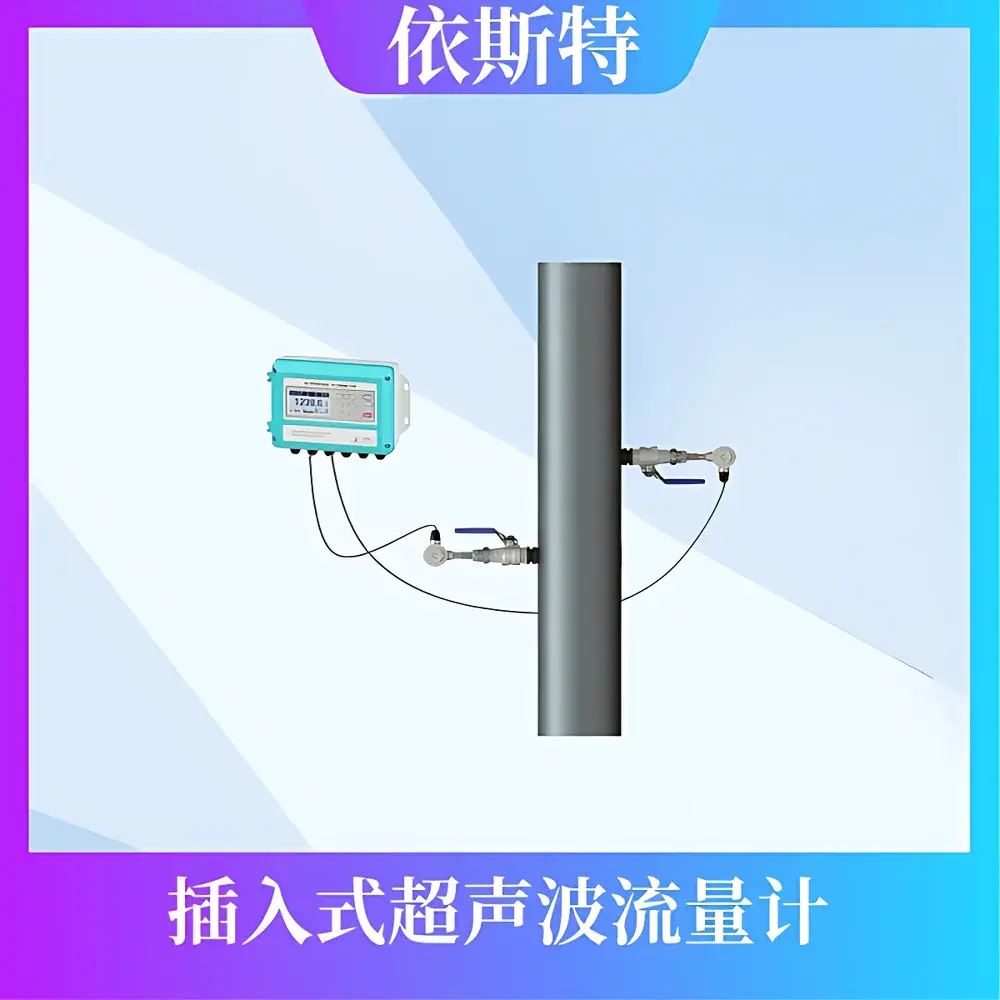
The YST Fire-Grade Clamp-On Ultrasonic Flow Meter YST305SBCS1 is an engineered solution for non-invasive, real-time volumetric flow measurement in fire protection water distribution systems. It operates on the principle of transit-time ultrasonic measurement: two piezoelectric transducers mounted on the exterior—or inserted through a port—emit and receive ultrasonic pulses diagonally across the pipe cross-section. The time difference between upstream and downstream signal propagation is directly proportional to the average axial flow velocity. This method eliminates the need for pipe cutting, flange removal, or system shutdown during installation—a critical requirement for active fire suppression infrastructure where operational continuity must be preserved under NFPA 13, ISO 6946, and local fire code mandates.
Key Features
- Zero-pressure-loss insertion design: The probe is inserted via a hot-tap saddle or threaded port, maintaining full pipe integrity and eliminating hydraulic resistance—critical for maintaining required residual pressure in fire pump discharge lines and standpipe risers.
- Broad pipe compatibility: Validated for metallic pipes (carbon steel, stainless steel, cast iron) and non-metallic pipes including PVC and PE, provided wall thickness does not exceed 20 mm—enabling deployment across legacy and modern fire service infrastructure.
- Robust environmental tolerance: Rated for continuous operation at temperatures from −20 °C to +80 °C and pressures up to 1.6 MPa, covering standard municipal and industrial fire water supply conditions per EN 12844 and UL 19.
- Multi-signal interface: Dual-output architecture supports analog 4–20 mA transmission (with configurable range and damping) and digital RS485 Modbus RTU communication, enabling seamless integration into existing PLC-based fire alarm control panels (FACP), building management systems (BMS), and SCADA networks.
- Low-maintenance architecture: Stainless-steel probe housing resists corrosion from chlorinated water and biofilm accumulation; absence of moving parts or inline obstructions ensures long-term calibration stability and minimal scheduled intervention.
Sample Compatibility & Compliance
The YST305SBCS1 is validated exclusively for clean, single-phase, low-viscosity aqueous media typical of fire protection systems—including treated municipal water, fire tank supply water, and recirculated pump test loop fluids. It is not certified for use with aerated, foamed, or heavily particulate-laden streams (e.g., >3% v/v suspended solids or >5% v/v entrained air), as these violate the acoustic coupling assumptions inherent to transit-time ultrasonic metrology. Installation adheres to ISO 10790-2 guidance for clamp-on and insertion-type ultrasonic flowmeters, and its mechanical design aligns with ASME B16.5 flange interface conventions for retrofit applications. While not third-party listed to UL 2148 or FM Approval Class 3260, its application context—retrofit monitoring rather than life-safety actuation—places it within the scope of NFPA 13 Chapter 16 (monitoring and testing instrumentation) and ISO 4064-1:2014 for secondary verification-grade flow indication.
Software & Data Management
The device incorporates embedded firmware supporting local parameter configuration via keypad navigation and LCD menu structure. All operational parameters—including damping factor, flow unit selection (L/min, m³/h), zero calibration offset, and pulse output scaling—are stored in non-volatile memory. Hourly and daily cumulative flow totals are retained for 12 months without external power backup. Data export is limited to real-time polling via Modbus RTU (function codes 03h/04h); no onboard web server, cloud API, or FDA 21 CFR Part 11-compliant audit trail is implemented. For GxP environments requiring electronic record integrity, integration with validated historian systems (e.g., Siemens Desigo CC, Honeywell Experion PKS) is recommended to capture timestamped flow events with system-level traceability.
Applications
- Continuous flow verification on fire pump test headers and jockey pump bypass lines
- Real-time demand monitoring at zone isolation valves in high-rise standpipe systems
- Post-retrofit validation of flow capacity after pipe relining or diameter reduction
- Leak detection support through baseline flow deviation analysis during quiescent periods
- Commissioning documentation for NFPA 25 annual flow tests and hydrant performance verification
FAQ
Can the YST305SBCS1 be used for custody transfer or billing applications?
No. This instrument is designed for monitoring and verification purposes only—not for fiscal metering. It lacks MID certification, OIML R49 compliance, or factory-traceable calibration against NIST-standard reference meters.
Is the probe suitable for underground or buried pipe installations?
Yes, provided the insertion port is accessible and the probe cable routing complies with IP68-rated conduit practices. The sensor body itself is rated IP67; extended submersion requires optional epoxy-sealed feedthroughs.
Does the device require periodic recalibration?
Per ISO 4064-2:2014, field verification every 24 months is recommended using a portable transit-time reference meter or bucket-and-stopwatch method per ASTM D1941. No user-accessible internal calibration trim is provided.
What is the minimum straight-pipe requirement upstream/downstream?
For insertion mounting, ≥10D upstream and ≥5D downstream are advised to minimize turbulence-induced velocity profile distortion—consistent with AGA Report No. 9 guidelines for ultrasonic flow measurement uncertainty control.
Can it measure reverse flow?
Yes. The transit-time algorithm inherently detects directionality; reverse flow is displayed as negative values on the LCD and transmitted accordingly via analog/digital outputs.