
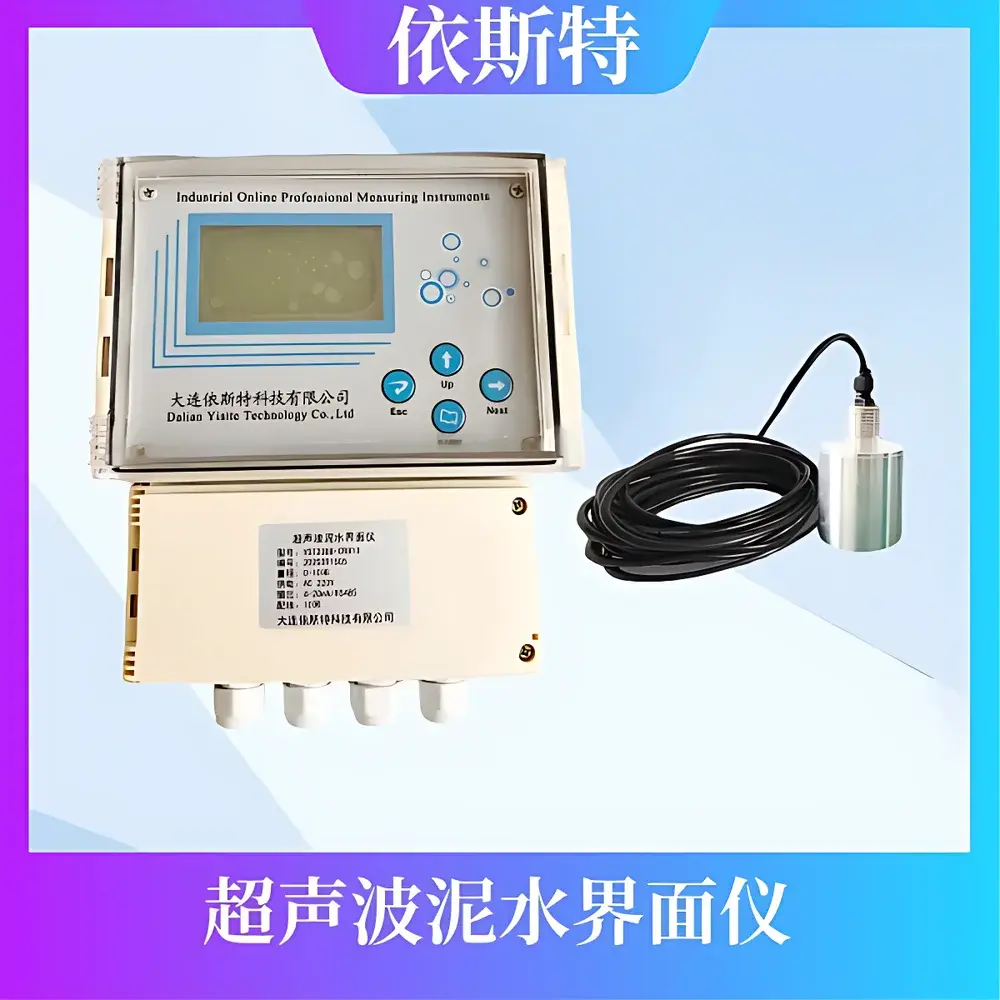
YST Intelligent Ultrasonic Sludge Blanket Level Monitor YST208B-CR810
| Brand | YST (Dalian Yist) |
|---|---|
| Origin | Liaoning, China |
| Model | YST208B-CR810 |
| Measuring Range | 0.5–20 m (sensor-dependent) |
| Accuracy | ±0.5% to ±1% FS |
| Resolution | 1 mm |
| Display | Bilingual LCD / TFT color screen with trend graph |
| Output Signals | 4–20 mA analog, RS485/Modbus RTU digital |
| Alarm Outputs | 2–4 relay channels (5 A / 250 VAC) |
| Power Supply | AC 220 V ±10% or DC 12–24 V |
| Power Consumption | <5 W |
| Enclosure Rating | IP65 (main unit), IP68 (sensor) |
| Housing Material | ABS/aluminum (unit), 304/316L stainless steel (sensor) |
| Standard Cable Length | 10 m (customizable) |
Overview
The YST Intelligent Ultrasonic Sludge Blanket Level Monitor YST208B-CR810 is an industrial-grade, non-contact level measurement instrument engineered for continuous, real-time monitoring of the sludge-water interface in municipal and industrial wastewater treatment processes. It operates on the principle of ultrasonic time-of-flight (ToF) measurement: a transducer emits high-frequency acoustic pulses toward the sludge blanket surface; the reflected echo is detected, and the transit time between emission and reception is converted into distance using calibrated sound velocity in water—compensated dynamically by an integrated temperature sensor. This distance, combined with pre-configured tank depth, yields precise sludge blanket thickness. Designed specifically for primary clarifiers, secondary sedimentation tanks, and sludge thickening basins, the YST208B-CR810 delivers stable, drift-free measurements under fluctuating hydraulic loads, suspended solids concentrations, and variable temperature conditions typical of activated sludge and conventional sedimentation systems.
Key Features
- Non-invasive ultrasonic sensing: Eliminates mechanical wear and fouling risks associated with contact probes; suitable for both surface-mount and submersible installation configurations.
- Real-time temperature compensation: Onboard thermistor continuously adjusts sound velocity calculation, mitigating measurement drift caused by seasonal or diurnal water temperature shifts (operational range: −10 °C to +70 °C).
- Electromagnetic interference (EMI) resilience: Advanced signal filtering and adaptive threshold algorithms suppress noise from variable-frequency drives, pumps, and adjacent electrical infrastructure common in wastewater plants.
- Dual power flexibility: Supports either AC 220 V ±10% or wide-range DC 12–24 V input—enabling deployment in both control room cabinets and remote field enclosures without external converters.
- Robust environmental sealing: Main unit rated IP65 (dust-tight and protected against low-pressure water jets); sensor housing IP68 (submersible up to 0.6 MPa), fabricated from marine-grade 316L stainless steel for long-term corrosion resistance in aggressive wastewater matrices.
- Intuitive human-machine interface: High-contrast TFT color display with bilingual (English/Chinese) menu navigation, real-time trend plotting, and configurable alarm thresholds—designed for rapid operator interpretation without specialized training.
Sample Compatibility & Compliance
The YST208B-CR810 is validated for use across heterogeneous sludge profiles encountered in municipal wastewater treatment—including flocculated biological sludge, chemically coagulated solids, and aged anaerobic digester return streams. Its measurement reliability has been verified under turbidities exceeding 5,000 NTU and total suspended solids (TSS) concentrations up to 30 g/L. While not certified to IEC 61508 (SIL) or ATEX standards out-of-the-box, the device complies with electromagnetic compatibility requirements per IEC 61326-1 (industrial environment) and safety standards per IEC 61010-1. For regulated facilities operating under ISO 9001, ISO 14001, or EPA-approved monitoring protocols, the instrument supports audit-ready data logging when integrated with compliant SCADA or DCS platforms. Optional firmware updates enable alignment with evolving US EPA Method 1631 or ISO 11047-based reporting frameworks for sludge blanket management.
Software & Data Management
Data output conforms to industry-standard protocols: analog 4–20 mA signals are linearly scaled to sludge thickness (e.g., 4 mA = 0 m, 20 mA = 20 m); Modbus RTU over RS485 allows direct integration with PLCs (Siemens S7, Allen-Bradley ControlLogix, Schneider Modicon) and distributed control systems. The embedded firmware includes timestamped internal storage (up to 30 days of 1-minute interval readings) and supports CSV export via USB or serial interface. When deployed with optional wireless telemetry modules (LoRaWAN or NB-IoT), historical datasets—including alarm events, calibration logs, and diagnostic status—are transmitted securely to cloud-based water intelligence platforms (e.g., OSIsoft PI System, Siemens Desigo CC, or custom MQTT brokers). All data transfers support TLS 1.2 encryption; configuration changes and firmware updates require authenticated access, supporting basic GLP/GMP traceability requirements for operational integrity documentation.
Applications
- Optimization of sludge withdrawal timing and volume in primary and secondary clarifiers to maintain optimal solids retention time (SRT) and prevent effluent turbidity excursions.
- Dynamic control of polymer dosing in gravity thickeners and dissolved air flotation (DAF) units based on real-time sludge concentration gradients.
- Interface tracking in lamella settlers and inclined plate clarifiers to verify hydraulic loading distribution and detect short-circuiting.
- Performance validation of sludge blanket height setpoints during process commissioning and routine maintenance audits.
- Integration into predictive maintenance workflows—correlating sludge accumulation rate trends with scraper torque, pump duty cycles, and digester feed consistency.
FAQ
What is the maximum recommended installation depth for the sensor?
The sensor is rated for continuous submersion at pressures up to 0.6 MPa, corresponding to approximately 60 meters of water column—however, practical ultrasonic measurement range is limited to 20 m due to signal attenuation in highly turbulent or aerated zones.
Can the device be calibrated in-situ without draining the tank?
Yes—zero-point calibration can be performed using a known reference distance (e.g., tank bottom or fixed benchmark), and span verification is supported via simulated echo delay testing using built-in diagnostics.
Is Modbus register mapping documentation available for system integrators?
Yes—full Modbus RTU register tables, including holding registers for measured value, temperature, status flags, and alarm thresholds, are provided in the technical manual and accessible via password-protected web interface.
Does the unit meet cybersecurity requirements for OT networks?
The base model implements read-only Modbus communication by default; write-access to critical parameters requires local physical authentication. Optional firmware enables role-based access control (RBAC) and secure boot functionality compatible with NIST SP 800-82 guidelines.
How frequently should maintenance checks be scheduled?
Visual inspection of sensor face and cable entry points is recommended quarterly; full functional verification—including echo amplitude analysis and temperature compensation validation—is advised semiannually or after major process upsets (e.g., shock loading, chemical cleaning events).







