
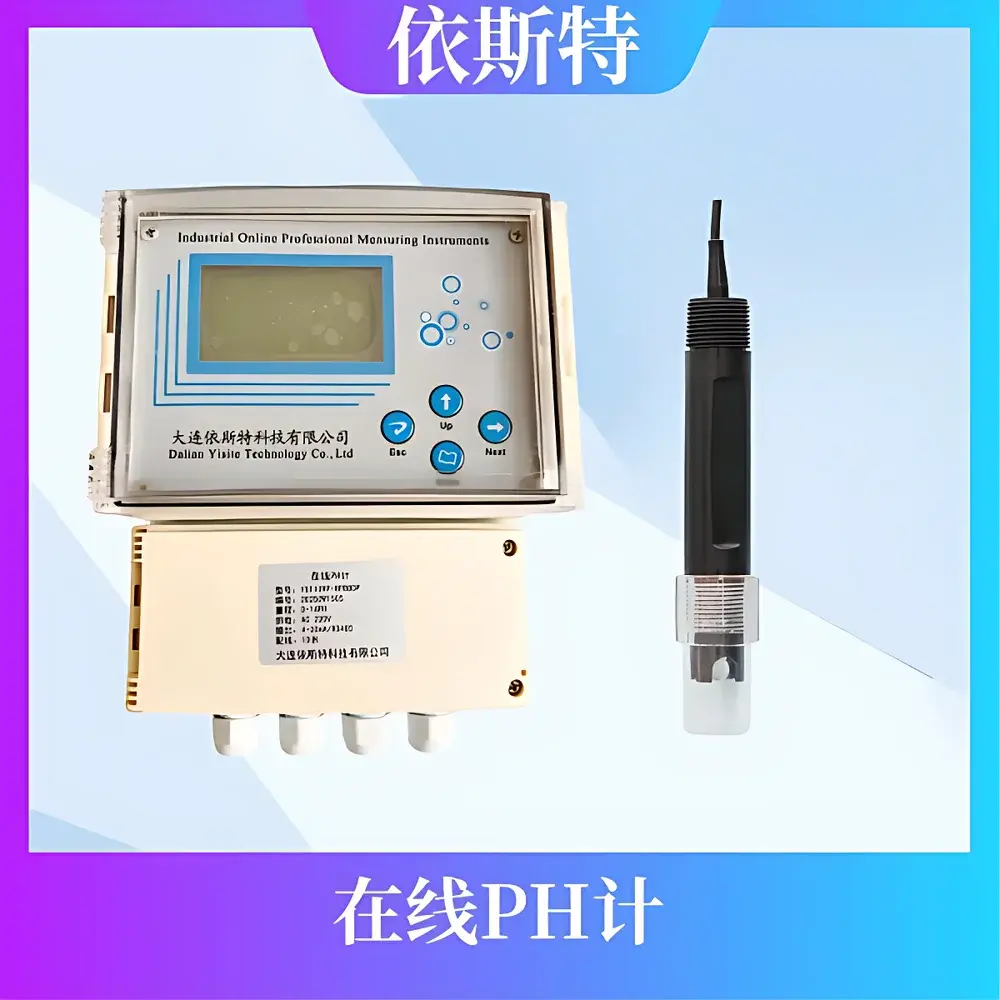
YST pH Meter YST109B-HP880 for Online Wastewater Monitoring
| Brand | YST (Dalian Yist) |
|---|---|
| Origin | Liaoning, China |
| Model | YST109B-HP880 |
| Measuring Range | pH 0–14 |
| Accuracy | ±0.1 pH |
| Temperature Compensation | 0–99.9 °C (25 °C reference, automatic) |
| Output Signals | 4–20 mA (2-wire), RS485 (Modbus RTU) |
| Power Supply | 24 VDC (wide-input tolerant) |
| Protection Rating | IP65 |
| Response Time | <30 s |
| Stability | ±0.02 pH/24 h |
Overview
The YST pH Meter YST109B-HP880 is an industrial-grade, online electrochemical sensor engineered for continuous pH monitoring in municipal wastewater treatment applications. Based on potentiometric measurement principles using a glass electrode and reference junction system, the device delivers real-time, stable pH data under dynamic effluent conditions—including high turbidity, variable organic load, and fluctuating ionic strength typical of domestic sewage streams. Designed for permanent installation in biological reactors, sedimentation tanks, and discharge points, it operates without manual sampling or lab intervention, enabling closed-loop process control and regulatory compliance tracking. Its architecture integrates robust electrode materials resistant to fouling by suspended solids and biofilm, and its temperature-compensated electronics ensure traceable accuracy across ambient operating ranges from 0 °C to 50 °C.
Key Features
- Potentiometric pH sensing with integrated temperature compensation (0–99.9 °C), referenced to 25 °C per IUPAC conventions
- Dual-output interface: isolated 4–20 mA analog signal compliant with IEC 61000-6-2/6-4 EMC standards, and RS485 serial communication supporting Modbus RTU protocol for integration into SCADA, DCS, or cloud-based water management platforms
- IP65-rated housing constructed from UV-stabilized polycarbonate and stainless steel fasteners, suitable for outdoor mounting, humid environments, and splash-prone locations without additional enclosures
- Opto-isolated signal conditioning circuitry to suppress common-mode noise and electromagnetic interference from pumps, blowers, and variable-frequency drives commonly present in wastewater facilities
- Field-calibratable via one-point or two-point buffer calibration (e.g., pH 4.01, 7.00, 10.01 NIST-traceable buffers), with calibration history retained in non-volatile memory
- Long-term drift stability of ±0.02 pH over 24 hours—validated under continuous operation in synthetic wastewater matrices per ASTM D1293-22 guidelines
Sample Compatibility & Compliance
The YST109B-HP880 is validated for direct immersion in untreated and secondary-treated domestic wastewater, including activated sludge effluents, trickling filter discharges, and membrane bioreactor (MBR) permeates. It meets material compatibility requirements for exposure to chloride ions (<2,000 mg/L), ammonia nitrogen (<50 mg/L), and total suspended solids (<200 mg/L). While not certified to ATEX or IECEx for explosive atmospheres, its design conforms to general-purpose industrial safety practices outlined in ISO 14001 and supports GLP-aligned operational documentation. Data integrity aligns with basic audit-trail expectations for routine environmental monitoring; however, full 21 CFR Part 11 compliance requires integration with validated third-party data acquisition software.
Software & Data Management
The meter operates autonomously without embedded firmware requiring PC-based configuration tools. All setup—including zero/span offset, temperature coefficient, damping factor, and Modbus slave ID—is performed via local push-button interface or remotely via Modbus register writes. The 4–20 mA output provides linear scaling (e.g., 4 mA = pH 0, 20 mA = pH 14), while RS485 enables polling of real-time pH, temperature, electrode impedance, and calibration status. No internal data logging is implemented; persistent storage must be handled at the supervisory system level (e.g., PLC historian, cloud platform). Firmware updates are not field-upgradable—hardware revision control is maintained through model-specific manufacturing batches.
Applications
- Real-time pH feedback control in aerobic/anaerobic bioreactors to maintain optimal microbial activity (e.g., nitrification above pH 7.2, denitrification below pH 7.8)
- Discharge compliance monitoring at final effluent points per national standards (e.g., China’s GB 18918-2002, EU Urban Wastewater Treatment Directive 91/271/EEC)
- Acid-base dosing automation in neutralization tanks, reducing chemical overfeed and sludge generation
- Distributed sensing networks in decentralized treatment systems (e.g., rural STPs, residential clusters), where RS485 daisy-chaining minimizes cabling costs
- Troubleshooting hydraulic shocks or influent toxicity events via rapid pH deviation detection (e.g., sudden drops indicating septic conditions or industrial slug loads)
FAQ
What is the recommended calibration frequency for continuous wastewater monitoring?
For stable municipal influent/effluent streams, biweekly calibration is typical; for highly variable or high-fouling environments, weekly or pre-shift verification is advised using certified buffer solutions.
Can the sensor be cleaned in situ without removal from the pipe or tank?
Yes—the electrode assembly permits mechanical wiping or low-pressure air/water jet cleaning while installed; chemical cleaning with dilute HCl (0.1 M) is possible but requires temporary isolation per OEM guidance.
Is temperature compensation mandatory when measuring wastewater pH?
Yes—temperature-induced potential shifts exceed ±0.03 pH/°C near neutral pH; automatic compensation using the built-in Pt1000 thermistor is essential for metrological validity.
Does the device support HART communication protocol?
No—only 4–20 mA (analog) and Modbus RTU over RS485 are supported; HART capability is not implemented in this hardware variant.
What is the expected service life of the pH electrode under continuous sewage exposure?
With proper maintenance and periodic cleaning, functional lifespan averages 12–18 months in secondary-treated effluent; raw influent applications may reduce this to 6–9 months depending on sulfide and grease content.



