
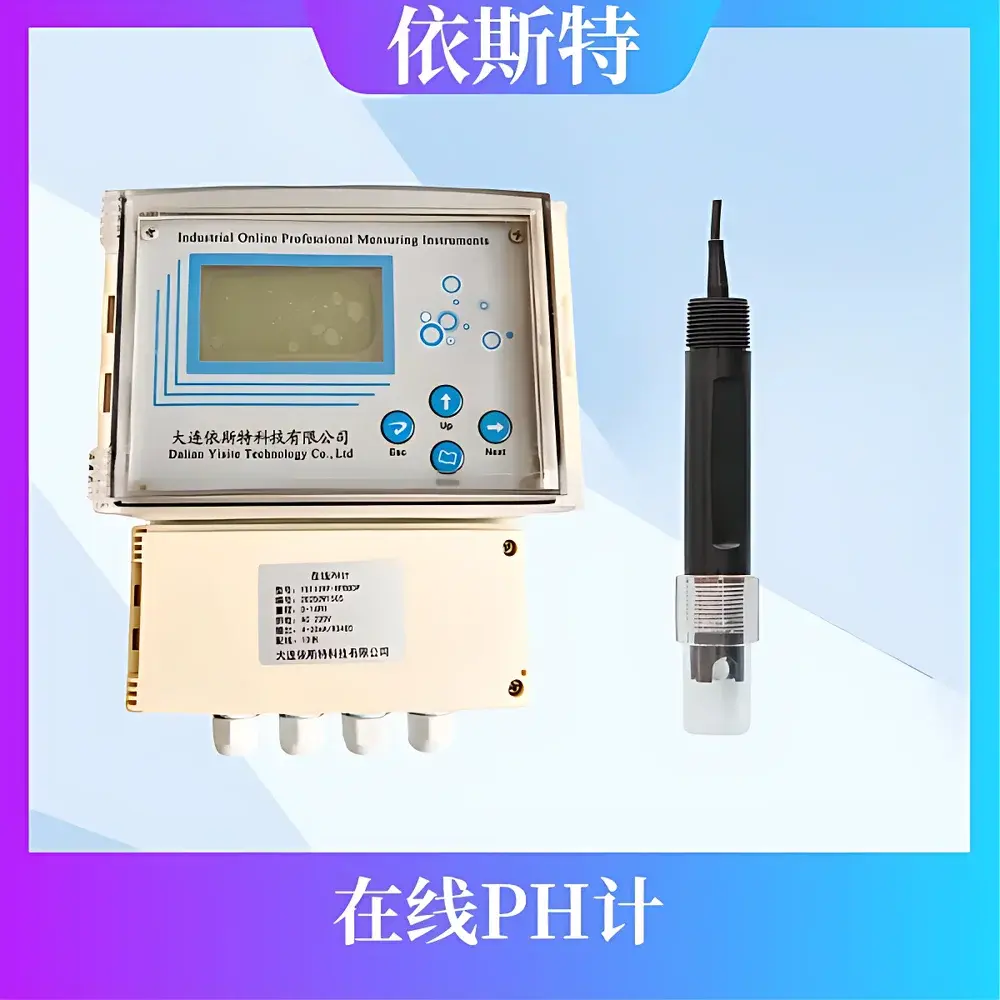
YST pH/ORP Online Analyzer YST109B-HP880
| Brand | YST (Dalian Yist) |
|---|---|
| Origin | Liaoning, China |
| Model | YST109B-HP880 |
| pH Range | 0–14 |
| ORP Range | −2000 to +2000 mV |
| pH Accuracy | ±0.02 |
| ORP Accuracy | ±5 mV |
| Temperature Compensation | 0–99.9 °C (reference 25 °C |
| Output Signals | 4–20 mA (2-wire), RS485 (Modbus RTU) |
| Power Supply | 24 VDC (wide-range, solar-compatible) |
| Media Compatibility | Aqueous solutions, weakly corrosive liquids (pH 2–12), suspensions |
| Drift Stability | ±0.02 pH/24 h |
| Enclosure Rating | IP65 |
| Response Time | <30 s |
| ADC Resolution | 24-bit |
| Calibration Modes | Manual & Automatic (single-/two-point) |
| Data Logging | 30-day local history storage |
| Electrode Options | Glass, antimony, or refillable gel-filled pH electrodes |
Overview
The YST pH/ORP Online Analyzer YST109B-HP880 is a robust, industrial-grade electrochemical process analyzer engineered for continuous, high-stability monitoring of hydrogen ion activity (pH) and oxidation-reduction potential (ORP) in aqueous process streams. Based on the fundamental principle of potentiometric measurement—where the voltage difference between a pH-sensitive sensing electrode and a stable reference electrode correlates directly to solution pH—the instrument delivers traceable, NIST-aligned measurements across the full operational range (pH 0–14; ORP −2000 to +2000 mV). Its integrated temperature sensor enables automatic compensation using the standardized Nernst equation, referenced to 25 °C with a defined thermal coefficient (±0.03 pH/°C), ensuring metrological consistency under dynamic ambient conditions. Designed for deployment in demanding environments—including wastewater treatment effluent channels, chemical reaction vessels, food processing rinse lines, and cooling tower circuits—the analyzer operates without routine recalibration intervals exceeding 7 days under steady-state conditions and meets functional requirements for ISO/IEC 17025-compliant laboratories when paired with certified reference buffers.
Key Features
- High-fidelity 24-bit analog-to-digital conversion architecture ensures minimal quantization error and long-term signal integrity, critical for trending subtle pH shifts in neutralization control loops.
- Galvanically isolated signal outputs (4–20 mA and RS485 Modbus RTU) suppress electromagnetic interference from VFDs, welding equipment, and high-current distribution panels—validated per IEC 61000-4-4 (EFT) and IEC 61000-4-5 (surge) standards.
- Dual-mode calibration support (manual and auto-recognition of standard buffer sets) simplifies compliance with ASTM D1293 (standard test method for pH of water) and USP <791> (pH measurement in pharmaceutical water systems).
- IP65-rated polycarbonate housing with UV-stabilized gasketing permits permanent outdoor mounting in humid, splash-prone zones without enclosure derating.
- Configurable relay outputs enable direct integration with dosing pumps, alarm sirens, or PLC interlocks—supporting fail-safe response protocols required under ANSI/ISA-84.00.01 (functional safety).
- Onboard data logging retains 30 days of timestamped pH, ORP, temperature, and diagnostic flags (e.g., electrode impedance, reference junction status), facilitating root-cause analysis during GLP/GMP audits.
Sample Compatibility & Compliance
The YST109B-HP880 is validated for use with low-conductivity water (≥50 µS/cm), municipal and industrial wastewater, food-grade brines, and mildly aggressive process fluids (pH 2–12). It is not intended for hydrofluoric acid, strong oxidizers (>10% HNO₃), or non-aqueous solvents. Electrode compatibility extends to glass-bodied, antimony-coated, and double-junction gel-electrolyte configurations—each selected per ISO 10523 (water quality — determination of pH) and DIN EN ISO 3696 (grade 3 water specifications). The device complies with CE marking directives (EMC 2014/30/EU, LVD 2014/35/EU), RoHS 2011/65/EU, and supports audit-ready documentation for FDA 21 CFR Part 11 when connected to validated SCADA platforms with electronic signature and audit trail functionality.
Software & Data Management
Configuration and diagnostics are performed via embedded web interface (HTTPS-enabled) or YST ConfigTool v3.2 (Windows-based), supporting firmware updates, calibration certificate export (PDF), and Modbus register mapping. All logged data adhere to CSV format with ISO 8601 timestamps and UTC synchronization. When interfaced with enterprise MES or LIMS systems, the analyzer transmits raw sensor values, compensated results, and health metrics—including electrode asymmetry voltage and liquid junction potential drift—enabling predictive maintenance scheduling aligned with ISO 55001 asset management frameworks.
Applications
- Effluent pH monitoring at municipal wastewater treatment plants to ensure regulatory compliance with EPA 40 CFR Part 136 discharge limits (pH 6.0–9.0).
- Real-time feedback control of acid/base dosing in chemical synthesis reactors, reducing reagent overfeed by up to 18% versus fixed-timed injection.
- In-line verification of cleaning-in-place (CIP) cycle neutrality in dairy and beverage facilities per 3-A Sanitary Standards SSI-001-06.
- Corrosion potential tracking in closed-loop cooling systems, where sustained ORP > +250 mV indicates oxidizing biocide efficacy.
- Quality gate monitoring of boiler feedwater alkalinity to prevent caustic embrittlement per ASME B31.1 power piping code.
FAQ
What reference temperature is used for automatic temperature compensation?
The instrument uses 25 °C as the default reference temperature, applying the Nernst slope correction factor (−0.1984 mV/pH/°C at 25 °C) with a linearized thermal coefficient of ±0.03 pH per °C deviation.
Can the analyzer operate without external power conditioning in solar-powered remote sites?
Yes—its 24 VDC input accepts 18–32 VDC with ripple tolerance ≤5%, making it compatible with MPPT charge controllers and deep-cycle battery banks typical in off-grid telemetry deployments.
Is electrode calibration traceable to national metrology institutes?
Calibration is performed using NIST-traceable pH 4.01, 7.00, and 10.01 buffer solutions; certificates of analysis are provided with each buffer kit.
How does the device handle suspended solids or fouling-prone media?
The optional flow-through sensor housing (YST-FTH-01) enables continuous sample flushing at ≥150 mL/min, while antimony electrodes offer enhanced resistance to coating in sludge-laden streams.
Does the unit support HART protocol?
No—only 4–20 mA (analog) and RS485 Modbus RTU (digital) are supported; HART requires separate hardware revision (YST109B-HP880-H).





