YST Ultrasonic Clamp-on Flow Meter YST305SBWS1
| Brand | YST (Dalian Yist) |
|---|---|
| Origin | Liaoning, China |
| Model | YST305SBWS1 |
| Pipe ID Range | DN50–DN2000 mm |
| Velocity Range | 0.1–15 m/s |
| Accuracy | ±1.0% of reading (liquid, standard conditions) |
| Repeatability | ≤0.2% |
| Velocity Resolution | 0.001 m/s |
| Flow Resolution | 0.001 m³/h |
| Operating Temp | Host –20–60°C, Transducer –40–160°C |
| Humidity | ≤95% RH (non-condensing) |
| Max Transducer Pressure | ≤2.5 MPa |
| Enclosure Rating | IP65 (host), IP68 (transducer) |
| Outputs | 4–20 mA (≤750 Ω), RS485 (Modbus RTU), Pulse (configurable width) |
| Power Supply | AC 220 V±10% (50/60 Hz) or DC 24 V±10%, Power Consumption ≤10 W |
Overview
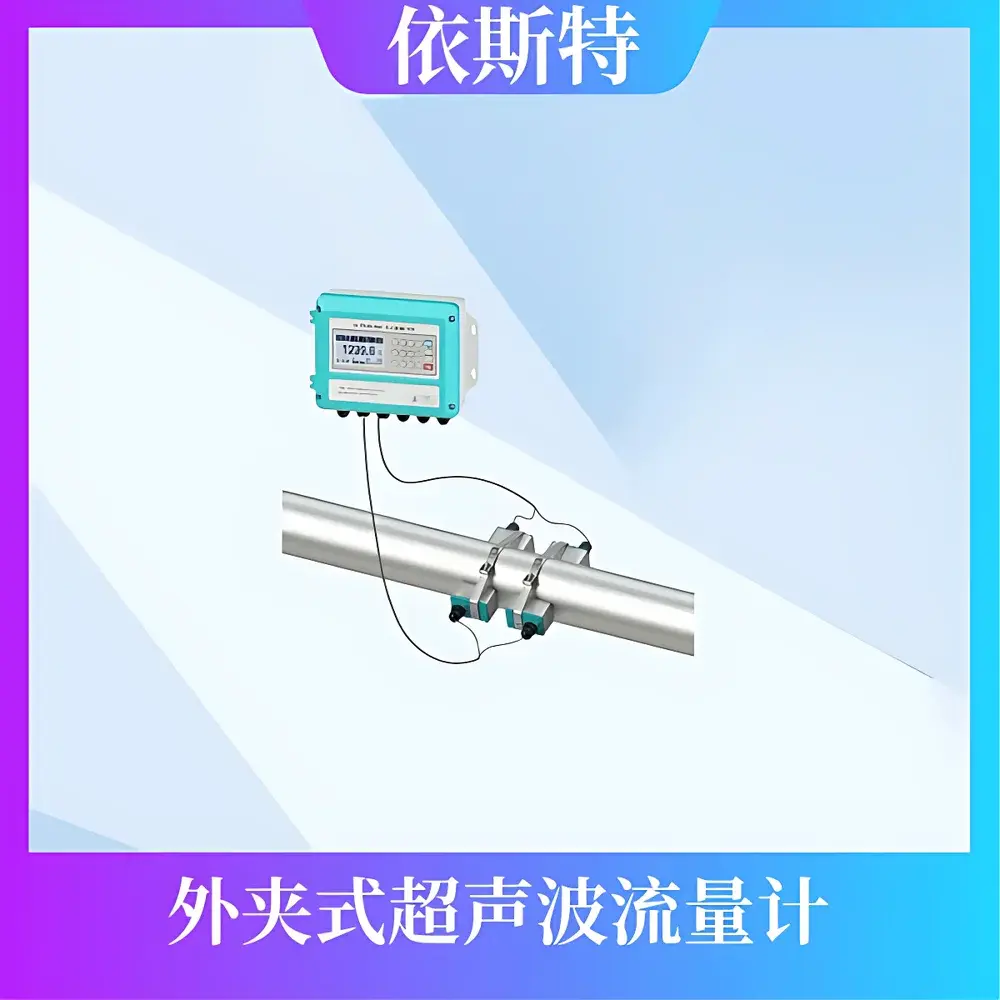
The YST Ultrasonic Clamp-on Flow Meter YST305SBWS1 is a non-intrusive, transit-time ultrasonic flow measurement system engineered for continuous liquid flow monitoring in industrial process pipelines without operational interruption. Utilizing the principle of ultrasonic transit-time difference—where the time-of-flight of high-frequency sound waves propagating upstream and downstream through flowing liquid is precisely measured—the instrument calculates volumetric flow rate based on pipe geometry, sound velocity, and flow-induced time differential. This physics-based methodology eliminates the need for pipe penetration, flange modification, or process shutdown during installation or maintenance, making it especially suitable for critical infrastructure including municipal water supply networks, chemical transfer lines, thermal oil circuits, and environmental compliance monitoring stations.
Key Features
- True clamp-on design with magnetic quick-mount transducer fixtures—enabling single-operator installation on pipes ranging from DN50 to DN2000 mm without welding, cutting, or bypassing the pipeline.
- Wide material compatibility: validated for use on carbon steel, stainless steel, cast iron, PVC, HDPE, GRP, and other common metallic and non-metallic pipe wall materials.
- High-temperature transducer capability (–40°C to +160°C), supporting stable operation in thermal oil, steam condensate, and high-temperature process fluid applications.
- Integrated temperature compensation algorithm that dynamically adjusts for changes in liquid sound velocity due to thermal drift—ensuring measurement consistency across varying ambient and process temperatures.
- No moving parts or wetted components—resulting in zero pressure drop, negligible long-term wear, and minimal calibration drift over extended service intervals.
- Dual power input flexibility: supports both AC 220 V ±10% (50/60 Hz) and DC 24 V ±10%, with total power consumption ≤10 W—ideal for remote or energy-constrained installations.
Sample Compatibility & Compliance
The YST305SBWS1 is calibrated and verified for single-phase liquids including potable water, seawater, diesel fuel, lubricating oils, ethylene glycol solutions, and other homogeneous Newtonian fluids with acoustic impedance suitable for ultrasonic coupling. It is not intended for slurries, highly aerated liquids, or multiphase flows. While not certified to IEC 61508 or SIL standards out-of-the-box, its hardware architecture and signal processing firmware support integration into systems compliant with ISO 5167, ASTM D1941 (for water flow), and EN 14154-2 (ultrasonic meters for water). The device meets electromagnetic compatibility requirements per IEC 61326-1 and environmental protection specifications under IP65 (electronics housing) and IP68 (transducers), ensuring reliable performance in outdoor, humid, or washdown environments.
Software & Data Management
The meter embeds a configurable firmware platform accessible via local keypad or remote serial interface. Configuration parameters—including pipe material, wall thickness, lining type, fluid type, and output scaling—are stored in non-volatile memory with write-protection options. RS485 Modbus RTU communication enables seamless integration into SCADA, DCS, or PLC-based supervisory systems for real-time data acquisition, historical logging, and alarm event reporting. The 4–20 mA analog output supports direct connection to legacy analog controllers or chart recorders, while the programmable pulse output facilitates mechanical counter interfacing or batch volume accumulation. All configuration changes are timestamped and logged internally, supporting basic audit trail functionality aligned with GLP-aligned operational practices. Firmware updates are performed via secure serial protocol and require physical access—no cloud connectivity or external network dependencies are implemented.
Applications
- Municipal water utilities: Real-time inflow/outflow monitoring at treatment plant boundaries without service interruption—supporting regulatory reporting under EPA 40 CFR Part 136 or EU Water Framework Directive compliance frameworks.
- Chemical and petrochemical facilities: Monitoring heat transfer fluids (e.g., thermal oil loops) where elevated operating temperatures preclude insertion-type sensors.
- Environmental inspection deployments: Rapid deployment across multiple temporary monitoring points during regulatory audits or spill response scenarios—leveraging portability and tool-free mounting.
- Energy management systems: Quantifying cooling water circulation, boiler feedwater return, or condensate recovery volumes for ISO 50001 energy performance tracking.
- Food & beverage production: Non-invasive verification of CIP line flow rates without compromising sanitary integrity or requiring hygienic certification of wetted surfaces.
FAQ
Can the YST305SBWS1 measure flow in lined or insulated pipes?
Yes—provided the lining material is acoustically transparent (e.g., rubber, epoxy, or polyurethane up to 5 mm thick) and insulation permits adequate transducer coupling. Pipe wall thickness and acoustic attenuation must be entered during setup for accurate path correction.
Is field recalibration required after initial commissioning?
No routine recalibration is necessary. The device employs factory-traceable acoustic path calibration and built-in temperature compensation. Verification may be performed using known reference flow conditions or portable transit-time comparators per ISO 10790 recommendations.
Does the meter support bidirectional flow measurement?
Yes. The transit-time algorithm inherently detects directionality; forward and reverse flow rates are reported separately with identical accuracy and resolution.
What is the minimum required straight pipe length upstream/downstream?
No upstream/downstream straight-run piping is required—this is a defining advantage of clamp-on ultrasonic technology. However, optimal accuracy is achieved when transducers are mounted on nominally uniform pipe sections free of valves, elbows, or pumps within 10 pipe diameters.
Is the device compatible with hazardous area classifications?
The standard YST305SBWS1 is rated for general-purpose industrial use (non-hazardous locations). Intrinsically safe variants with ATEX or IECEx certification are available upon request and subject to custom configuration.