YST Ultrasonic Flow Meter YST305TBCS1 – Clamp-On, Four-Path Transit-Time Liquid Flowmeter
| Brand | YST (Dalian Yist) |
|---|---|
| Origin | Liaoning, China |
| Model | YST305TBCS1 |
| Pipe Diameter Range | DN10–DN6000 mm |
| Flow Velocity Range | 0 to ±30 m/s |
| Accuracy | ±1% (at flow velocity ≥2 m/s) |
| Medium Temperature | −40 °C to +150 °C |
| Sensor IP Rating | IP68 |
| Output Signals | 2× 4–20 mA, 1× pulse, optional RS485 (Modbus RTU) |
| Power Supply | 90–240 VAC or 18–36 VDC |
| Display | Backlit QVGA LCD showing instantaneous & cumulative flow |
Overview
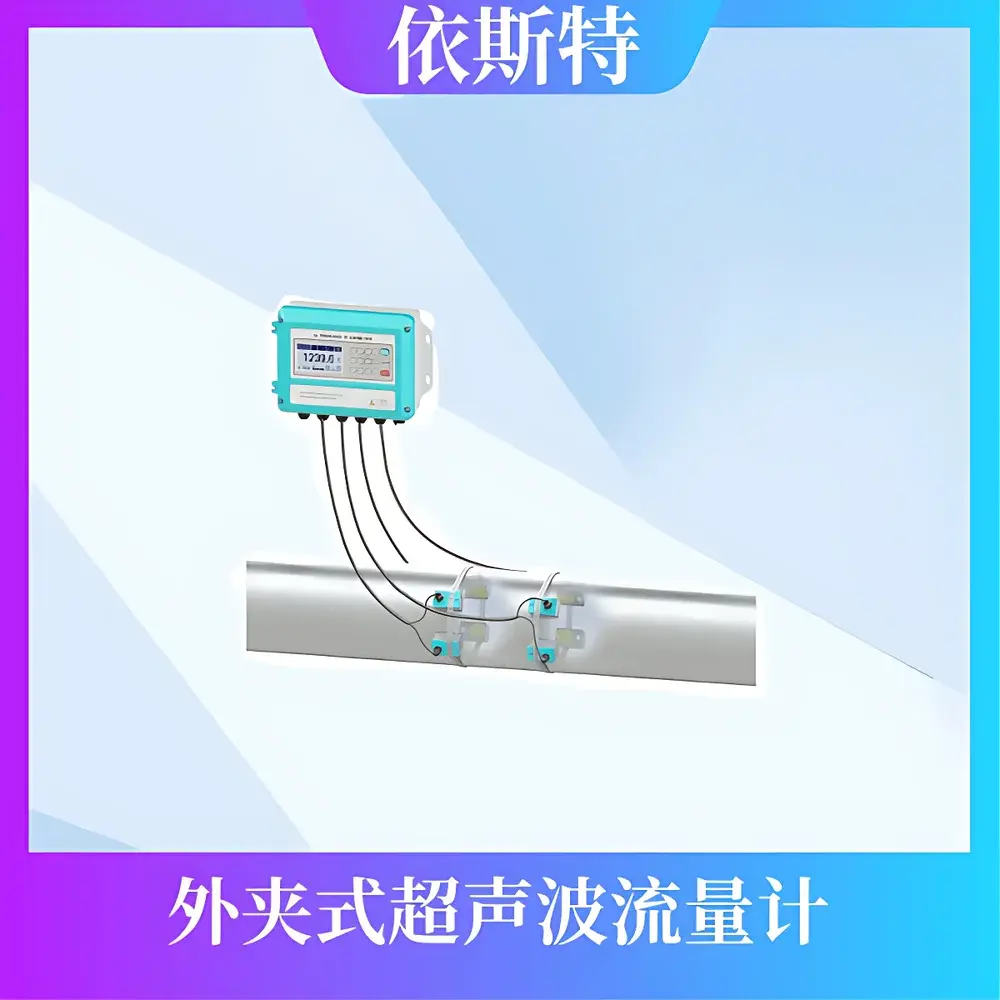
The YST Ultrasonic Flow Meter YST305TBCS1 is a clamp-on, four-path transit-time ultrasonic flowmeter engineered for non-intrusive, high-reliability liquid flow measurement in industrial and municipal infrastructure. Unlike inline or insertion-type devices, it operates by transmitting and receiving ultrasonic pulses across the pipe wall—measuring the time-of-flight difference between upstream and downstream paths to calculate average axial velocity. This principle eliminates pressure drop, mechanical wear, and process interruption, making it ideal for permanent monitoring of large-diameter pipelines carrying potable water, cooling water, crude oil, light hydrocarbons, and industrial effluents. Its four independent acoustic paths—arranged in a cross-diagonal configuration—provide spatial averaging across the pipe’s velocity profile, significantly reducing sensitivity to flow disturbances, asymmetry, and partial blockages. Designed for continuous operation in harsh environments, the YST305TBCS1 supports long-term stability without recalibration under varying thermal and hydraulic conditions.
Key Features
- Non-invasive installation: Sensors mount externally using ultrasonic coupling gel; no pipe cutting, welding, or process shutdown required.
- Four-path transit-time architecture: Dual pairs of transducers generate orthogonal acoustic paths, enabling robust velocity profiling and enhanced signal redundancy.
- Wide applicability: Compatible with carbon steel, stainless steel, PVC, HDPE, cast iron, and other acoustically conductive pipe materials.
- High-temperature capability: Transducer design and thermal compensation algorithms ensure metrological integrity from −40 °C to +150 °C.
- Integrated local display: Backlit QVGA LCD provides real-time visualization of instantaneous flow rate, totalized volume, flow direction, signal quality index, and diagnostic status.
- Dual analog outputs (4–20 mA) with configurable range and scaling, plus pulse output for totalization; optional RS485 interface compliant with Modbus RTU protocol for SCADA integration.
- Power flexibility: Accepts universal AC mains (90–240 VAC) or low-voltage DC (18–36 VDC), supporting both field-mounted and control-room installations.
Sample Compatibility & Compliance
The YST305TBCS1 is validated for use with liquids exhibiting sufficient acoustic impedance contrast relative to the pipe wall—specifically those with sound speed >1000 m/s and attenuation coefficient <10 dB/m at 1 MHz. Verified media include potable water, treated wastewater, glycol-water mixtures, diesel, kerosene, light crude oil, and aqueous chemical solutions. It is not suitable for highly aerated, heavily particulate-laden, or gaseous media. While not certified to IEC 61508 or SIL standards, the device meets electromagnetic compatibility requirements per IEC 61326-1 (industrial environment) and carries CE marking for EMC and LVD directives. Its measurement methodology aligns with principles outlined in ISO 6416 (acoustic flowmeters) and ASTM D7559 (transit-time ultrasonic flow measurement in pipes). For regulated applications requiring audit trails or data integrity, the optional Modbus-enabled firmware supports timestamped data logging compatible with GLP/GMP-aligned systems when integrated with validated host software.
Software & Data Management
The YST305TBCS1 includes embedded firmware with configurable data logging (up to 30 days of 1-minute interval records stored internally), alarm thresholds (e.g., low-flow, signal-loss, temperature deviation), and diagnostics including signal-to-noise ratio (SNR), path validity flags, and transducer health indicators. Configuration is performed locally via keypad navigation or remotely via Modbus register access. When connected to a supervisory system, flow data—including compensated volumetric flow, net/total accumulation, and diagnostic metadata—can be exported at user-defined intervals. The device supports standard engineering units (m³/h, L/min, GPM, etc.) and allows custom scaling for mass flow derivation when fluid density is known. No proprietary software is required for basic commissioning; however, YST provides a Windows-based PC utility (YST-ConfigTool v3.x) for advanced setup, firmware updates, and export of CSV-formatted logs—fully compatible with common data historians and analytics platforms.
Applications
- Municipal water distribution: Real-time monitoring of district metering areas (DMAs), leakage detection, and demand forecasting without service interruption.
- Industrial cooling circuits: Continuous verification of condenser water, chiller loop, and jacket water flow in power plants, refineries, and manufacturing facilities—especially where fouling or corrosion precludes intrusive meters.
- District heating networks: Bidirectional thermal energy metering in primary and secondary loops, supporting accurate billing and hydraulic balancing under variable temperature differentials.
- Wastewater treatment: Influent/effluent flow tracking, pump station performance analysis, and regulatory reporting compliance (e.g., EPA NPDES discharge monitoring).
- Oil & gas midstream: Custody transfer support for refined product pipelines and tank farm transfer lines where temporary or semi-permanent measurement is needed.
FAQ
Can the YST305TBCS1 measure bidirectional flow?
Yes—the transit-time differential calculation inherently supports reverse flow detection and quantification, with directional indication displayed and output via analog/pulse signals.
What is the minimum required straight pipe length upstream/downstream?
No straight-run requirement applies, as the meter does not disturb flow; however, optimal accuracy is achieved with ≥10D upstream and ≥5D downstream of disturbances (e.g., elbows, valves) to ensure developed flow profiles.
How often does the device require recalibration?
None—being a non-mechanical, physics-based instrument with no drift-prone components, it maintains factory calibration indefinitely unless physical damage or extreme environmental exposure occurs.
Is the sensor suitable for sub-zero ambient conditions?
Yes—the IP68-rated transducers are rated for continuous outdoor exposure down to −40 °C; coupling gel formulation must be selected for low-temperature service to maintain acoustic transmission.
Does the device support HART or Profibus communication?
No—only 4–20 mA analog outputs and Modbus RTU over RS485 are supported; HART or Profibus require external protocol converters.