YST Ultrasonic Insertion Flow Meter YST305SBCS1 for Cooling Water Systems
| Brand | YST (Dalian Yist) |
|---|---|
| Origin | Liaoning, China |
| Model | YST305SBCS1 |
| Medium | Cooling water, circulating water (homogeneous, single-phase, low-viscosity liquid |
| Pipe ID Range | DN50–DN3000 mm |
| Material Compatibility | Carbon steel, stainless steel, cast iron, PVC, PE (non-metallic wall thickness ≤20 mm) |
| Velocity Range | 0.1–10 m/s |
| Accuracy | ±1.0% linearity, ±0.5% repeatability (standard conditions) |
| Pressure Rating | ≤1.6 MPa |
| Operating Temperature (probe) | −20 °C to +80 °C |
| Power Supply | AC 220 V ±10% (50/60 Hz) or DC 24 V ±15% |
| Output Signals | 4–20 mA (load 250–750 Ω), RS485 (Modbus-RTU) |
| Display | Backlit LCD showing instantaneous flow, cumulative flow, velocity |
| Environmental Robustness | Vibration resistance (≤50 Hz, amplitude ≤0.1 mm), EMI immunity (electric field ≤10 V/m, magnetic field ≤100 A/m) |
Overview
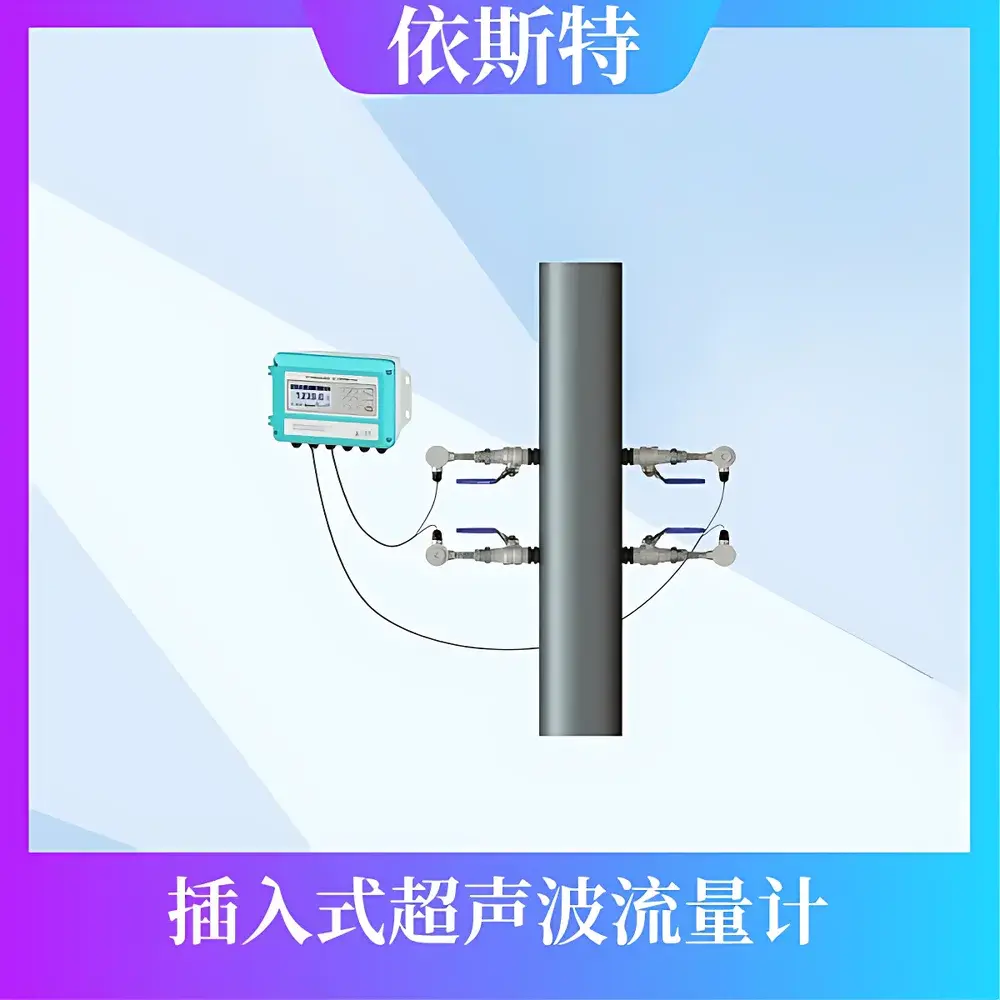
The YST Ultrasonic Insertion Flow Meter YST305SBCS1 is an engineered solution for non-intrusive, in-situ flow measurement of cooling and circulating water in industrial piping systems. It operates on the transit-time ultrasonic principle: two transducers are inserted into the pipe wall at a defined chordal path, emitting and receiving ultrasonic pulses upstream and downstream. The time difference between upstream and downstream propagation is directly proportional to the average axial velocity across the sound path. This velocity—corrected for pipe geometry, fluid temperature, and acoustic path angle—is used to compute volumetric flow rate with high reproducibility. Designed specifically for continuous monitoring in thermal management systems, the YST305SBCS1 eliminates the need for pipe cutting, flange removal, or process shutdown during installation—a critical advantage in power generation, chemical processing, HVAC, and manufacturing facilities where operational continuity is paramount.
Key Features
- True insertion design: Dual transducer probe assembly mounts through a single 18–22 mm drilled port; no spool piece, no bypass, no wetted moving parts.
- Zero pressure drop: Full-bore profile preserves hydraulic integrity—no throttling, no energy loss, no risk of cavitation or erosion-induced flow disturbance.
- Broad pipe compatibility: Validated for metallic pipes (carbon steel, stainless steel, cast iron) and non-metallic pipes (PVC, PE) with wall thickness ≤20 mm; accommodates DN50 to DN3000 (2″ to 118″) nominal diameters.
- Robust environmental rating: Probe housing constructed from 316 stainless steel and PEEK; IP68-rated electronics enclosure; qualified for vibration (IEC 60068-2-6, 50 Hz, 0.1 mm peak-to-peak) and electromagnetic interference (IEC 61326-1, Class B).
- Dual power flexibility: Supports both AC 220 V ±10% (50/60 Hz) and DC 24 V ±15%, enabling integration into legacy control panels or modern low-voltage instrumentation networks.
- Onboard intelligence: Integrated microprocessor performs real-time signal conditioning, temperature compensation (via optional RTD input), and automatic zero tracking; stores >8,760 hours of timestamped flow data locally.
Sample Compatibility & Compliance
The YST305SBCS1 is validated for clean to moderately conditioned cooling water and closed-loop circulating water—liquids that are homogeneous, single-phase, and exhibit kinematic viscosity ≤500 cP. It is not intended for slurries, aerated fluids, or liquids with >5% volumetric gas content or >100 mg/L suspended solids (per ISO 4064-1:2014 Annex C guidance). Installation requires acoustically coupled pipe walls with minimal internal scale or biofilm buildup; ultrasonic coupling gel and torque-controlled mounting ensure stable signal transmission. While not certified to specific international metrological standards (e.g., MID, OIML R49), its performance aligns with industry expectations for utility-grade monitoring per ANSI/HI 9.1–9.5 and ISO 17025-accredited calibration practices. For regulated environments (e.g., GMP-compliant utilities), the device supports audit-ready data export via Modbus-RTU and may be included in validation protocols under user-defined IQ/OQ/PQ documentation.
Software & Data Management
The YST305SBCS1 includes embedded firmware supporting local configuration via front-panel keypad and LCD menu navigation. All parameters—including damping time, flow unit, pipe material, wall thickness, and temperature compensation coefficients—are programmable without external tools. RS485 Modbus-RTU communication enables seamless integration with SCADA, DCS, or PLC systems (slave ID 1–247, baud rates 9600–115200 bps). The 4–20 mA analog output is fully scalable and linearized across the configured flow range, with HART-compatible digital overlay optionally available upon request. Historical data—comprising hourly averaged flow, velocity, and temperature—is retained in non-volatile memory for ≥12 months (circular buffer). Export is performed via serial dump or Modbus register readout; raw data conforms to CSV-compatible timestamped format (YYYY-MM-DD HH:MM:SS, L/min, m/s, °C) for import into Excel, PI System, or historian platforms. No proprietary software license or cloud dependency is required.
Applications
- Real-time monitoring of condenser cooling water circuits in fossil-fuel and nuclear power plants.
- Flow verification and balancing of chiller plant distribution loops in commercial HVAC infrastructure.
- Energy efficiency audits of industrial cooling towers and heat exchanger networks.
- Leak detection and system integrity verification in large-diameter municipal or campus cooling water mains.
- Process cooling water allocation tracking in multi-line chemical reactors and extrusion lines.
- Baseline flow profiling prior to retrofitting variable-frequency drive (VFD) controls on cooling pumps.
FAQ
Does the YST305SBCS1 require pipe shutdown for installation?
No. Installation uses a hot-tap drilling tool to create a 18–22 mm access port while the pipe remains pressurized and flowing. The probe is then inserted and sealed using a compression fitting and high-temperature EPDM gasket.
Can it measure flow in lined or insulated pipes?
Yes—provided the liner material is acoustically transparent (e.g., epoxy, rubber ≤3 mm thick) and insulation is removed locally around the transducer mounting zone. Ultrasonic coupling must occur directly between transducer and pipe wall.
Is temperature compensation mandatory?
Not mandatory, but strongly recommended. The device accepts optional Pt100 RTD input for real-time speed-of-sound correction, improving accuracy by up to 0.3% in systems with >10 °C inlet/outlet temperature variation.
What maintenance is required?
Annual visual inspection of probe seal integrity and cleaning of transducer faces with isopropyl alcohol. No recalibration is needed unless mechanical damage occurs or pipe geometry changes significantly (e.g., heavy scaling, internal coating).
How does it handle low-flow conditions below 0.3 m/s?
The meter maintains measurement capability down to 0.1 m/s using adaptive signal averaging and noise-rejection algorithms; however, uncertainty increases above ±3.0% at velocities <0.2 m/s due to boundary layer effects and turbulence attenuation—consistent with ISO/TR 11379:2020 guidance for insertion-type ultrasonics.