
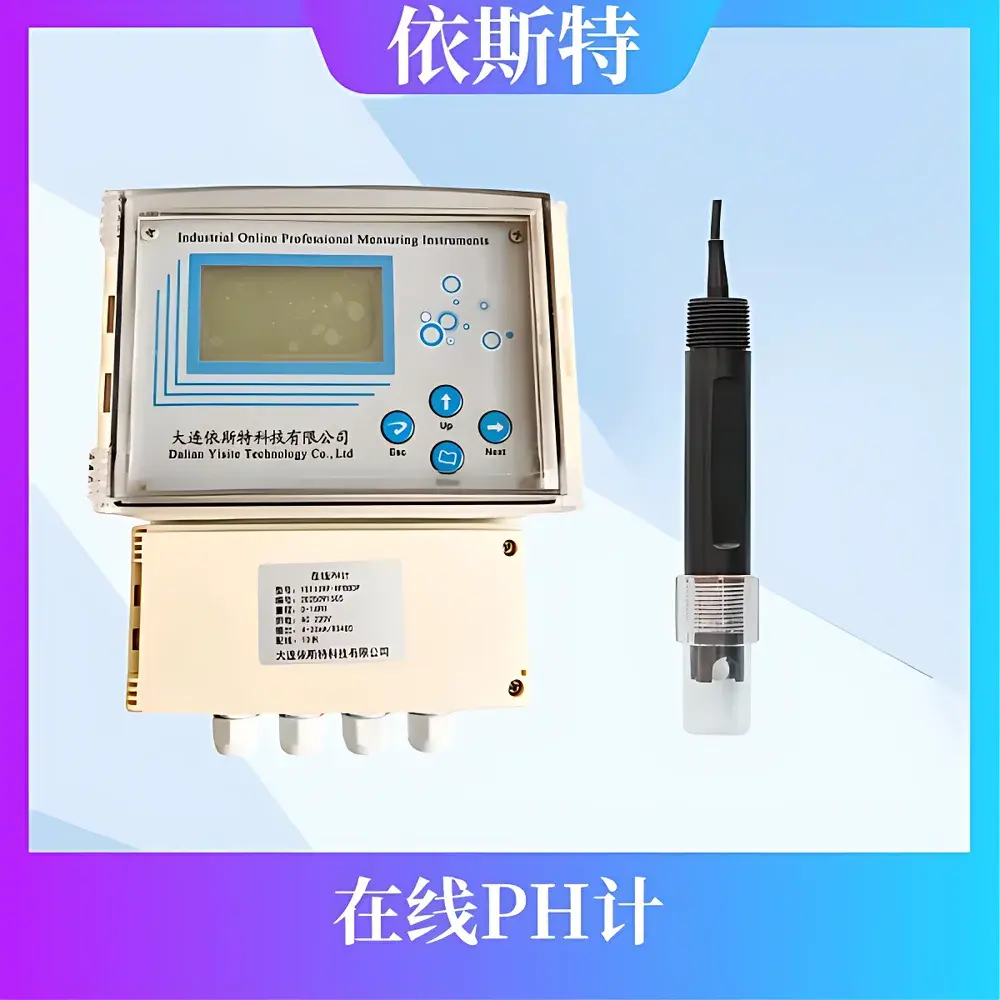
YST109B-HP880 Hospital Wastewater pH Monitor
| Brand | YST (Dalian Yist) |
|---|---|
| Model | YST109B-HP880 |
| Measurement Range | pH 0.00–14.00 |
| Accuracy | ±0.1 pH |
| Resolution | 0.01 pH |
| Temperature Compensation | 0–60 °C (Automatic) |
| Power Supply | DC 12 V |
| Power Consumption | ≤1 W |
| Protection Rating | IP65 |
| Operating Temperature | −10 °C to 50 °C |
| Communication Protocol | RS485 Modbus-RTU |
Overview
The YST109B-HP880 Hospital Wastewater pH Monitor is an industrial-grade, panel-mount or submersible-capable electrochemical analyzer engineered specifically for continuous pH monitoring in healthcare wastewater streams. Unlike general-purpose laboratory or municipal pH meters, this instrument integrates robust sensor architecture and application-tuned signal conditioning to maintain measurement integrity amid complex, variable matrices—such as hospital effluent containing residual pharmaceuticals, disinfectants (e.g., chlorine derivatives), organic metabolites, and suspended solids. Its core sensing principle relies on a glass electrode paired with a stable Ag/AgCl reference system, calibrated per ISO 7888 and ASTM D1293 standards for aqueous pH determination. Designed for integration into existing treatment infrastructure—including equalization tanks, neutralization basins, and pre-disinfection points—the YST109B-HP880 delivers traceable, repeatable pH data under real-world operational conditions where conventional sensors often drift or foul.
Key Features
- High-stability pH electrode with reinforced glass membrane and double-junction reference design to resist poisoning from sulfides, heavy metals, and oxidizing agents commonly present in medical wastewater
- Integrated automatic temperature compensation (ATC) using a Pt1000 thermistor, compliant with NIST-traceable thermal response curves across 0–60 °C
- 4.3-inch sunlight-readable capacitive touch display with intuitive menu navigation, supporting one-button calibration (2-point or 3-point) and real-time trend visualization
- Modular sensor head design enables field-replacement without recalibration of the transmitter unit—reducing downtime and service labor costs
- Housing constructed from UV-stabilized ABS/PC blend with IP65 ingress protection, certified for indoor/outdoor wall-mount or conduit-box installation near wet locations
- Low-power DC 12 V operation (≤1 W) suitable for battery-backed or solar-assisted remote monitoring configurations
Sample Compatibility & Compliance
The YST109B-HP880 is validated for use with heterogeneous, non-homogeneous wastewater streams typical of hospitals, clinics, and diagnostic centers—where influent composition fluctuates diurnally due to surgical schedules, radiopharmaceutical administration, and cleaning cycles. It meets CE marking requirements for electromagnetic compatibility (EN 61326-1) and safety (EN 61010-1). While not intended for potable water or ultra-pure process streams, its electrode chemistry and flow-independent design ensure reliable performance in low-to-moderate conductivity samples (200–5000 µS/cm), including chlorinated effluents up to 5 mg/L free chlorine residual. Data logging functionality supports audit readiness under local environmental regulatory frameworks, including China’s HJ 212–2017 emissions monitoring protocol and aligns with functional prerequisites for GLP-aligned facility reporting systems.
Software & Data Management
Data output conforms to Modbus-RTU over RS485 (two-wire, half-duplex), enabling seamless integration with programmable logic controllers (PLCs), distributed control systems (DCS), SCADA platforms, and cloud-based environmental management software (EMS). The device buffers up to 1,000 timestamped records—including pH values, temperature readings, calibration events, and alarm triggers—with configurable storage intervals (1 min to 24 h). All stored entries include UTC timestamps and CRC-16 checksums to ensure data integrity. Alarm outputs support dry-contact relay activation (NO/NC) for interlocking with chemical dosing pumps or supervisory notification systems. Though the unit does not implement FDA 21 CFR Part 11-compliant electronic signatures or audit trails internally, its raw data export capability allows full traceability when interfaced with validated third-party data acquisition servers operating under GxP-aligned validation protocols.
Applications
- Real-time pH monitoring at hospital wastewater equalization tank outlets to optimize lime or acid dosing prior to biological treatment or UV disinfection
- Regulatory compliance verification at discharge points subject to local environmental authority permits (e.g., pH 6.0–9.0 limits per GB 18466–2005)
- Trend analysis of diurnal pH variation correlated with clinical activity logs to identify operational inefficiencies or upstream contamination events
- Preventive maintenance scheduling based on electrode impedance drift detection and calibration history tracking
- Integration into centralized hospital facility management systems (FMS) for cross-system KPI dashboards covering water, energy, and waste metrics
FAQ
Is the YST109B-HP880 suitable for continuous submersion in untreated hospital sewage?
Yes—when equipped with the optional extended-length sensor cable and stainless-steel protective guard, it supports long-term immersion in aerated or quiescent wastewater environments. However, periodic mechanical cleaning of the glass bulb is recommended every 7–14 days depending on suspended solids load.
Does the device support automatic buffer recognition during calibration?
No—it requires manual selection of standard buffer pH values (e.g., 4.01, 7.00, 10.01) but stores calibration coefficients with date/time stamps and operator ID fields for internal recordkeeping.
Can historical data be exported via USB or Ethernet?
Data export is serial-only via RS485; external USB or Ethernet connectivity requires a protocol gateway or middleware server configured for Modbus-to-TCP bridging.
What is the expected service life of the pH electrode under typical hospital wastewater conditions?
With routine cleaning and proper storage during shutdowns, the electrode demonstrates ≥12 months of stable performance before requiring replacement—validated through accelerated fouling tests per ISO 15197 Annex C methodologies.
Is firmware upgrade supported remotely?
Firmware updates require local physical access using a dedicated configuration tool and UART interface; no over-the-air (OTA) update capability is implemented.
Related Products



