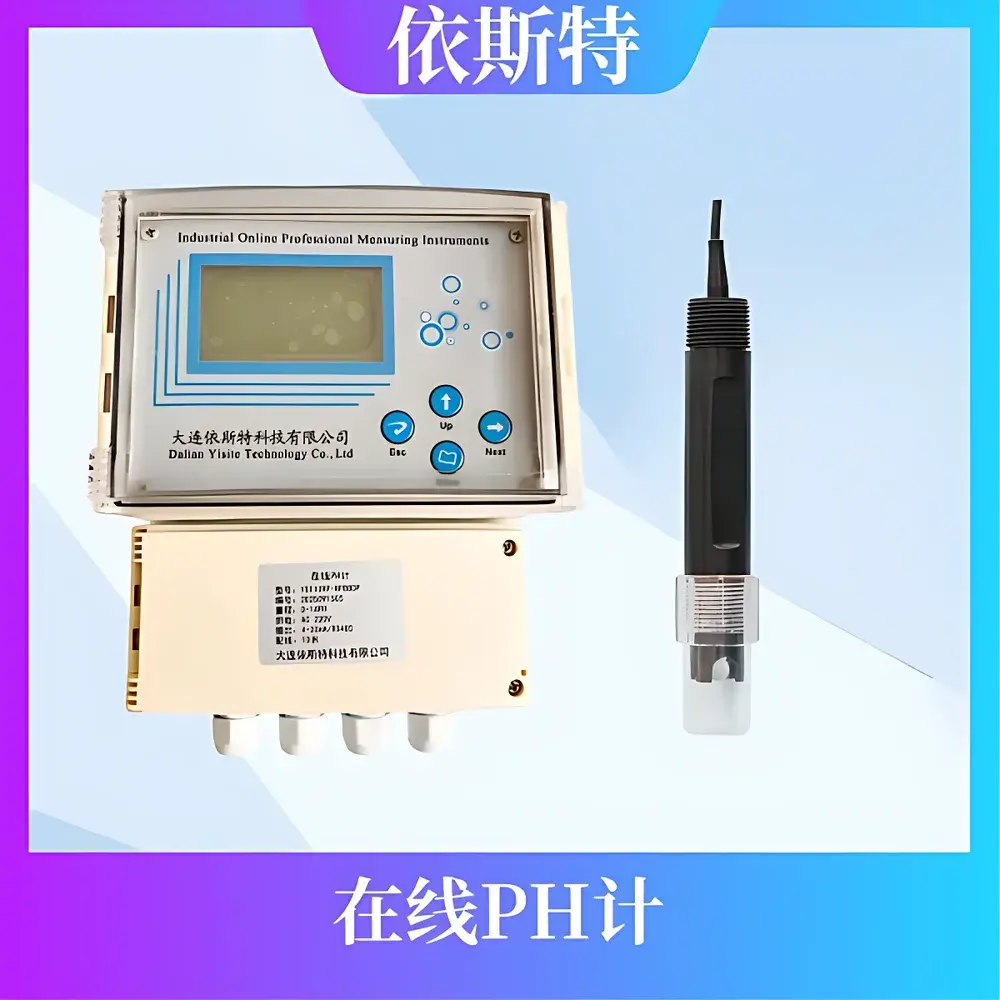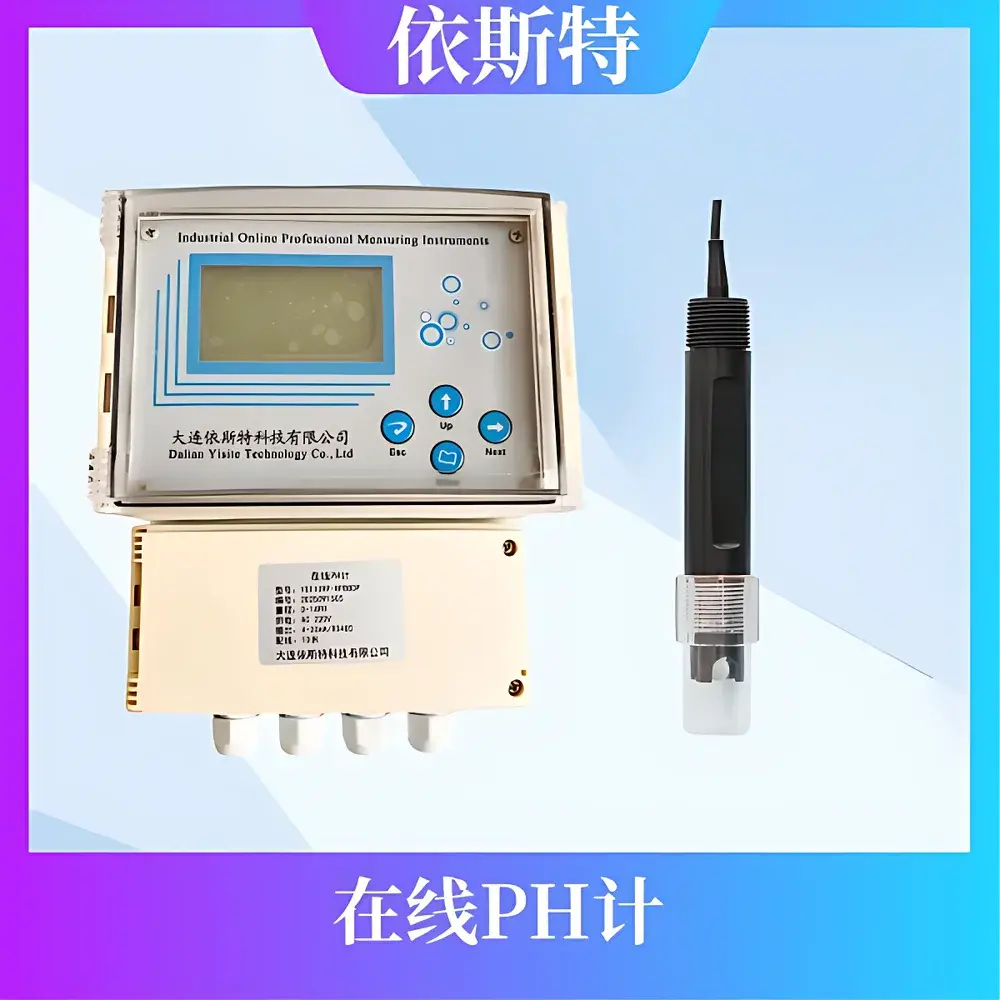
YST109B-HP880 Online pH Meter for Wastewater Monitoring
| Brand | YST (Dalian Yist Instrument Co., Ltd.) |
|---|---|
| Origin | Liaoning, China |
| Model | YST109B-HP880 |
| Measuring Range | pH 0–14 (optimized for wastewater: pH 2–12) |
| Temperature Compensation | 0–100 °C (automatic) |
| Output Signals | 4–20 mA analog + RS485 digital (Modbus RTU) |
| Power Supply | AC 220 V ±10% / 50 Hz or DC 24 V (optional) |
| Installation Types | Immersion, Flow-through, Insertion |
| Sensor IP Rating | IP68 |
| Transmitter IP Rating | IP65/IP67 |
| Response Time | ≤3 s (to 90% of final value) |
| Sensor Housing Material | 316L stainless steel & PTFE |
| Electrode Options | Glass electrode or solid-state electrode |
Overview
The YST109B-HP880 Online pH Meter is an industrial-grade process analytical instrument engineered for continuous, real-time monitoring of pH in municipal and industrial wastewater streams. Designed according to the operational demands of biological treatment units, equalization tanks, neutralization basins, and effluent discharge points, it employs a potentiometric measurement principle based on the Nernst equation—detecting hydrogen ion activity via a reference-electrode–sensing-electrode pair immersed directly in flowing or static wastewater. Unlike laboratory-grade benchtop meters, the YST109B-HP880 integrates robust sensor architecture with adaptive signal conditioning to maintain accuracy under high-turbidity, high-suspended-solid, and chemically aggressive conditions typical of raw sewage and mixed industrial effluents. Its dual-output interface (4–20 mA analog + Modbus RTU over RS485) ensures seamless integration into existing DCS, SCADA, or PLC-based control systems without requiring protocol gateways.
Key Features
- Wastewater-optimized sensing: Calibrated and validated for stable operation within pH 2–12—the critical range encountered in anaerobic digesters, activated sludge basins, and chemical precipitation stages.
- Automatic temperature compensation (ATC): Built-in Pt1000 or thermistor-based thermal sensing enables real-time correction across 0–100 °C, minimizing drift caused by seasonal or process-induced thermal fluctuations.
- Dual-electrode configuration support: Compatible with both traditional glass-bodied pH electrodes (for high-precision applications) and maintenance-free solid-state electrodes (for high-fouling or abrasive environments).
- IP68-rated sensor probe: Hermetically sealed 316L stainless steel body combined with chemically inert PTFE junction and diaphragm resists corrosion from sulfides, chlorides, heavy metals, and organic solvents.
- Sub-3-second response time: Achieves ≥90% of final reading within 3 seconds under standard flow conditions (≥0.3 m/s), enabling timely feedback for automated dosing control loops.
- Flexible mounting options: Supports immersion (submersible), insertion (into pipe spool pieces), and flow-cell configurations—enabling adaptation to retrofit or greenfield installations without process interruption.
Sample Compatibility & Compliance
The YST109B-HP880 is validated for use in heterogeneous, non-homogeneous aqueous matrices containing suspended solids (>500 mg/L), oils, grease, and particulate matter up to 2 mm in diameter. Its anti-clogging junction design mitigates electrolyte contamination and reference potential drift commonly observed in conventional gel-filled electrodes. While not certified to IEC 61508 (SIL) or ATEX/IECEx for hazardous areas, the transmitter complies with electromagnetic compatibility standards per IEC 61326-1 (industrial environment) and safety requirements per IEC 61010-1. It supports audit-ready data logging when paired with compatible SCADA historians and meets foundational traceability requirements for ISO/IEC 17025-aligned wastewater laboratories performing method validation per ASTM D1293 or ISO 10523.
Software & Data Management
The device operates autonomously without embedded firmware-based software; instead, it delivers calibrated, linearized pH and temperature values as analog current or discrete Modbus registers (e.g., Holding Register 40001 = pH × 100, 40002 = temperature × 10). When integrated into enterprise-level platforms (e.g., Siemens Desigo CC, Honeywell Experion PKS, or open-source Grafana + MQTT), it supports long-term trend analysis, alarm thresholding (e.g., pH < 6.2 or > 8.5), and automated calibration event logging. Though it does not implement FDA 21 CFR Part 11-compliant electronic signatures or audit trails natively, its deterministic output behavior and timestamped register reads enable third-party validation for GLP/GMP-aligned environmental monitoring programs where raw sensor data is archived alongside operator annotations.
Applications
- Real-time pH feedback control in aerobic/anaerobic bioreactors to sustain optimal microbial metabolism and prevent nitrification inhibition.
- Neutralization process monitoring in electroplating, pharmaceutical, and food processing wastewater pretreatment lines.
- Effluent compliance verification prior to discharge—supporting regulatory reporting under EPA NPDES permits or EU Urban Wastewater Treatment Directive (91/271/EEC).
- Early detection of upstream process upsets (e.g., acid spill events, caustic cleaning rinseback) through rapid deviation alerts.
- Performance benchmarking of lime, NaOH, or CO₂ dosing systems via correlation of pH response dynamics with reagent feed rates.
FAQ
What electrode types are supported by the YST109B-HP880?
It accepts standard BNC or DIN-type connectors for both refillable glass electrodes and factory-sealed solid-state electrodes. Electrode selection should be guided by fouling risk: glass electrodes offer higher initial accuracy (<±0.05 pH), while solid-state variants provide extended service intervals in high-sulfide or high-silica environments.
Is automatic calibration available?
No—calibration requires manual two-point (e.g., pH 4.01 and 7.00) or three-point (adding pH 10.01) procedures using certified buffer solutions. However, the transmitter stores calibration coefficients and retains them during power cycles.
Can the device operate in pressurized pipelines?
Yes—when installed via threaded insertion fittings (e.g., 3/4″ NPT) into pressurized mainlines up to 10 bar, provided the sensor tip remains fully wetted and flow velocity exceeds 0.2 m/s to prevent boundary layer stagnation.
How often should maintenance be performed?
Under typical municipal wastewater conditions, visual inspection and junction cleaning are recommended every 3–6 months; electrode replacement intervals range from 6–24 months depending on chemical exposure and cleaning frequency.
Does the transmitter support HART communication?
No—only 4–20 mA analog output and RS485 Modbus RTU are implemented. HART-capable variants are not part of the YST109B-HP880 product line.
Related Products