
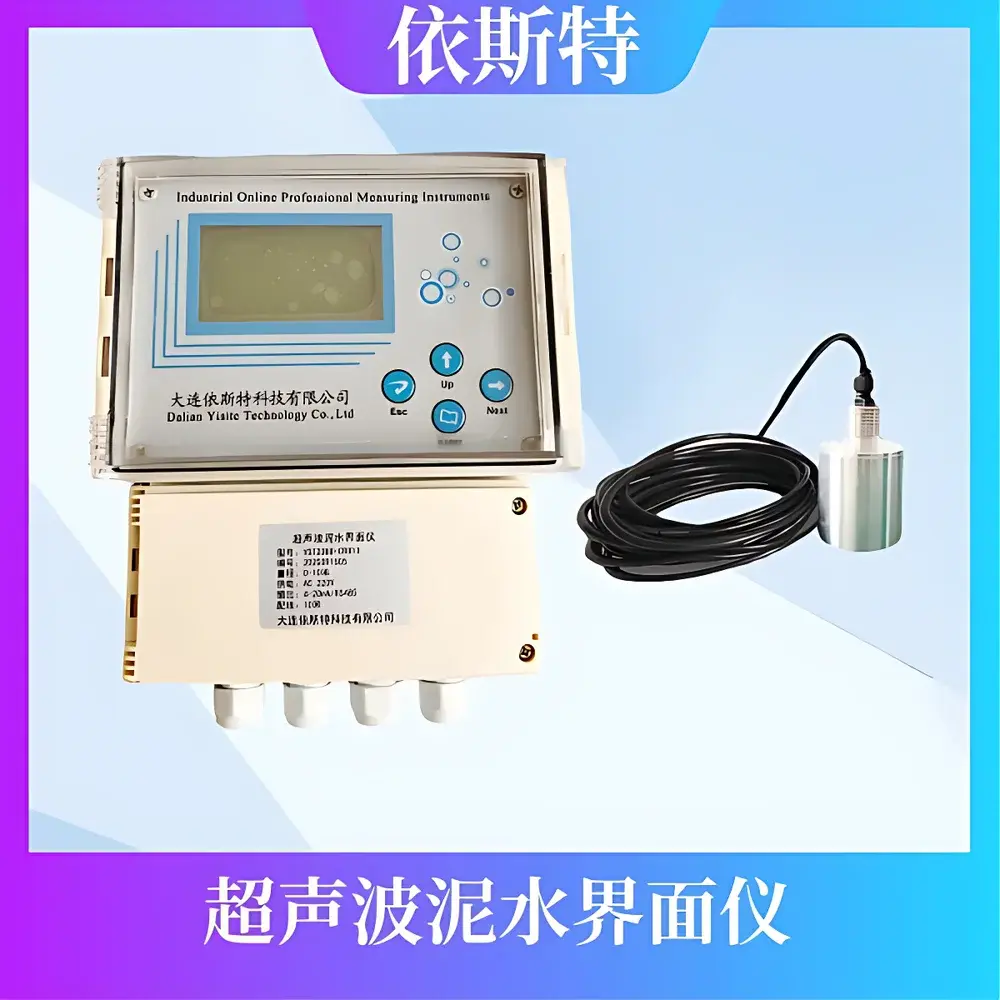
YST208B-CR810 Ultrasonic Sludge Blanket Level Monitor
| Brand | YST (Dalian Yist Instruments) |
|---|---|
| Origin | Liaoning, China |
| Model | YST208B-CR810 |
| Measuring Range | 0.2–10 m (customizable) |
| Power Supply | AC 220 V ±10% or DC 24 V |
| Output Signals | 4–20 mA analog, RS485 digital |
| Sensor IP Rating | IP68 |
| Host IP Rating | IP65 |
| Sensor Operating Temperature | −10 to 60 °C |
| Host Operating Temperature | 0 to 50 °C |
| Mounting Options | Top-mounted, side-mounted, submersible |
Overview
The YST208B-CR810 Ultrasonic Sludge Blanket Level Monitor is an industrial-grade, non-invasive level sensing instrument engineered for continuous, real-time determination of the sludge–supernatant interface in clarifiers, thickeners, and sedimentation basins. It operates on the principle of time-of-flight ultrasonic echo detection: a transducer emits high-frequency acoustic pulses downward into the liquid column; the time delay between emission and reception of the reflected signal from the density discontinuity at the sludge blanket surface is converted into distance using calibrated sound velocity—compensated in real time by an integrated temperature sensor. This physics-based measurement approach eliminates reliance on manual sampling or optical methods vulnerable to turbidity, floc size variation, or suspended solids interference. Designed for integration into municipal and industrial water/wastewater treatment processes, the YST208B-CR810 delivers repeatable interface position data with sub-centimeter resolution under dynamic hydraulic conditions—supporting automated sludge withdrawal control, process optimization, and regulatory compliance reporting.
Key Features
- Real-time sludge blanket level monitoring with automatic temperature-compensated sound velocity correction, ensuring accuracy across varying water temperatures (−10 to 60 °C)
- Dual cleaning mechanism: integrated ultrasonic vibration and high-pressure water jetting to prevent biofilm and viscous sludge adhesion on the transducer face—extending maintenance intervals to quarterly cycles
- Flexible installation architecture: supports top-mount, side-mount, and fully submersible configurations to accommodate diverse tank geometries and retrofit requirements
- Robust environmental protection: IP68-rated sensor housing for permanent underwater operation; IP65-rated host enclosure suitable for humid, dusty control room or outdoor cabinet environments
- Multi-protocol output interface: simultaneous 4–20 mA analog output for PLC/DCS analog input cards and Modbus RTU over RS485 for digital telemetry and SCADA integration
- On-device data logging: internal memory retains ≥12 months of timestamped level readings at user-configurable intervals (e.g., 1–60 minute sampling), enabling retrospective analysis without external historian dependency
Sample Compatibility & Compliance
The YST208B-CR810 is validated for use in heterogeneous aqueous media typical of secondary clarifiers, gravity thickeners, dissolved air flotation (DAF) units, and potable water coagulation-sedimentation basins. It maintains stable performance in suspensions containing organic flocs, inorganic precipitates (e.g., iron/manganese hydroxides), and mixed liquor with total suspended solids (TSS) concentrations up to 30,000 mg/L. While not certified to IEC 61508 or SIL standards out-of-the-box, its hardware architecture and firmware design align with functional safety principles for Category B equipment per IEC 61511. Data integrity complies with GLP-aligned practices: all logged values include UTC timestamps, sensor health flags, and calibration status metadata. The device supports audit-trail-ready operation when interfaced with FDA 21 CFR Part 11–compliant SCADA systems via secure Modbus TCP gateways.
Software & Data Management
The monitor operates autonomously without proprietary PC software; configuration and diagnostics are performed via local LCD with multilingual (English/Chinese) menu navigation and intuitive parameter setup. All operational parameters—including measurement range, alarm thresholds, cleaning cycle timing, and output scaling—are stored in non-volatile memory with write-protection against accidental overwrite. RS485 communication enables seamless integration into industry-standard platforms including Ignition SCADA, Siemens Desigo CC, and Schneider EcoStruxure. Historical datasets export as CSV via USB or Modbus register readout, preserving ISO 8601 timestamps and unit-annotated fields (e.g., “Level_mm”, “Temp_C”, “Signal_Quality_%”). Optional MQTT publishing modules (firmware v2.3+) allow cloud ingestion into AWS IoT Core or Azure IoT Hub for AI-driven anomaly detection and predictive maintenance modeling.
Applications
- Municipal wastewater treatment: Real-time interface tracking in final clarifiers to trigger automated scraper arm activation and optimize return activated sludge (RAS) flow rates
- Industrial effluent management: Monitoring sludge accumulation in oil-water separators and metal hydroxide precipitation tanks to prevent overflow and ensure discharge compliance
- Potable water production: Quantifying矾花 (floc) blanket depth in lamella settlers and circular clarifiers to dynamically adjust coagulant dosing and improve turbidity removal efficiency
- Biofilm reactor monitoring: Detecting scum layer formation in MBR membrane tanks and controlling surface skimming cycles to maintain flux stability
- Resource recovery facilities: Guiding thickener underflow concentration control in anaerobic digestion feed preparation to maximize biogas yield and minimize polymer consumption
FAQ
What is the minimum detectable sludge blanket thickness?
The device resolves interface position changes ≥5 mm; however, reliable detection requires a minimum density gradient across the interface—typically achieved when sludge concentration exceeds 1,500 mg/L TSS.
Can the sensor be installed in stainless steel or concrete tanks with curved walls?
Yes—top-mount and side-mount configurations accommodate both flat and curved surfaces; acoustic beam divergence (±6° half-angle) ensures robust signal return even with minor misalignment.
Does the system support remote firmware updates?
Firmware updates require physical USB connection or local RS485 access; over-the-air (OTA) updates are not supported in current hardware revision.
Is calibration required after initial installation?
Factory calibration is traceable to NIST-accredited ultrasonic transit-time standards; field verification using known reference depths is recommended annually or after mechanical impact.
How does the device handle air bubbles or surface foam?
Advanced signal processing filters reject transient echoes from entrained air; persistent foam layers >2 cm thick may attenuate signal strength—side-mount installation is advised in such cases.
Related Products







