
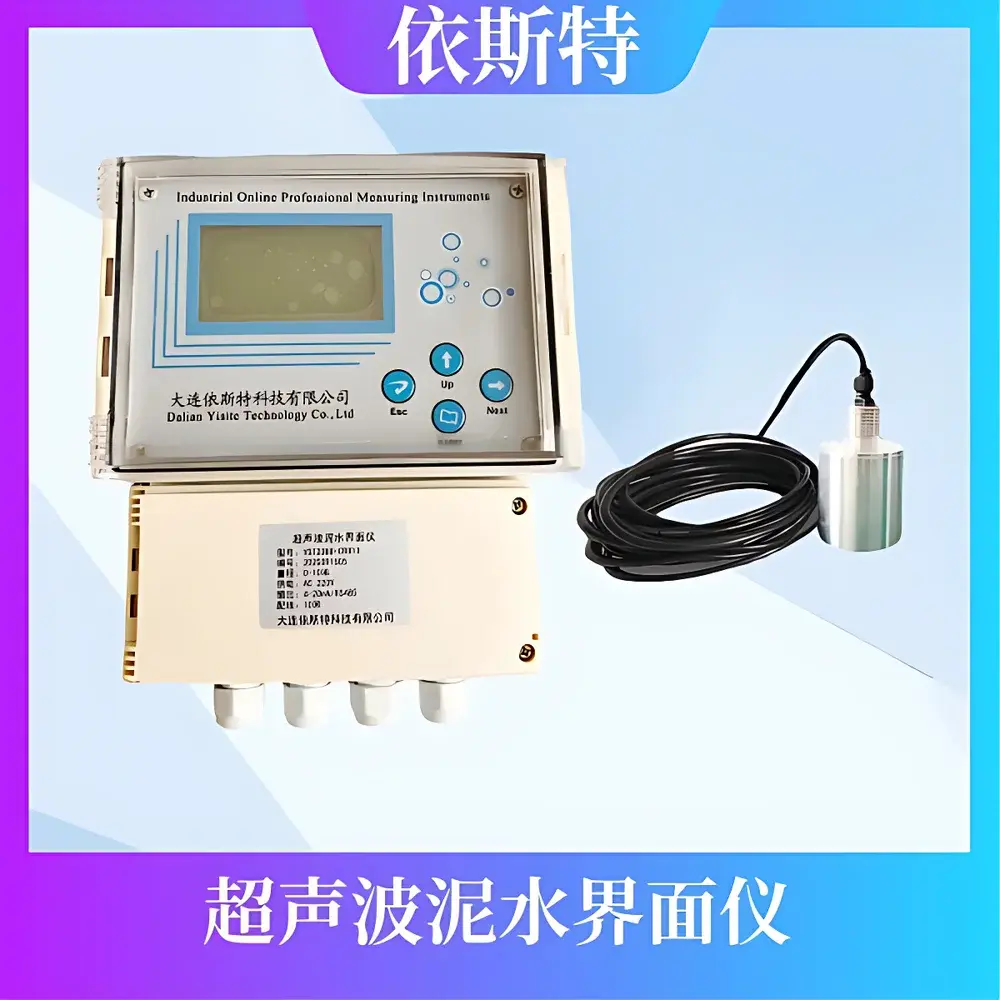
YST208B-CR810 Ultrasonic Sludge Blanket Level Monitor
| Brand | YST (Dalian Yist Environmental Technology Co., Ltd.) |
|---|---|
| Origin | Liaoning, China |
| Model | YST208B-CR810 |
| Measuring Range | 0.5–20 m (sensor-dependent) |
| Accuracy | ±0.5% to ±1% FS |
| Resolution | 1 mm |
| Display | Bilingual LCD with trend graph |
| Output Signals | 4–20 mA analog, RS485/Modbus RTU digital |
| Alarm Outputs | 2–4 relay channels (5 A / 250 VAC) |
| Power Supply | AC 220 V ±10% or DC 12–24 V |
| Power Consumption | <5 W |
| Enclosure Rating | IP65 (main unit), IP68 (sensor) |
| Housing Material | ABS/aluminum (unit), 304/316L stainless steel (sensor) |
| Standard Cable Length | 10 m (customizable) |
Overview
The YST208B-CR810 Ultrasonic Sludge Blanket Level Monitor is an industrial-grade interface detection system engineered for continuous, non-invasive measurement of the sludge-water interface in municipal wastewater treatment clarifiers and sedimentation tanks. It operates on the principle of time-of-flight ultrasonic echo analysis: a high-frequency transducer emits acoustic pulses vertically into the liquid column; the time delay between transmission and reception of the reflected signal—originating at the acoustic impedance discontinuity between clarified supernatant and suspended sludge—is converted into precise distance-to-interface values. This method enables real-time quantification of sludge blanket depth without physical contact or moving parts, eliminating mechanical wear and reducing calibration drift. Designed specifically for harsh, variable-density effluent environments—including those containing suspended solids, microbubbles, and turbulent flow—the instrument employs adaptive signal processing algorithms to suppress noise and maintain measurement integrity under fluctuating hydraulic and thermal conditions.
Key Features
- Multi-configuration deployment: Supports both immersion-mounted and non-contact (top-mounted) installation modes—enabling flexible integration into circular, rectangular, or radial-flow secondary clarifiers without structural modification. Minimum clearance from tank wall: 30 cm; avoidance of inlet jets and mechanical mixers ensures stable signal acquisition.
- Robust environmental tolerance: Sensor rated for continuous operation in water temperatures ranging from −10 °C to +70 °C and hydrostatic pressures up to 0.6 MPa. Main unit housing meets IP65 ingress protection standards for dust and water resistance, suitable for high-humidity, chemically aggressive plant environments.
- Intelligent maintenance mitigation: Integrated dual-mode cleaning system combines ultrasonic vibration (to disrupt biofilm adhesion) with optional high-pressure water flush capability—extending recommended maintenance intervals from monthly to quarterly under typical municipal sludge conditions.
- Dual-output architecture: Simultaneous provision of isolated 4–20 mA analog output (HART-compatible wiring) and RS485 serial interface compliant with Modbus RTU protocol, facilitating direct integration with PLCs, SCADA systems, and distributed control architectures.
- Local data resilience: Onboard non-volatile memory retains ≥1 year of timestamped interface depth records at user-configurable logging intervals (1 min to 1 h), supporting regulatory audit trails and process retrospective analysis.
Sample Compatibility & Compliance
The YST208B-CR810 is validated for use in activated sludge, extended aeration, and conventional primary/secondary clarifier applications where sludge blanket thickness ranges from 0.5 m to 20 m. Its measurement stability has been verified across mixed liquor suspended solids (MLSS) concentrations from 1,500 mg/L to 12,000 mg/L and in presence of entrained air bubbles (<5% volume fraction). While not certified to IEC 61508 or SIL standards, the device conforms to electromagnetic compatibility requirements per EN 61326-1 (industrial environment), and its analog output complies with NAMUR NE43 fault signaling conventions. Data storage and alarm event logging meet minimum requirements for GLP-aligned operational recordkeeping; optional time-synchronized logging supports alignment with ISO 9001 and ISO 14001 quality/environmental management documentation practices.
Software & Data Management
The embedded firmware supports local configuration via intuitive bilingual (English/Chinese) menu navigation on the backlit LCD display. All operational parameters—including damping factor, alarm thresholds, zero/span calibration offsets, and communication baud rate—are adjustable without external tools. Historical data export is enabled through Modbus register polling; third-party SCADA platforms can retrieve real-time interface depth, temperature compensation status, signal strength indicators, and diagnostic flags (e.g., “low SNR”, “probe fouling warning”). When interfaced with cloud-based water utility management platforms, latency remains ≤10 seconds end-to-end under standard TCP/IP network conditions. Audit logs capture all configuration changes with timestamps and operator ID fields (if authenticated via external authentication proxy), satisfying foundational traceability expectations under EPA 40 CFR Part 136 and EU Water Framework Directive reporting frameworks.
Applications
- Optimized sludge wasting control: Real-time interface tracking enables dynamic adjustment of return activated sludge (RAS) and waste activated sludge (WAS) pump duty cycles—reducing over-wasting and preventing sludge bulking incidents.
- Flocculation dosing optimization: In potable water treatment clarifiers, precise monitoring of floc blanket position allows closed-loop control of coagulant and flocculant feed rates, demonstrated to reduce chemical consumption by up to 8% annually.
- Process anomaly detection: Sudden interface displacement events—indicative of hydraulic shock loading, denitrification gas release, or septic conditions—are captured and trigger configurable relay alarms for operator intervention or automated diversion protocols.
- Regulatory compliance reporting: Long-term archived interface profiles support verification of sludge retention time (SRT) consistency and provide evidentiary data for discharge permit renewals and state-level NPDES reporting obligations.
FAQ
What is the maximum recommended installation depth for the sensor?
The standard sensor is rated for submersion up to 20 m depth. For installations exceeding 15 m, consult factory engineering for pressure-compensated transducer variants.
Can the device distinguish between multiple interfaces (e.g., scum layer, sludge blanket, and settled sludge)?
No. The YST208B-CR810 is optimized for single-interface detection—the primary sludge-water boundary. Multi-layer profiling requires specialized multi-frequency or pulsed-echo instrumentation.
Is the 4–20 mA output intrinsically safe for hazardous area installation?
Not by default. The unit does not carry ATEX, IECEx, or UL Class I Div 2 certification. Explosion-proof enclosures or safety barriers must be deployed externally if installed in classified zones.
Does the system support remote firmware updates?
Firmware upgrades require physical access and are performed via USB-to-serial adapter using proprietary configuration software provided under license agreement.
How frequently should zero-point calibration be performed?
Under stable installation conditions with clean probe surfaces, annual calibration verification is sufficient. More frequent checks are advised after mechanical impact, prolonged exposure to abrasive sludge, or following major process upsets.
Related Products







