
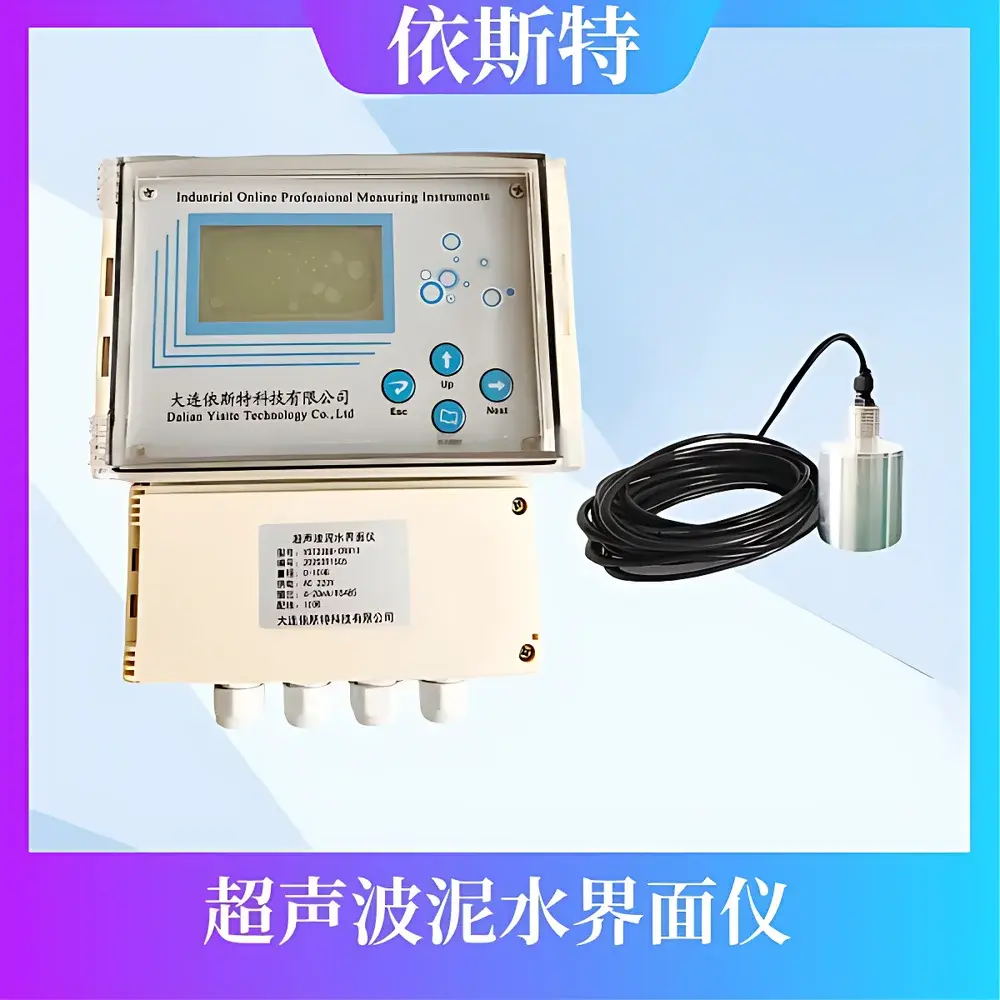
YST208B-CR810 Ultrasonic Sludge Blanket Level Monitor
| Brand | YST (Dalian Yist Instrument Co., Ltd.) |
|---|---|
| Origin | Liaoning, China |
| Model | YST208B-CR810 |
| Measuring Range | 0.2–10 m (expandable) |
| Accuracy | ±1% FS or ±5 mm (whichever is greater) |
| Resolution | 1 mm |
| Ultrasonic Frequency | 20–50 kHz |
| Operating Temperature (Sensor) | −10°C to +60°C |
| Enclosure Rating | Sensor IP68, Main Unit IP65 |
| Output Signals | 4–20 mA analog, RS485 digital |
| Power Supply | 220 V AC or 24 V DC |
Overview
The YST208B-CR810 Ultrasonic Sludge Blanket Level Monitor is an integrated, non-invasive level sensing instrument engineered for continuous, real-time detection of the sludge-water interface in clarifiers, thickeners, and sedimentation basins. It operates on the principle of time-of-flight ultrasonic echo measurement: a transducer emits low-frequency acoustic pulses (20–50 kHz) toward the liquid surface and suspended solids layer; the system calculates distance based on the elapsed time between pulse transmission and reflected echo reception. Unlike optical or conductivity-based methods, ultrasonic sensing remains unaffected by turbidity, color, chemical composition, or moderate surface foam—making it particularly suitable for municipal wastewater, industrial effluent, and dredging applications where media heterogeneity and fouling risk are high. The device integrates transducer, signal processing unit, display, and I/O interfaces into a single robust housing, eliminating field wiring complexity and minimizing calibration drift associated with multi-component systems.
Key Features
- Monolithic Design: Fully integrated sensor and electronics eliminate external cabling, junction boxes, and separate controllers—reducing installation time by >40% compared to conventional two-piece ultrasonic systems.
- Environmental Resilience: IP68-rated submersible transducer withstands immersion in aggressive wastewater matrices including sulfide-rich sludge, hydrocarbon-laden effluents, and mildly corrosive industrial streams; main unit rated IP65 for outdoor panel mounting or enclosure integration.
- Thermal Stability: Transducer operation certified from −10°C to +60°C ensures reliable performance across seasonal temperature swings in unheated clarifier weirs and open-air lagoons.
- Dual-Mode Output Architecture: Simultaneous 4–20 mA analog output (HART-compatible) and RS485 Modbus RTU digital interface enable seamless integration with PLCs, SCADA systems, and cloud-based telemetry platforms without signal conversion hardware.
- Intuitive Human-Machine Interface: Backlit LCD with bilingual (English/Chinese) menu navigation supports local commissioning, zero/span verification, and diagnostic status review without external software or configuration tools.
- Self-Diagnostic Capability: Built-in health monitoring reports transducer impedance anomalies, echo signal-to-noise ratio degradation, and power supply fluctuations—enabling predictive maintenance and reducing unplanned downtime.
Sample Compatibility & Compliance
The YST208B-CR810 is validated for use in heterogeneous aqueous suspensions containing suspended solids concentrations ranging from 50 mg/L (pre-settled effluent) to >30 g/L (activated sludge blankets). It maintains measurement integrity in media with dynamic density gradients, variable particle size distributions (0.1 µm–2 mm), and intermittent surface scum layers. While not certified to ISO/IEC 17025 for metrological traceability, its accuracy specification (±1% FS or ±5 mm) aligns with typical requirements for process control per ISO 5814 (water quality — determination of dissolved oxygen) and ASTM D3693 (standard guide for wastewater treatment plant instrumentation). The device supports audit-ready data logging when paired with compatible third-party controllers compliant with FDA 21 CFR Part 11 for electronic records and signatures in regulated environments.
Software & Data Management
No proprietary PC software is required for basic operation; all configuration is performed via front-panel navigation. However, optional firmware updates and extended diagnostics can be performed using standard terminal emulation software (e.g., PuTTY) over RS485. When connected to a Modbus-enabled historian or edge gateway, the instrument supports timestamped data streaming at user-defined intervals (1 s to 1 h). Local event logging—including interface height excursions beyond user-set thresholds, communication timeouts, and power interruptions—is retained in non-volatile memory for ≥30 days. Data export formats include CSV and JSON, facilitating ingestion into LIMS, asset management systems, or AI-driven anomaly detection models trained on historical sludge blanket dynamics.
Applications
- Secondary Clarifier Optimization: Real-time sludge blanket depth monitoring enables closed-loop control of underflow pumping rates, preventing sludge bulking and effluent turbidity spikes in activated sludge plants.
- Industrial Wastewater Thickeners: Continuous interface tracking in lamella settlers or gravity thickeners handling metal hydroxide sludges, phosphate precipitates, or organic coagulant flocs.
- Dredging & Sediment Surveying: Fixed-mount deployment in retention ponds or river channels to quantify accumulated sediment thickness pre- and post-dredging—supporting volume estimation and compliance reporting under EPA Method 1669 or ISO 11464.
- Sludge Digestion Monitoring: Interface level trending in anaerobic digesters to detect scum layer formation and optimize mixing cycles—reducing energy consumption and foaming incidents.
- Emergency Overflow Detection: Integration with alarm relays to trigger audible/visual alerts or automatic valve actuation when sludge blanket exceeds critical elevation thresholds.
FAQ
What is the minimum detectable sludge layer thickness?
The instrument resolves interface transitions ≥1 mm in vertical displacement; however, effective detection requires a measurable acoustic impedance contrast between supernatant and sludge layers—typically achieved at solids concentrations ≥1.5 g/L.
Can the transducer be mounted sideways in a pressurized pipe?
No. The YST208B-CR810 is designed for open-channel or tank-top mounting only. Side-mounting in pipes introduces multipath reflections and flow-induced turbulence that compromise echo fidelity.
Is calibration required after initial installation?
Factory calibration is stable over the full operating temperature range; field verification against a known reference level (e.g., calibrated dip tape or laser rangefinder) is recommended every 6 months for critical control loops.
Does the device support automatic cleaning mechanisms?
It is compatible with externally mounted ultrasonic or mechanical wiper systems controlled via dry-contact relay outputs—though such accessories are supplied separately.
How does the device handle surface foam or floating debris?
Low-frequency ultrasound (20–50 kHz) penetrates thin (<5 cm) biological foam layers; persistent thick scum may require periodic manual removal or installation of a foam-skimming pre-chamber to ensure consistent first-echo detection.
Related Products







