
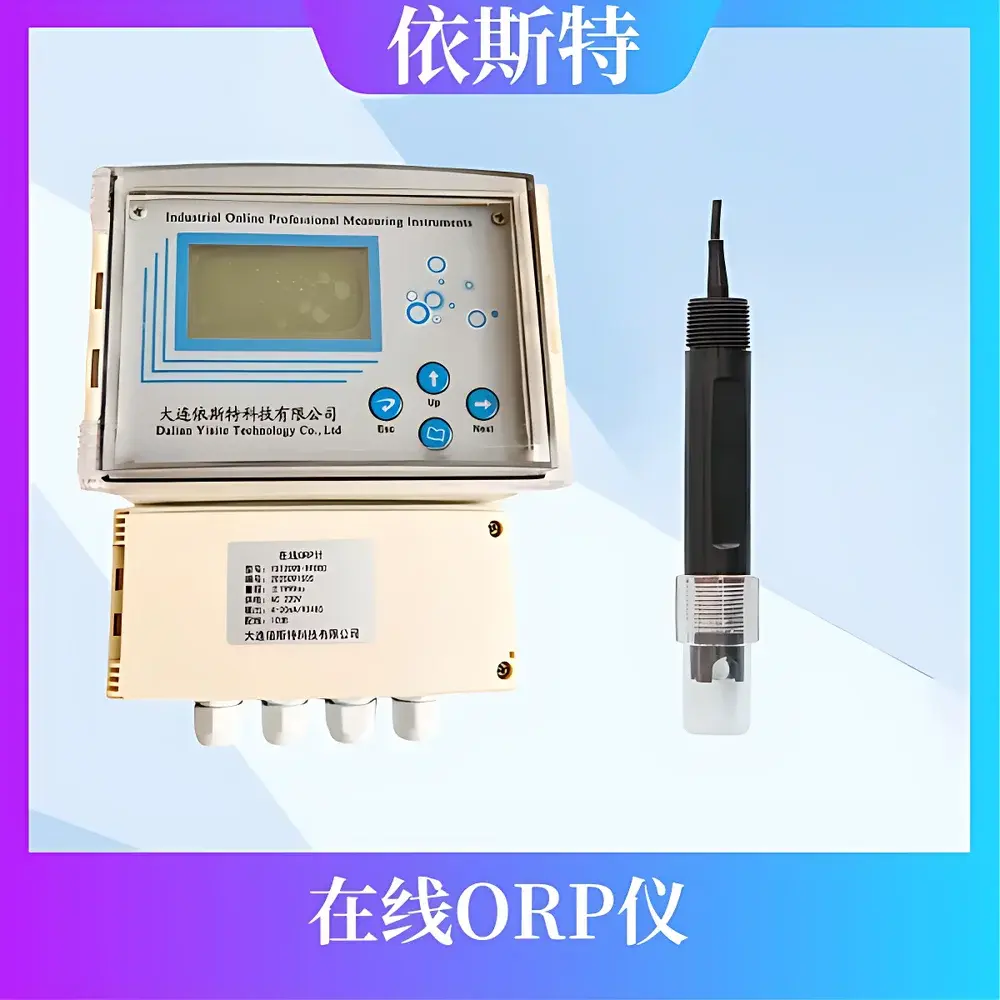
YST209B-RP880 Online ORP Monitor for Circulating Water Systems
| Brand | YST (Dalian Yist Instruments) |
|---|---|
| Origin | Liaoning, China |
| Model | YST209B-RP880 |
| Measurement Range | -1999 to +1999 mV |
| Accuracy | ±2 mV @ 25 °C |
| Response Time | ≤10 s (to 90% of final value) |
| Temperature Compensation | Automatic, 0–100 °C |
| Output Signals | Isolated 4–20 mA + RS485 digital interface |
| Sensor IP Rating | IP68 |
| Transmitter IP Rating | IP65 |
| Operating Ambient | 0–60 °C, ≤90% RH (non-condensing, away from strong magnetic fields) |
| Power Supply | 220 V ±10%, 50 Hz |
| Installation Type | Submersible (tank/pipeline) |
Overview
The YST209B-RP880 Online ORP Monitor is an industrial-grade electrochemical instrumentation system engineered for continuous, real-time monitoring of oxidation-reduction potential (ORP) in circulating water systems. Designed and manufactured by Dalian Yist Instruments, this device operates on the fundamental principle of potentiometric measurement: a galvanic cell formed between a platinum indicator electrode and a stable reference electrode (typically Ag/AgCl or calomel) generates a voltage proportional to the redox activity of the aqueous medium. This millivolt-level signal is conditioned, temperature-compensated using an integrated Pt100 or NTC thermistor, amplified, and converted into standardized analog and digital outputs. Unlike laboratory-based ORP meters, the YST209B-RP880 is purpose-built for unattended, long-term deployment in cooling towers, closed-loop HVAC systems, power plant condenser water circuits, and industrial process recirculation loops—environments where rapid detection of oxidant depletion, biocide efficacy, or corrosion onset is critical to operational integrity.
Key Features
- Triple-electrode sensor architecture: Integrates a high-purity platinum sensing element, a robust gel-filled reference electrode with low-impedance junction, and a precision temperature sensor—all housed in a chemically resistant PPS or PVDF body rated IP68 for direct submersion.
- Intelligent signal conditioning: The transmitter employs auto-ranging amplification and adaptive filtering to suppress electromagnetic interference common in pump rooms and motor control centers, ensuring stable output even under variable flow and electrical noise conditions.
- Automatic temperature compensation (ATC): Implements a non-linear algorithm compliant with Nernst equation fundamentals across 0–100 °C, eliminating manual correction and reducing measurement drift in thermally dynamic systems.
- Dual-output capability: Simultaneous isolated 4–20 mA current loop (HART-compatible) and Modbus RTU over RS485 enable seamless integration with PLCs (e.g., Siemens S7, Allen-Bradley ControlLogix), SCADA platforms, and cloud-based IIoT gateways without external signal converters.
- Configurable alarm logic: Two programmable relay outputs support high/low limit thresholds with adjustable hysteresis, time delay, and latching/non-latching modes—suitable for triggering chemical dosing pumps or SCADA alerts.
- Maintenance-aware design: Optional automatic cleaning module (air pulse or ultrasonic) mitigates biofilm and scaling; electrode calibration intervals are extended to 60–90 days under typical industrial water chemistry, verified via two-point (standard buffer + process check) procedures.
Sample Compatibility & Compliance
The YST209B-RP880 is validated for use in aqueous media with conductivity ≥50 µS/cm and pH 2–12. It tolerates suspended solids up to 500 mg/L and chloride concentrations ≤5,000 ppm, making it suitable for chlorinated, brominated, and peroxide-based treatment regimes. While not certified to IEC 61508 (SIL) or ATEX/IECEx, its construction adheres to general industrial safety principles aligned with IEC 61000-6-2 (EMC immunity) and IEC 61000-6-4 (EMC emission) standards. For regulated environments—including pharmaceutical water systems governed by USP <1231> or food processing facilities subject to FDA 21 CFR Part 11—the device supports audit-trail-capable calibration logging when paired with compatible supervisory software, though full electronic record compliance requires implementation at the system level (e.g., historian or MES integration).
Software & Data Management
The transmitter includes embedded configuration via local keypad and LCD or remote setup using YST’s Windows-based PC utility (YST-ConfigTool v3.x), which enables parameter backup/restore, firmware updates, and trend logging (up to 30 days of 1-minute interval data stored internally). Raw ORP values, temperature readings, and status flags (e.g., sensor fault, calibration due) are transmitted via Modbus registers (0x0001–0x000F) for ingestion into third-party platforms such as Ignition SCADA, Siemens Desigo CC, or custom Python-based dashboards. All configuration changes are timestamped and logged locally, satisfying basic GLP traceability requirements for routine operational verification.
Applications
- Cooling water management: Monitoring ORP to optimize oxidizing biocide (e.g., chlorine, chlorine dioxide) dosing and prevent microbiologically influenced corrosion (MIC) in petrochemical and power generation facilities.
- Food & beverage processing: Validating sanitizer residual activity (e.g., hypochlorite, peracetic acid) in CIP rinse cycles and recirculated wash water, supporting HACCP plan verification.
- Pharmaceutical utilities: Supporting purified water (PW) and water-for-injection (WFI) system sanitization validation through real-time redox profiling during thermal or chemical sanitization events.
- Wastewater reuse systems: Tracking redox shifts during membrane pretreatment or advanced oxidation processes (AOPs) to assess oxidant demand and fouling propensity.
FAQ
What is the recommended calibration frequency for the YST209B-RP880 in continuous operation?
Calibration is advised every 60–90 days under stable water chemistry; however, daily verification against a known standard (e.g., +228 mV Zobell solution at 25 °C) is recommended as part of routine QA checks.
Can the sensor be installed in pressurized pipelines?
Yes—provided the installation uses a properly rated insertion fitting (e.g., NPT 3/4″ threaded adapter) and maximum line pressure does not exceed 10 bar (145 psi) at operating temperature.
Does the device support automatic temperature compensation for non-aqueous solutions?
No—ATC is optimized for aqueous electrolytes only; measurements in organic solvents or low-conductivity fluids require manual correction or alternative instrumentation.
Is the RS485 interface compatible with Modbus TCP networks?
The native interface is Modbus RTU over RS485; conversion to Modbus TCP requires an industrial protocol gateway (e.g., Moxa EDS-G205A) or PLC with built-in serial-to-Ethernet bridging.
How is sensor fouling addressed during long-term deployment?
The optional air-pulse cleaning kit delivers periodic bursts of compressed air (0.4–0.6 MPa) directly to the electrode surface; ultrasonic cleaning modules are available for high-fouling applications such as wastewater-adjacent cooling systems.





