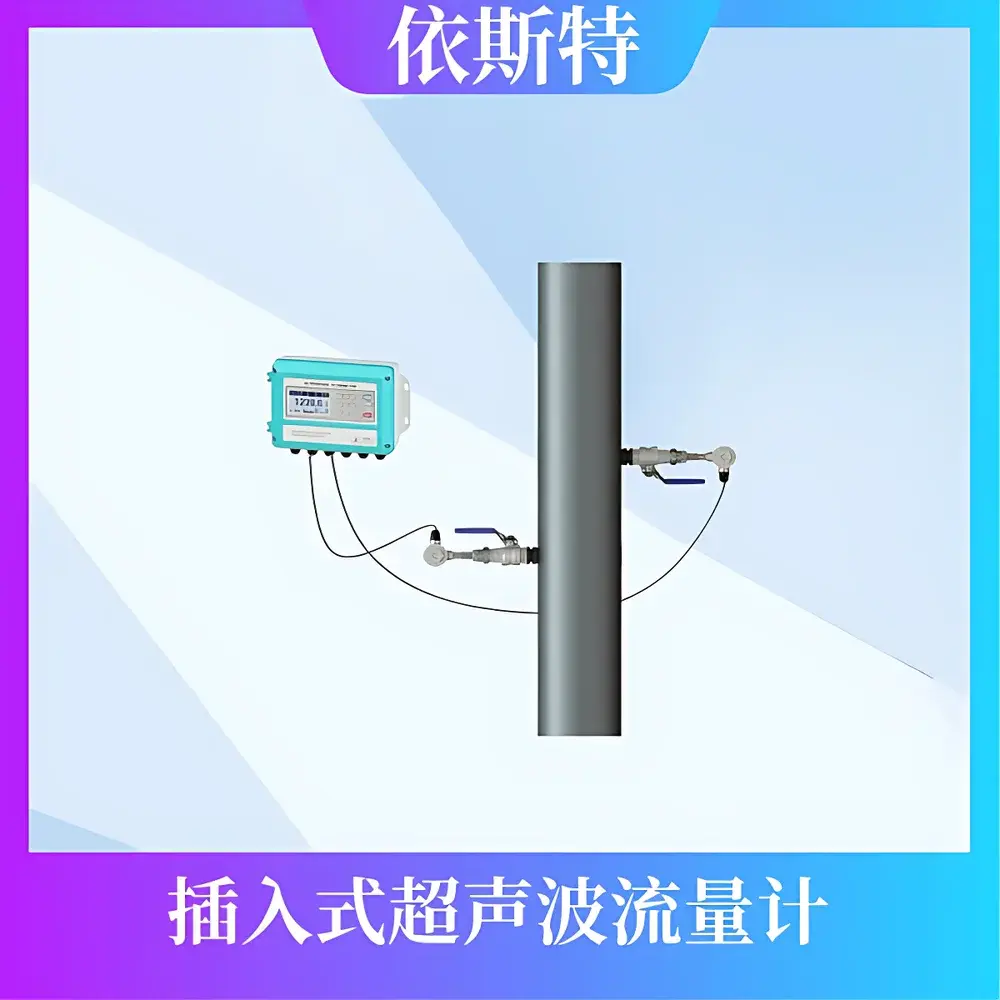
YST305SBCS1 Integrated Split-Type Insertion Ultrasonic Liquid Flowmeter
| Brand | YST (Dalian Yist) |
|---|---|
| Origin | Liaoning, China |
| Model | YST305SBCS125 |
| Accuracy | ±1.0% FS |
| Velocity Range | 0.01–12.0 m/s (bidirectional) |
| Pipe Diameter Range | DN15–DN2000 |
| Medium | Municipal sewage, industrial wastewater, water, and other single-phase liquids |
| Sensor Material | Stainless steel (316L typical) |
| Converter Operating Temperature | −10°C to +45°C |
| Relative Humidity | ≤85% RH |
| Enclosure Rating | IP65 |
| Communication | RS-485, MODBUS RTU |
| Cable | Twisted-pair shielded, standard length 9 m (max. 1000 m with repeater) |
| Repeatability | ±0.2% FS |
Overview
The YST305SBCS1 Integrated Split-Type Insertion Ultrasonic Liquid Flowmeter is an engineered solution for non-intrusive, clamp-on–adjacent flow measurement in demanding wastewater treatment environments. It operates on the principle of transit-time ultrasonic measurement: two transducers mounted diametrically across a pipe wall emit and receive ultrasonic pulses; the time difference between upstream and downstream propagation is directly proportional to the average axial velocity of the fluid. This method eliminates pressure loss, moving parts, or flow obstruction—critical advantages in municipal and industrial effluent applications where solids, air entrainment, and variable conductivity preclude electromagnetic or mechanical metering. Designed specifically for continuous, long-term installation in gravity-fed or pressurized sewer lines, influent/effluent channels, and industrial discharge pipes, the YST305SBCS1 delivers stable velocity-derived volumetric flow under high-turbidity, low-flow, and chemically aggressive conditions.
Key Features
- Insertion-type installation: Single-point sensor insertion through a drilled tap (no pipe cutting or process shutdown required), minimizing operational disruption during retrofit or commissioning.
- Split architecture: Separation of converter (electronics housing) and ultrasonic sensor enables flexible mounting—converter can be located up to 1000 m from the sensor via shielded twisted-pair cable, accommodating confined spaces, hazardous zones, or remote control rooms.
- Robust sensor construction: 316 stainless steel wetted parts provide resistance to corrosion, abrasion, and biofouling in raw sewage, activated sludge, and chemically laden industrial effluents.
- Advanced signal processing: Adaptive digital filtering and dual-path echo validation suppress noise from pipe vibration, pump harmonics, and gas bubbles—ensuring reliable detection even at velocities as low as 0.01 m/s.
- Integrated temperature compensation: Built-in Pt100 RTD (optional or embedded) corrects for real-time sound speed variation due to water temperature drift (5–40°C range), maintaining accuracy across seasonal thermal gradients.
- Bidirectional measurement capability: Supports reverse-flow detection and net flow calculation—essential for tidal influent systems, equalization basins, and recirculation loops.
Sample Compatibility & Compliance
The YST305SBCS1 is validated for single-phase, acoustically conductive liquids with minimum sonic attenuation—primarily water-based streams containing suspended solids (<10% v/v), microbubbles, or trace hydrocarbons. It is compatible with carbon steel, stainless steel, ductile iron, PVC, and HDPE piping (with appropriate acoustic coupling and wall thickness verification). While not certified to IEC 61508 (SIL) or ATEX/IECEx out-of-the-box, its IP65-rated converter enclosure meets NEMA 4X environmental requirements for outdoor or semi-outdoor deployment. For regulatory reporting, the device supports data logging and MODBUS register mapping aligned with EPA Method 1609 and ISO 4064-1:2019 Annex C for ultrasonic flowmeter performance evaluation. Calibration traceability follows ISO/IEC 17025-compliant procedures per manufacturer’s internal metrology lab (certificate available upon request).
Software & Data Management
The onboard converter features a 4-line backlit LCD display showing real-time instantaneous flow rate (m³/h, L/min), average velocity (m/s), positive/negative/net cumulative volume (m³), and daily total. All parameters are accessible via MODBUS RTU over RS-485, enabling integration into SCADA, DCS, or PLC systems without protocol translation. Optional PC configuration software (Windows-based) allows setup of damping filters, zero calibration, pipe geometry input, and alarm thresholds (e.g., low-flow timeout, signal loss, temperature deviation). Audit-trail functionality logs critical events—including parameter changes, sensor disconnects, and firmware updates—with timestamps. While not natively compliant with FDA 21 CFR Part 11, the system supports external secure logging servers for GMP/GLP-aligned wastewater monitoring programs when deployed with IT-controlled access controls and electronic signature workflows.
Applications
- Municipal wastewater treatment plant influent and effluent flow monitoring (primary clarifier feed, secondary clarifier overflow, disinfection channel discharge)
- Industrial pretreatment compliance tracking (textile dye houses, food processing outfalls, pharmaceutical wastewater streams)
- Stormwater detention basin inflow/outflow quantification for CSO reporting
- Sludge transfer line monitoring in dewatering and digestion circuits
- Water reclamation facility reuse flow metering (irrigation, industrial cooling makeup)
- Leak detection and hydraulic balance analysis across gravity sewer networks
FAQ
What pipe materials are compatible with the YST305SBCS1?
Carbon steel, stainless steel (304/316), cast iron, copper, PVC, and HDPE pipes are supported—provided wall thickness, lining type, and acoustic impedance permit sufficient ultrasonic energy transmission. Liner thickness must be verified against manufacturer-provided acoustic tables.
Can the flowmeter operate reliably in highly aerated or sludge-laden flows?
Yes—the transit-time algorithm incorporates multi-echo averaging and dynamic gain control to maintain lock on valid signal paths despite intermittent bubble interference or particle scattering. Performance remains within ±1.0% accuracy for solids concentrations up to 8% v/v and air void fractions <5%.
Is field recalibration required after installation?
No routine recalibration is needed. Zero-check verification (dry-pipe mode) is recommended after initial commissioning and annually thereafter. Full recalibration is only necessary if sensor damage, severe fouling, or replacement occurs.
Does the device support pulse output or analog 4–20 mA?
The standard YST305SBCS125 model includes RS-485/MODBUS only. Optional modules (sold separately) provide isolated 4–20 mA output (HART-compatible) and open-collector pulse output (0.1–10 kHz range) for legacy system integration.
How is sensor fouling mitigated during long-term operation?
The stainless steel sensor face is polished to reduce adhesion; periodic manual cleaning (every 3–6 months depending on sludge load) using soft brush and mild detergent is sufficient. No ultrasonic self-cleaning or chemical injection is integrated.