YST306D50-BF223 Ultrasonic Heat Meter for Wastewater Energy Recovery
| Brand | YST (Dalian Yist) |
|---|---|
| Origin | Liaoning, China |
| Model | YST306D50-BF223 |
| Nominal Diameter | DN50 |
| Flow Range | 0.01–1000 m³/h |
| Heat Energy Range | 0.01–10,000 GJ |
| Temperature Range | 4–150 °C |
| ΔT Range | 2–70 °C |
| Max Working Pressure | 1.6 MPa |
| Protection Rating | IP65 |
| Communication | RS485 (Modbus RTU) |
| Power Supply | 220 V AC or optional lithium battery |
Overview
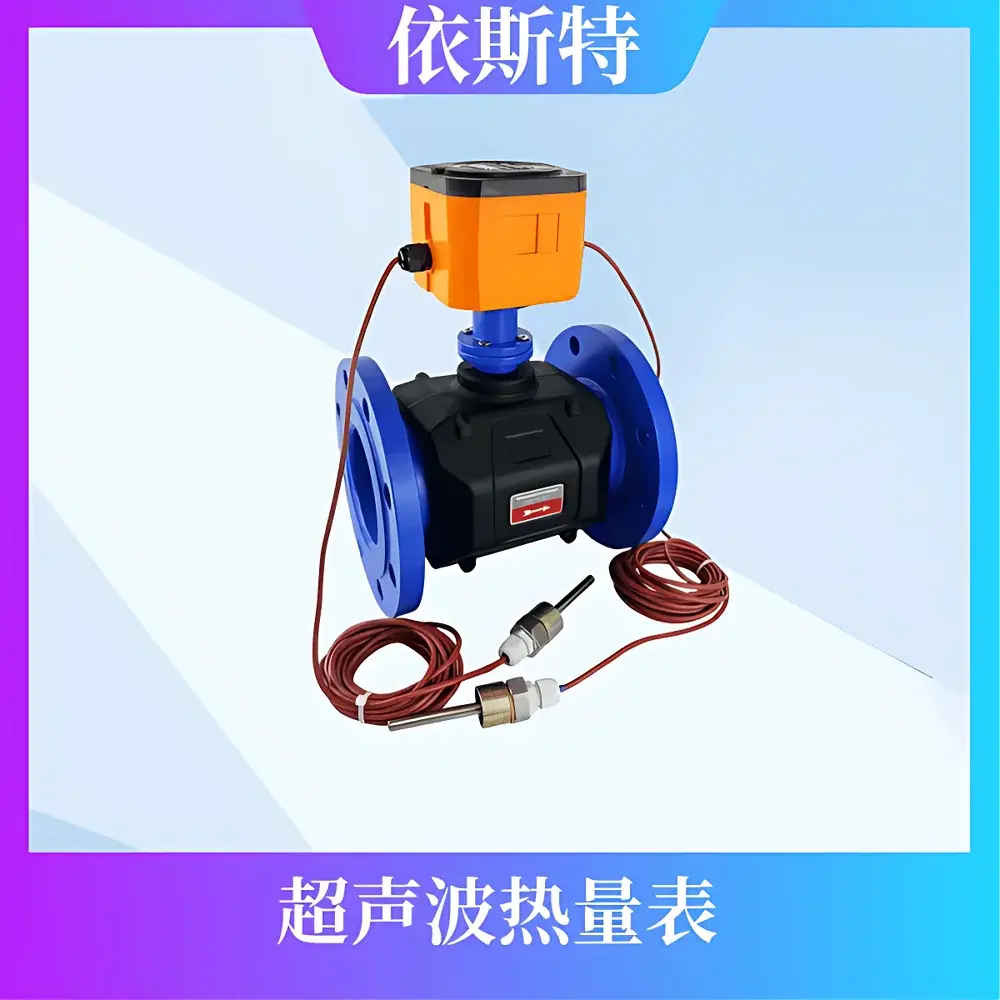
The YST306D50-BF223 Ultrasonic Heat Meter is an industrial-grade thermal energy meter engineered specifically for continuous, non-intrusive measurement of heat transfer in wastewater streams. It operates on the time-of-flight ultrasonic principle—measuring the differential transit time of high-frequency sound waves propagating upstream and downstream within the pipe—to calculate volumetric flow rate with high reproducibility. Simultaneously, integrated Pt1000 platinum resistance temperature sensors (Class A accuracy per IEC 60751) measure inlet and outlet fluid temperatures with sub-0.1 °C resolution. The onboard microprocessor applies the standard calorimetric equation Q = ṁ × cp × ΔT to compute cumulative heat energy (in gigajoules), where ṁ is mass flow derived from volumetric flow and fluid density estimation, cp is specific heat capacity (configurable for water or user-defined fluids), and ΔT is the validated temperature differential. Designed for deployment in municipal wastewater treatment plants, industrial effluent recovery loops, and district heating return-line reuse systems, this meter supports sustainable energy auditing, regulatory reporting, and performance verification of waste-heat-to-energy installations under real-world conditions—including suspended solids, variable conductivity, and intermittent air entrainment.
Key Features
- Non-invasive ultrasonic flow measurement eliminates pressure drop, mechanical wear, and clogging risks—critical for untreated or partially treated wastewater containing particulates, grease, or biofilm.
- DN50 clamp-on or insertion-style transducer configuration enables installation on existing pipelines without cutting, welding, or system shutdown—ideal for retrofit applications in constrained spaces near valves, bends, or pumps.
- Dual Pt1000 temperature probes (inlet/outlet) with stainless steel 316L sheaths and IP65-rated junction boxes ensure long-term stability in humid, chemically aggressive environments.
- Robust embedded calculator unit featuring a backlit LCD display, local data logging (≥12 months of hourly records), and configurable alarm thresholds for ΔT, flow velocity, or sensor fault detection.
- Compliant with EN 1434-2015 (Heat meters – Part 1: General requirements; Part 3: Installation requirements) and aligned with ISO 4064-2014 metrological framework for liquid flowmeters.
- Low-power operation mode supports extended battery life (up to 5 years with lithium primary cell option), enabling deployment in remote or off-grid infrastructure sites.
Sample Compatibility & Compliance
The YST306D50-BF223 is validated for use with conductive liquids having acoustic impedance compatible with standard ultrasonic coupling gels (e.g., wastewater, cooling water, glycol mixtures up to 30 % concentration). It accommodates fluid temperatures from 4 °C to 150 °C (high-temp variant available upon request) and operating pressures up to 1.6 MPa. Its design conforms to electromagnetic compatibility standards IEC 61000-4-2/3/4/6 and environmental protection directives RoHS 2011/65/EU and REACH Regulation (EC) No. 1907/2006. While not certified to MID (Measuring Instruments Directive) Annex MI-004 for legal metrology in EU member states, it meets technical prerequisites for internal energy accounting, sustainability reporting (e.g., ISO 50001), and engineering validation under GLP-aligned data integrity practices.
Software & Data Management
Data acquisition and configuration are managed via Modbus RTU protocol over RS485 interface (two-wire, half-duplex), supporting integration into SCADA, BMS, or cloud-based energy management platforms (e.g., Siemens Desigo, Schneider EcoStruxure, or custom MQTT gateways). The device stores timestamped flow, temperature, ΔT, and cumulative heat energy values at user-defined intervals (1 min to 1 h). Internal memory retains ≥100,000 records with cyclic overwrite logic. Configuration parameters—including fluid type, pipe material, sensor spacing, and calibration coefficients—are protected by password-secured access. Audit trail functionality logs all parameter changes with timestamps and operator IDs, satisfying basic traceability requirements for ISO 9001 and ISO/IEC 17025 quality management systems.
Applications
- Quantification of recoverable thermal energy in secondary/tertiary effluent streams from municipal wastewater treatment plants.
- Performance monitoring of heat exchangers in industrial process water recirculation loops (e.g., food processing, textile dyeing, pharmaceutical cooling).
- Sub-metering of district heating return lines where low-grade waste heat is repurposed for space heating or domestic hot water preheating.
- Baseline energy auditing and post-retrofit verification for LEED EBOM or ISO 50001-certified facilities.
- Supporting carbon accounting frameworks such as GHG Protocol Scope 2 emissions tracking when linked to grid electricity displacement calculations.
FAQ
What is the minimum required straight pipe length for accurate ultrasonic measurement?
A minimum of 10D upstream and 5D downstream (where D = pipe diameter) is recommended for laminar or transitional flow profiles. For turbulent flow (Re > 4000), 5D upstream and 2D downstream may suffice—verified during site-specific commissioning.
Can the meter compensate for varying water density or specific heat due to temperature or salinity changes?
Yes—the firmware allows manual input of cp (J/kg·K) and ρ (kg/m³) tables or selection from built-in water property databases (IAPWS-IF97 compliant interpolation) to maintain calculation accuracy across operational temperature ranges.
Is field recalibration possible without returning the unit to the factory?
No full recalibration is performed in-field; however, zero-flow verification and gain adjustment using known reference temperatures are supported via service menu, requiring calibrated external thermometers and stable static conditions.
Does the device support pulse output or analog 4–20 mA signal for legacy PLC integration?
Not natively—the YST306D50-BF223 relies exclusively on RS485 Modbus RTU for digital communication. Optional external protocol converters (e.g., Modbus RTU to 4–20 mA) can be deployed if required by legacy control architecture.
How is data integrity ensured during power interruption or communication failure?
All critical measurements are written to non-volatile flash memory before each logging interval. Power-loss recovery preserves the last valid cumulative register value and resumes logging upon restoration without data gap or reset.