
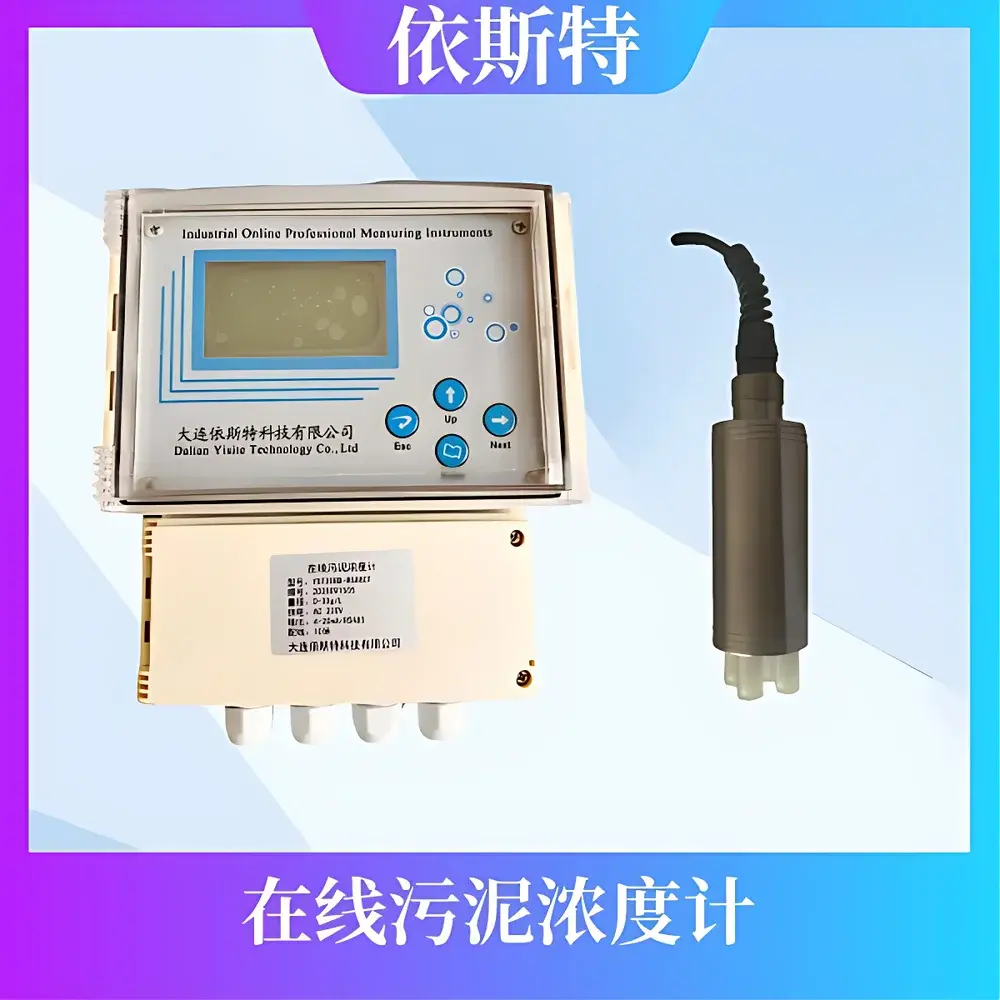
YST308B-MS880T Intelligent Sludge Concentration Analyzer
| Brand | YST (Dalian Yist Instruments) |
|---|---|
| Origin | Liaoning, China |
| Model | YST308B-MS880T |
| Measurement Principle | Dual-beam infrared light scattering (ISO 7027 compliant) |
| Range | 0.01–20,000 mg/L (standard) |
| Resolution | 0.01–1 mg/L (scale-dependent) |
| Accuracy | ±5% of reading (subject to sludge homogeneity) |
| Repeatability | ±2% |
| Operating Temperature | 0–45 °C |
| Storage Temperature | −15–50 °C |
| Enclosure Rating | IP68 / NEMA 6P |
| Output Interface | RS485 / Modbus RTU |
| Housing Material | SUS316L stainless steel body |
| Optional Feature | Motorized brush cleaning system |
Overview
The YST308B-MS880T Intelligent Sludge Concentration Analyzer is an ISO 7027-compliant, dual-beam infrared scattering sensor engineered for continuous, in-situ measurement of suspended solids concentration (SSC) in wastewater and sludge streams. Designed specifically for municipal and industrial water treatment applications, it quantifies mixed liquor suspended solids (MLSS), return activated sludge (RAS), waste activated sludge (WAS), and primary/secondary clarifier effluent concentrations with high optical stability and minimal drift. Its measurement principle relies on the differential attenuation and angular scattering response of near-infrared light (typically 850 nm) across two synchronized optical paths—one reference beam and one sample-interacting beam—enabling real-time compensation for window fouling, color interference, and temperature-induced refractive index shifts. This architecture ensures robust performance in turbid, chemically aggressive, and high-viscosity environments where conventional single-beam turbidimeters exhibit significant signal hysteresis or calibration drift.
Key Features
- Dual-beam infrared scattering optics conforming to ISO 7027:2016 for standardized turbidity and suspended solids correlation
- Wide dynamic range: 0.01–20,000 mg/L (standard configuration); extended range option up to 45,000 mg/L for thickened sludge monitoring
- Temperature-compensated algorithm integrated into firmware, minimizing thermal drift across 0–45 °C operating envelope
- SUS316L wetted parts and POM structural housing provide long-term corrosion resistance in chloride-rich, sulfide-laden, and acidic/alkaline wastewater matrices
- IP68/NEMA 6P-rated submersible design enables direct immersion in aeration basins, clarifiers, thickeners, and open-channel flows without external housings or flow cells
- Modbus RTU over RS485 interface supports deterministic polling, multi-drop network topology (up to 32 nodes), and integration with PLCs, DCS, and SCADA platforms compliant with IEC 61131-3 and ISA-88 standards
- Optional motor-driven brush cleaning system programmable via Modbus register, reducing manual maintenance intervals by up to 70% in high-fouling installations
Sample Compatibility & Compliance
The YST308B-MS880T is validated for use in heterogeneous, non-Newtonian aqueous suspensions typical of biological wastewater treatment systems—including activated sludge, anaerobic digestate, chemical coagulation flocs, and industrial process liquors from pulp & paper, textile dyeing, food processing, and pharmaceutical manufacturing. It does not require sample dilution, filtration, or centrifugation. While not a certified reference method per ASTM D3977 or ISO 11923, its output correlates empirically with gravimetric TSS measurements under controlled calibration conditions using site-specific sludge standards. The device meets electromagnetic compatibility requirements per EN 61326-1 (industrial environment) and conforms to RoHS Directive 2011/65/EU. Its digital output architecture supports audit-ready data logging when deployed with GLP/GMP-compliant SCADA systems featuring 21 CFR Part 11–enabled electronic signatures and change control logs.
Software & Data Management
The analyzer operates as a self-contained field device with embedded firmware; no host PC software is required for basic operation. Configuration, calibration, and diagnostic functions are accessible via Modbus registers (e.g., holding register 40001–40100) using standard industrial configuration tools (e.g., ModScan, QModMaster). For centralized deployment, the device integrates natively with cloud-based water intelligence platforms supporting MQTT or OPC UA protocols through gateway-level protocol translation. All measurement data—including raw scatter intensity, compensated concentration value, temperature reading, cleaning actuation status, and internal diagnostics—are timestamped and transmitted at user-defined intervals (1 s to 15 min). Historical datasets can be exported in CSV or JSON format for trend analysis, model-based control input, or regulatory reporting aligned with EPA NPDES or EU Urban Wastewater Treatment Directive Annex I monitoring requirements.
Applications
- Real-time MLSS monitoring in aerobic and anoxic bioreactors to optimize dissolved oxygen setpoints and prevent nitrification/denitrification imbalance
- Continuous RAS/WAS concentration tracking for adaptive sludge age control and solids retention time (SRT) management
- Clarifier underflow density profiling to detect early-stage sludge blanket rise and mitigate effluent turbidity excursions
- Industrial pretreatment monitoring—e.g., fiber recovery in pulp mills, pigment loading in textile effluents, starch suspension in food processing wastewaters
- Mobile or portable deployment on environmental monitoring vessels for rapid assessment of riverine or estuarine suspended sediment loads (SSC)
- Performance verification of dissolved air flotation (DAF) units and lamella settlers via influent–effluent SSC differentials
FAQ
Is the YST308B-MS880T suitable for measuring sludge in anaerobic digesters?
Yes—the sensor’s infrared wavelength and dual-beam architecture minimize interference from biogas bubbles and organic chromophores common in digester supernatant. However, calibration should be performed using representative digested sludge samples due to particle size distribution differences.
Can the device be calibrated against laboratory TSS measurements?
Yes. A two-point field calibration (zero and span) using gravimetrically determined sludge standards is recommended quarterly or after major maintenance. Correlation coefficients >0.98 are typically achieved within plant-specific operational ranges.
Does the Modbus interface support alarm thresholds and event logging?
Yes. Six user-configurable concentration alarms (high/high-high/low/low-low + rate-of-change) are implemented in firmware. Each alarm state triggers a discrete Modbus coil and stores timestamped event records in non-volatile memory.
What is the expected service life of the optical windows under continuous operation?
With optional brush cleaning enabled and operated per manufacturer guidelines, optical window service life exceeds 24 months in typical municipal activated sludge applications. In high-abrasion environments (e.g., grit-laden primary effluent), inspection every 6 months is advised.
Is firmware upgrade supported remotely?
Firmware updates require local physical access via RS485 and are delivered as signed binary packages. Remote update capability is not implemented to maintain IEC 62443-3-3 SL2 cybersecurity compliance for critical infrastructure deployments.
Related Products







