
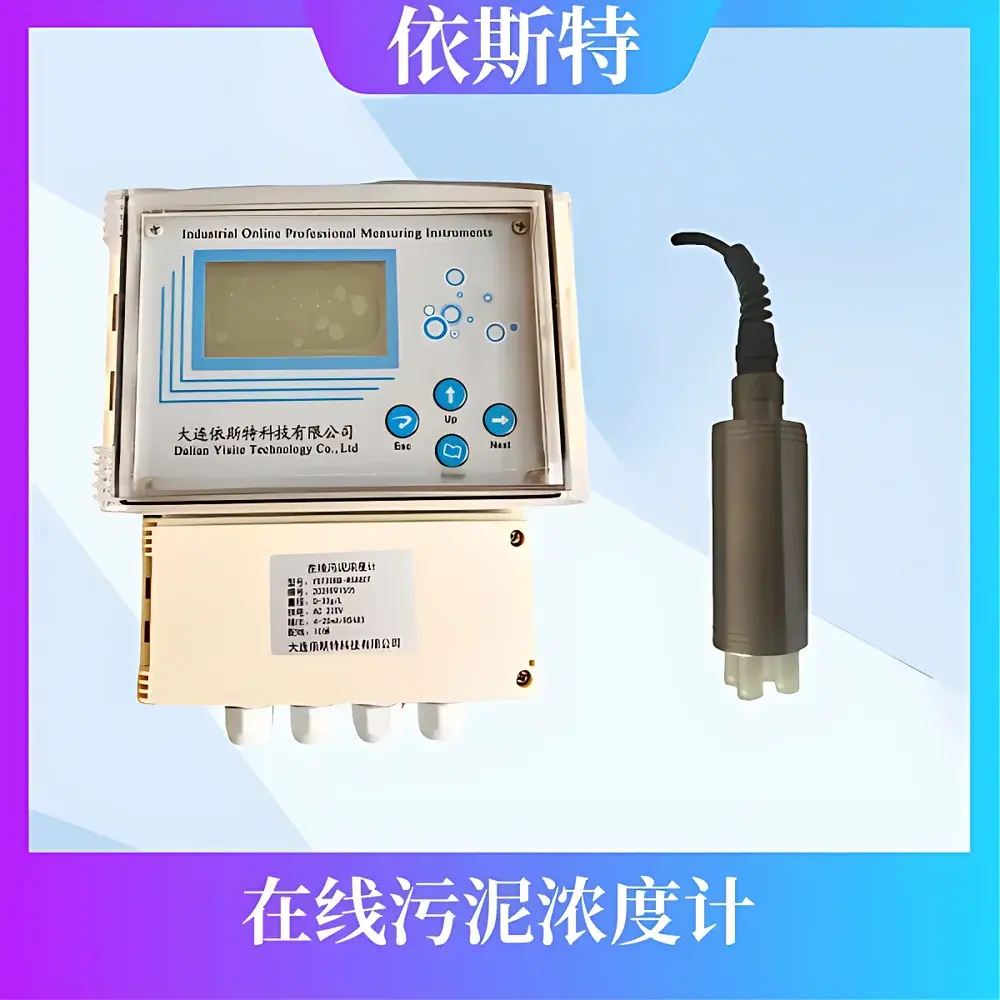
YST308B-MS880T Optical Sludge Concentration Monitor by YST (Dalian Yist Instrument Co., Ltd.)
| Brand | YST (Dalian Yist Instrument Co., Ltd.) |
|---|---|
| Origin | Liaoning, China |
| Model | YST308B-MS880T |
| Measurement Range | 0–9999 mg/L (extendable to 0–50 g/L) |
| Principle | Dual-mode infrared optical sensing (880 nm LED source, combined scatter & transmission detection) |
| Accuracy | ±1% FS |
| Resolution | 3 mg/L (0–1000 mg/L), 0.01 g/L (>1000 mg/L) |
| Operating Temp. | Sensor: 0–60°C |
| Controller | −10–55°C |
| Output | 4–20 mA analog + RS485 Modbus-RTU digital |
| IP Rating | Sensor IP68, Controller IP65 |
| Power Supply | AC 85–265 V ±10% or DC 9–36 V |
| Sampling Interval | 1–30 min adjustable |
| Housing | Sensor body 316L stainless steel, Controller enclosure polycarbonate |
Overview
The YST308B-MS880T Optical Sludge Concentration Monitor is an industrial-grade, continuous online analyzer engineered for real-time quantification of suspended solids concentration in wastewater streams. It operates on a dual-mode optical principle—integrating infrared light scattering and transmission measurements at a precisely stabilized 880 nm wavelength—to deliver high reproducibility across heterogeneous slurry matrices. Unlike single-scatter turbidity sensors, this configuration mitigates signal saturation at high concentrations while maintaining sensitivity in low-SST (suspended solids total) ranges, enabling reliable monitoring from primary clarifiers to aerobic digesters and membrane bioreactors (MBRs). The device is designed for integration into process control loops where dynamic sludge inventory management directly impacts aeration efficiency, sludge wasting rates, and effluent quality compliance—particularly under fluctuating hydraulic and organic loading conditions typical in municipal and industrial wastewater treatment plants.
Key Features
- Dual-Optical Measurement Architecture: Simultaneous scatter and transmittance detection compensates for particle size distribution shifts and refractive index variations, reducing bias in mixed liquor or chemically coagulated effluents.
- Auto-Compensated Signal Processing: Embedded temperature compensation (0–60°C sensor range) and real-time turbidity interference correction algorithms minimize drift caused by ambient thermal gradients or background coloration.
- Robust Industrial Enclosure: Sensor probe constructed from electropolished 316L stainless steel with IP68 ingress protection; controller housing rated IP65 with flame-retardant polycarbonate—suitable for humid, corrosive, and splash-prone environments.
- Multi-Protocol Data Output: Standard 4–20 mA current loop output with HART-compatible configuration options, plus RS485 serial interface compliant with Modbus-RTU protocol for seamless integration with PLCs, DCS platforms, and SCADA systems.
- Self-Diagnostic Monitoring: Continuous internal health checks detect fouling accumulation on the optical window, cable integrity faults, and power supply anomalies—triggering configurable status alerts via digital output or HMI interface.
- Low-Maintenance Optics: Flat-surface optical path design minimizes sediment adhesion; optional ultrasonic cleaning module (sold separately) supports extended unattended operation in high-fouling applications.
Sample Compatibility & Compliance
The YST308B-MS880T is validated for use in activated sludge, anaerobic digestate, chemical precipitation sludges, and food-processing effluents containing organic particulates, colloidal matter, and moderate levels of dissolved colorants. Its measurement performance aligns with ASTM D3730 (Standard Test Method for Total Suspended Solids in Water) for field-deployed optical estimation, and supports regulatory reporting requirements under EPA Method 160.2 and ISO 11923:1997 (Water quality — Determination of suspended solids — Gravimetric method) when correlated against lab-based reference measurements. While not certified for GLP or FDA 21 CFR Part 11 environments, its data logging architecture—including timestamped raw signal values, compensated SST outputs, and diagnostic flags—supports audit-ready documentation for ISO 14001-certified facilities and municipal wastewater discharge compliance programs.
Software & Data Management
The monitor operates autonomously without proprietary software dependency. Configuration, calibration, and diagnostics are accessible via local IR interface or Modbus register mapping—enabling full remote access through existing plant HMIs or cloud-based IIoT gateways. All measurement records include UTC timestamps, sensor temperature, raw scatter/transmission ADC counts, and compensated SST values. When integrated with historian systems (e.g., OSIsoft PI, Ignition SCADA), trend analysis of sludge inventory dynamics enables predictive adjustment of return activated sludge (RAS) flow rates and waste activated sludge (WAS) pumping schedules. Optional firmware updates—distributed via secure HTTPS portal—maintain compatibility with evolving Modbus implementations and cybersecurity standards (IEC 62443 Level 1).
Applications
- Real-time monitoring of mixed liquor suspended solids (MLSS) in aerobic basins and oxidation ditches
- Continuous tracking of return sludge concentration in secondary clarifier underflow lines
- Feed-forward control of polymer dosing in dewatering centrifuges and belt presses
- Early detection of filamentous bulking events via abnormal scatter-to-transmission ratio trends
- Performance verification of lamella settlers and dissolved air flotation (DAF) units
- Compliance logging for NPDES permit reporting of suspended solids limits in final effluent
FAQ
What calibration procedures are required?
Factory calibration is performed using NIST-traceable formazin standards. Field verification is recommended quarterly using clean water blanks and a representative slurry standard; zero and span adjustments are accessible via Modbus registers or local IR menu.
Can the sensor be installed in pressurized pipelines?
Yes—the probe is rated for static pressures up to 10 bar and features a threaded NPT or DIN 11851 process connection; flanged variants available upon request.
Does the device support automatic cleaning?
The base model includes passive anti-fouling optics; optional ultrasonic transducer kits (YST-UCM-1) can be retrofitted to activate periodic cleaning cycles synchronized with sampling intervals.
How does it handle colored or highly turbid wastewater?
The 880 nm infrared wavelength reduces interference from humic substances and dye-derived absorbance; combined scatter/transmission ratio analysis further decouples absorption effects from true particle concentration.
Is explosion-proof certification available?
ATEX and IECEx certifications are not included in the standard configuration; however, intrinsically safe barrier-compatible versions (with isolated 4–20 mA output) can be supplied under custom order with lead-time extension.







