
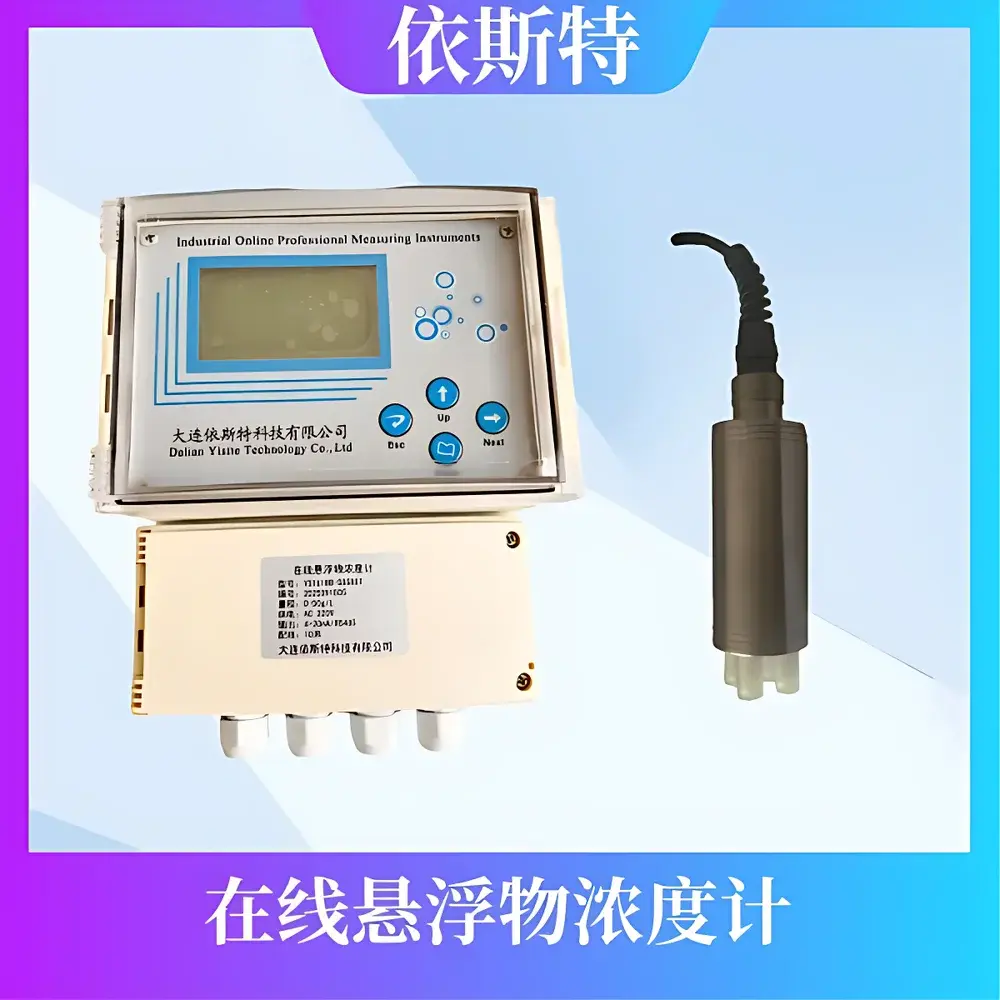
YST308B-MS880T Suspended Solids Analyzer by Dalian YST
| Brand | Dalian YST |
|---|---|
| Origin | Liaoning, China |
| Model | YST308B-MS880T |
| Measurement Range | 0–50 g/L (activated sludge), 0–400 g/L (silica) |
| Units | mg/L / ppm selectable |
| Accuracy | ±1–2% FS |
| Repeatability | ±1–2% |
| Operating Temp. | 0–50 °C |
| Max. Pressure | ≤10 bar |
| Flow Rate | 0.3–3 m/s |
| Output | 4–20 mA isolated |
| Communication | Modbus RTU/ASCII |
| Enclosure Rating | Transmitter IP65, Sensor IP68 |
| Power Supply | AC 220 V or DC 24 V |
| Weight | 6 kg |
Overview
The YST308B-MS880T Suspended Solids Analyzer is an optical turbidimetric sensor system engineered for continuous, in-line monitoring of suspended solids concentration in wastewater and industrial effluent streams. Designed according to the principles of near-infrared (NIR) light scattering and absorption attenuation, the instrument measures changes in optical transmission and backscatter intensity across a calibrated path length—enabling real-time quantification of total suspended solids (TSS), mixed liquor suspended solids (MLSS), and settleable solids without sample filtration, centrifugation, or gravimetric drying. Its core architecture integrates a ruggedized immersion probe with a field-mounted transmitter unit, supporting deployment in open channels, pipes, and activated sludge basins under dynamic hydraulic conditions. The analyzer operates on the premise that particle size distribution, refractive index, and surface morphology influence optical response—parameters empirically compensated via multi-point factory calibration against reference slurries (e.g., activated sludge and silica standards). This ensures traceable performance across heterogeneous matrices typical of municipal and chemical wastewater treatment applications.
Key Features
- Optical sensing platform utilizing dual-wavelength NIR detection to minimize interference from color, dissolved organics, and bubble entrainment
- 316 stainless steel sensor housing with sapphire optical window and integrated ultrasonic or mechanical auto-cleaning mechanism to maintain signal integrity in high-fouling environments
- Wide dynamic range: 0–50 g/L for activated sludge and 0–400 g/L for inert particulates such as silica—supporting both mg/L and ppm output scaling
- Isolated 4–20 mA analog output with HART-compatible digital overlay; optional Modbus RTU/ASCII protocol for integration into SCADA, DCS, or PLC-based control systems
- Transmitter rated IP65 for outdoor panel mounting; sensor rated IP68 for permanent submersion up to 10 bar pressure and flow velocities of 0.3–3 m/s
- Factory-calibrated traceability to NIST-traceable reference suspensions; onboard zero/span verification capability for routine operational checks
Sample Compatibility & Compliance
The YST308B-MS880T is validated for use in raw sewage, primary and secondary clarifier effluents, return activated sludge (RAS), waste activated sludge (WAS), and chemically complex industrial discharges—including those containing chlorides, sulfates, and low-pH organic acids. Its optical design mitigates drift caused by biofilm accumulation or mineral scaling through periodic self-cleaning cycles. While not certified to ISO/IEC 17025 for laboratory accreditation, the device conforms to functional requirements outlined in EPA Method 160.2 (TSS gravimetric reference) and supports data collection workflows aligned with ISO 5667-2 (water sampling) and ISO 10523 (pH and conductivity correlation). For regulatory reporting, the 4–20 mA output may be interfaced with EPA-compliant data acquisition systems meeting 40 CFR Part 136 validation criteria. The unit’s firmware architecture supports audit-trail logging of calibration events and configuration changes—facilitating GLP-aligned recordkeeping where required.
Software & Data Management
The transmitter includes embedded configuration software accessible via local keypad or infrared handheld interface. No proprietary PC software is required for basic setup; however, optional configuration utilities support advanced parameter tuning—including particle-type selection (biological vs. mineral), temperature compensation coefficients, and alarm hysteresis settings. All measurement data are timestamped and stored in non-volatile memory for up to 30 days at 1-minute intervals. Raw analog outputs integrate seamlessly with third-party historian platforms (e.g., Ignition, Siemens Desigo, Honeywell Experion) and environmental compliance dashboards (e.g., Enviance, Elysis). The device does not incorporate cloud connectivity or remote firmware update capabilities—ensuring air-gapped operation where cybersecurity policies restrict network exposure.
Applications
- Real-time optimization of sludge blanket depth and return activated sludge (RAS) pumping rates in secondary clarifiers
- Monitoring MLSS concentration in aerobic and anoxic bioreactors to maintain optimal F/M ratios and prevent nitrification failure
- Effluent TSS compliance tracking at discharge points prior to UV disinfection or membrane filtration stages
- Process control in chemical precipitation units, where rapid detection of coagulant dosage effects improves settling efficiency
- Performance benchmarking of dissolved air flotation (DAF) and lamella clarifier systems under variable influent loading
FAQ
What calibration standards are recommended for field verification?
NIST-traceable silica suspensions (e.g., Ludox AM-30) and homogenized activated sludge samples preserved at 4 °C for ≤24 hours are recommended. Calibration should be performed at two points spanning the expected operating range.
Can the sensor be installed in partially filled channels or open-channel flows?
Yes—when mounted with a flow conditioning baffle or submerged in a stilling well, provided minimum submergence depth exceeds 100 mm and velocity remains within 0.3–3 m/s.
Does the device meet ATEX or IECEx requirements for hazardous area installation?
No—the YST308B-MS880T is rated for general-purpose industrial environments only and is not certified for Zone 1/2 or Class I Div 1 locations.
How frequently should the auto-cleaning cycle be scheduled in high-fouling applications?
Default interval is 2 hours; this can be adjusted between 15 minutes and 24 hours via local configuration to balance cleaning efficacy and mechanical wear.
Is the 4–20 mA output intrinsically safe?
No—it is isolated but not intrinsically safe; external barriers compliant with IEC 60079-11 must be used if connecting to hazardous-area instrumentation loops.







