
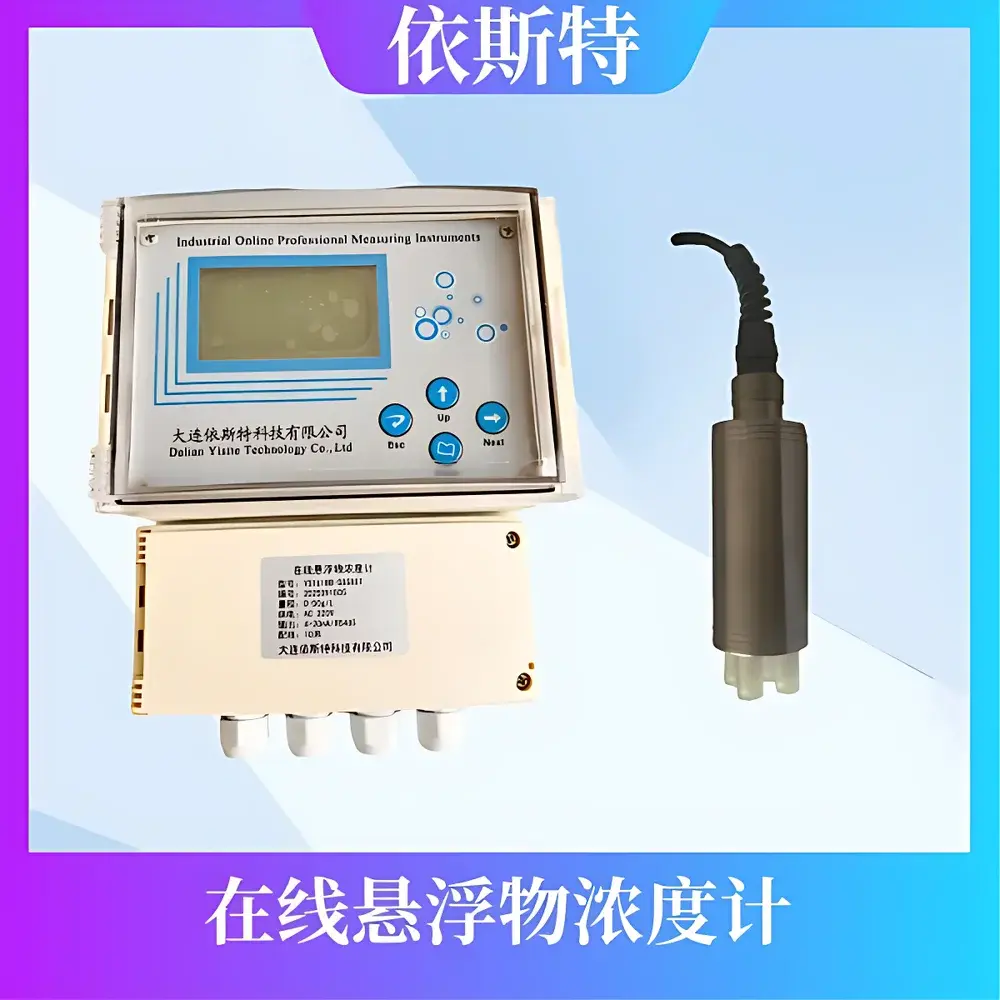
YST308B-MS880T Suspended Solids Analyzer for Municipal Water Treatment Plants
| Brand | YST (Dalian Yist) |
|---|---|
| Origin | Liaoning, China |
| Model | YST308B-MS880T |
| Measurement Range | 0–2000 NTU / 0–500 mg/L (switchable) |
| Accuracy | ±1.5% FS |
| Power Supply | AC 220 V ±10%, 50 Hz ±1 Hz or DC 24 V ±10% (optional) |
| Output Signal | 4–20 mA isolated (load < 750 Ω) |
| Ingress Protection | IP65 |
| Operating Temperature | 0–60 °C |
| Data Logging | 1 month @ 5-min intervals (non-volatile memory, 10-year data retention after power loss) |
| Installation | Flow-through sensor |
| Compliance | HJ 212–2017 protocol support for environmental monitoring platform integration |
Overview
The YST308B-MS880T Suspended Solids Analyzer is an industrial-grade optical turbidimeter engineered for continuous, real-time monitoring of suspended solids concentration in municipal drinking water treatment processes. It operates on the principle of multi-beam near-infrared (NIR) light scattering detection—specifically employing a quadruple optical path configuration with dual emitters and dual detectors—to deliver robust turbidity (NTU) and mass-based suspended solids (mg/L) measurements under dynamic hydraulic and compositional conditions. Unlike single-beam transmissometers or basic nephelometers, this architecture enables active cross-compensation for optical window fouling, chromatic interference from dissolved organic matter, and flow-induced signal drift—critical performance attributes in raw water intake, sedimentation effluent, and filtration influent applications. Designed to meet the operational rigor of Class I–III waterworks in China’s urban water supply systems, the analyzer integrates seamlessly into process control loops and regulatory data reporting infrastructure without requiring laboratory-grade calibration frequency or specialist operator training.
Key Features
- Four-Beam Matrix Optical Architecture: Dual NIR light sources (850 nm) and paired photodetectors arranged in orthogonal geometry enable real-time differential signal correction, minimizing drift caused by lens deposition, air bubbles, or variable water color.
- Temperature-Compensated Measurement Engine: Integrated Pt100 RTD sensor feeds dynamic thermal offset correction into the signal processing algorithm, ensuring stable output across 0–60 °C ambient and process temperature ranges.
- Dual-Range Switchable Output: Configurable measurement scale between 0–2000 NTU (turbidity) and 0–500 mg/L (suspended solids), with factory-calibrated correlation curves traceable to ISO 7027:2016 reference standards.
- Industrial-Grade Transmitter Design: Single-board electronics with embedded watchdog timer, ESD-protected I/O, and conformal-coated PCBs ensure >99.9% uptime in humid, electrically noisy plant environments.
- Flexible Power & Signal Interface: Supports primary AC 220 V operation with optional DC 24 V backup; analog 4–20 mA output meets IEC 61000-6-2 EMC requirements; RS485 interface complies with Modbus RTU v1.1 for SCADA integration.
- Regulatory-Ready Data Handling: Internal non-volatile memory logs timestamped readings at user-defined intervals (default: 5 minutes); all stored data retain integrity during extended power interruption (≥10 years).
Sample Compatibility & Compliance
The YST308B-MS880T is validated for use with potable water, surface water, and clarified effluent streams exhibiting turbidity up to 2000 NTU and total suspended solids up to 500 mg/L. Its flow-through sensor design accommodates standard DN20–DN50 pipe installations (threaded or flanged), with pressure rating up to 1.0 MPa and maximum flow velocity of 3 m/s. The device conforms to GB/T 11901–1989 (determination of suspended solids in water) and implements HJ 212–2017 communication protocol for direct interoperability with provincial-level Environmental Monitoring Information Platforms (EMIP) and municipal water utility SCADA systems. While not certified to ISO/IEC 17025 or EPA Method 180.1, its measurement repeatability (≤±0.8% RSD over 24 h) and long-term stability (drift <±2% FS per 6 months) align with GLP-aligned operational validation practices common in municipal QA/QC laboratories.
Software & Data Management
No proprietary PC software is required for commissioning or routine operation. All configuration—including range selection, damping time, current output scaling, and alarm thresholds—is performed via intuitive Chinese-language LCD menu using tactile membrane keys. For enterprise-level deployment, the RS485 interface supports ASCII or Modbus RTU framing, enabling integration with third-party historian systems (e.g., Ignition, Siemens Desigo CC, or Schneider EcoStruxure). Logged data are exportable as CSV via USB host port (optional accessory) or retrieved remotely through Modbus function code 04 (Read Input Registers). Audit trails—including parameter changes, calibration events, and power cycle timestamps—are retained in internal memory and accessible via diagnostic menu, satisfying basic 21 CFR Part 11 documentation expectations for electronic records in regulated utilities.
Applications
- Real-time monitoring of raw water turbidity at intake structures to trigger coagulant dosing adjustments
- Performance verification of sedimentation basins and lamella settlers via effluent turbidity trending
- Early detection of filter breakthrough during rapid sand or multimedia filtration cycles
- Compliance reporting for national drinking water standards (GB 5749–2022) at critical control points
- Process optimization in water quality improvement retrofits, particularly where legacy instrumentation lacks digital connectivity
FAQ
Does the YST308B-MS880T require periodic factory recalibration?
No—field calibration is supported via manual 4–20 mA current source injection and zero/span verification using formazin or AMCO AEPA standards. Annual verification against traceable reference materials is recommended but not mandatory for routine operation.
Can the sensor be installed in vertical piping sections?
Yes—the flow-through probe is orientation-agnostic and rated for bidirectional flow; however, upstream straight-pipe requirements (≥5× pipe diameter) must be observed to ensure laminar flow profile development.
Is the device compatible with international data protocols such as OPC UA or MQTT?
Not natively—only Modbus RTU over RS485 is implemented. Protocol translation gateways (e.g., Moxa EDS-G205E) may be deployed externally to bridge to OPC UA or cloud platforms.
What maintenance intervals are recommended for the optical window?
Under typical municipal water conditions, mechanical wiper cleaning is advised every 3–6 months; chemical cleaning with dilute citric acid (5%) is permissible if mineral scaling occurs.
How does the analyzer handle air entrainment in low-pressure sampling lines?
The dual-detector geometry inherently suppresses bubble-induced noise; additionally, configurable damping (0.1–30 s) filters transient spikes without compromising response time to genuine process shifts.







