
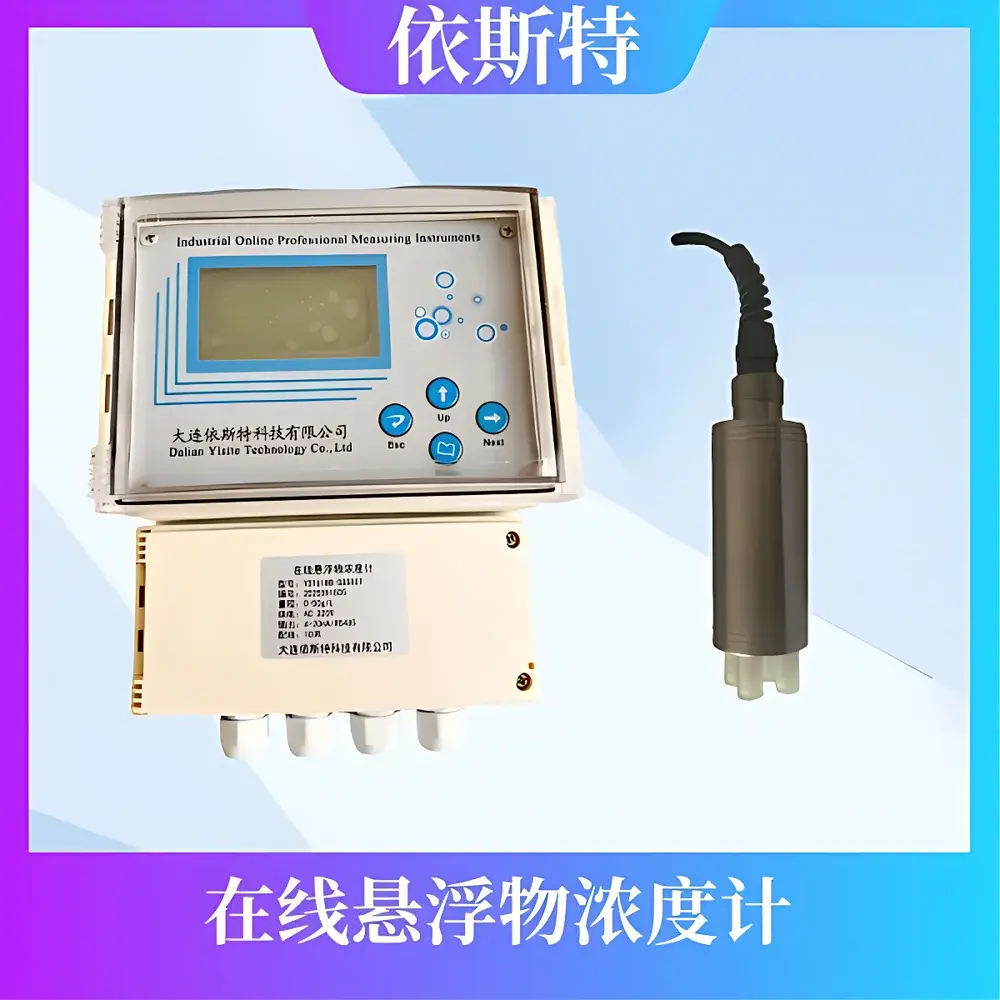
YST308B-MS880T Suspended Solids & Sludge Analyzer
| Brand | YST (Dalian Yist Environmental Technology Co., Ltd.) |
|---|---|
| Origin | Liaoning, China |
| Model | YST308B-MS880T |
| Measurement Principle | Infrared Scattering (880 nm) |
| Range | 0–50,000 mg/L (multi-range configurable) |
| Power Supply | DC 12–24 V, <50 mA avg. |
| Output Signals | 4–20 mA analog, RS485 digital (Modbus RTU) |
| Sensor IP Rating | IP68 |
| Host IP Rating | IP65 |
| Sensor Operating Temp. | −10 to 60 °C |
| Host Operating Temp. | 0 to 50 °C |
| Installation Options | Top-mount, side-mount, submersible |
| Sensor Material | 316 stainless steel |
| Housing Material | POM engineering plastic |
Overview
The YST308B-MS880T Suspended Solids & Sludge Analyzer is an industrial-grade in-situ optical sensor engineered for continuous, real-time quantification of suspended solids (SS) and mixed liquor suspended solids (MLSS) concentrations in aqueous environments. It operates on the principle of near-infrared (NIR) light scattering at a fixed wavelength of 880 nm — a spectral region selected to minimize interference from natural water coloration, humic substances, and common dissolved organic compounds. Unlike gravimetric or filtration-based laboratory methods, this analyzer delivers instantaneous, non-contact measurement without sample extraction, enabling dynamic process feedback in wastewater treatment plants, industrial effluent streams, and surface water monitoring stations. Its robust optical architecture incorporates dual-beam compensation logic to distinguish true particulate scattering from transient artifacts such as microbubbles, air entrainment, or turbidity fluctuations — a critical capability in aerated basins, clarifiers, and high-solids digesters where conventional single-beam sensors exhibit drift.
Key Features
- Optical stability via dual-beam infrared scattering design, mitigating signal drift caused by fouling, color variation, or gas bubble interference.
- Configurable multi-range measurement capability (0–50,000 mg/L), supporting both low-concentration surface water surveillance and high-solids activated sludge applications.
- Integrated ultrasonic probe cleaning system, reducing maintenance frequency to quarterly intervals under typical municipal wastewater conditions.
- Submersible-grade sensor housing (IP68) constructed from 316 stainless steel, compatible with long-term immersion in corrosive, saline, or chemically aggressive effluents.
- Modular mechanical design permitting top-mount, side-mount, or fully submerged installation — adaptable to rectangular tanks, circular clarifiers, oxidation ditches, and membrane bioreactors (MBRs).
- Embedded firmware supporting dual-output protocols: isolated 4–20 mA analog output for PLC integration and RS485 serial interface compliant with Modbus RTU standard for SCADA and cloud-based data platforms.
Sample Compatibility & Compliance
The YST308B-MS880T demonstrates reliable performance across heterogeneous matrices including municipal secondary clarifier effluent, anaerobic digester supernatant, textile dyeing wastewater, petrochemical cooling tower blowdown, and landfill leachate. Its 880 nm optical path exhibits reduced sensitivity to chromophoric interference compared to visible-light sensors, making it suitable for compliance with ASTM D3977 (Standard Practice for Sampling Activated Sludge) and ISO 11923 (Water Quality — Determination of Suspended Solids by Gravimetric Method) as a field-deployable surrogate for reference lab analysis. While not certified for regulatory reporting per se, its repeatability (±2% FS typical) and long-term stability (<1% drift/month) support operational decision-making aligned with ISO 9001 and ISO/IEC 17025 quality management frameworks. The device meets CE marking requirements for electromagnetic compatibility (EN 61326-1) and environmental protection (RoHS Directive 2011/65/EU).
Software & Data Management
The analyzer does not include proprietary software but functions as a plug-and-play field instrument within existing industrial automation ecosystems. Its Modbus RTU register map supports direct integration into Siemens SIMATIC, Rockwell Automation Logix, Schneider EcoStruxure, or open-source platforms such as Node-RED and Grafana. All configuration parameters — including zero/span calibration points, damping time, range selection, and alarm thresholds — are programmable via Modbus commands or local keypad navigation. Audit trails for calibration events and alarm logs are retained in non-volatile memory. For facilities requiring FDA 21 CFR Part 11 compliance, the device may be deployed as part of a validated system when paired with a Part 11-compliant historian (e.g., AVEVA System Platform or Ignition SCADA), where electronic signatures and change control are enforced at the supervisory layer.
Applications
- Real-time MLSS monitoring in aerobic and anoxic zones to optimize sludge retention time (SRT) and prevent nitrification failure.
- Clarifier sludge blanket level tracking to trigger automated sludge withdrawal cycles and avoid overflow events.
- Effluent SS trending for compliance verification against discharge permits (e.g., EPA NPDES limits).
- Process diagnostics in MBR systems, where rapid detection of membrane fouling onset enables proactive chemical cleaning scheduling.
- Industrial pretreatment monitoring for electroplating, food processing, and pharmaceutical manufacturing sites subject to local sewer authority SS caps.
- Remote watershed monitoring stations where low-power operation (<0.6 W) and DC power compatibility enable solar-battery deployment.
FAQ
Is the YST308B-MS880T suitable for seawater or brackish water applications?
Yes — the 316 stainless steel sensor body and POM housing provide resistance to chloride-induced corrosion; however, calibration should be performed using representative saline standards, and periodic inspection for biofouling is recommended in warm marine environments.
Can the device be calibrated in-situ without removal from the process?
Yes — zero calibration is achievable using clean water or air (for top-mounted configurations); span calibration requires a traceable suspended solids standard (e.g., Formazin or polymer latex suspension) introduced into the flow path or tank.
Does the analyzer support temperature compensation?
Yes — an integrated Pt1000 RTD measures local fluid temperature and applies empirically derived correction factors to mitigate refractive index shifts affecting scattering intensity.
What is the expected service life of the optical window under continuous operation?
Under typical municipal wastewater conditions with ultrasonic cleaning enabled, the sapphire-coated optical window maintains >95% transmission for ≥24 months; replacement kits are available as field-serviceable components.
How does the dual-beam architecture differ from traditional single-beam turbidity sensors?
It employs a reference beam path alongside the measurement beam to continuously monitor lamp aging, window fouling, and ambient light intrusion — enabling real-time signal normalization that preserves accuracy without manual recalibration.
Related Products







