
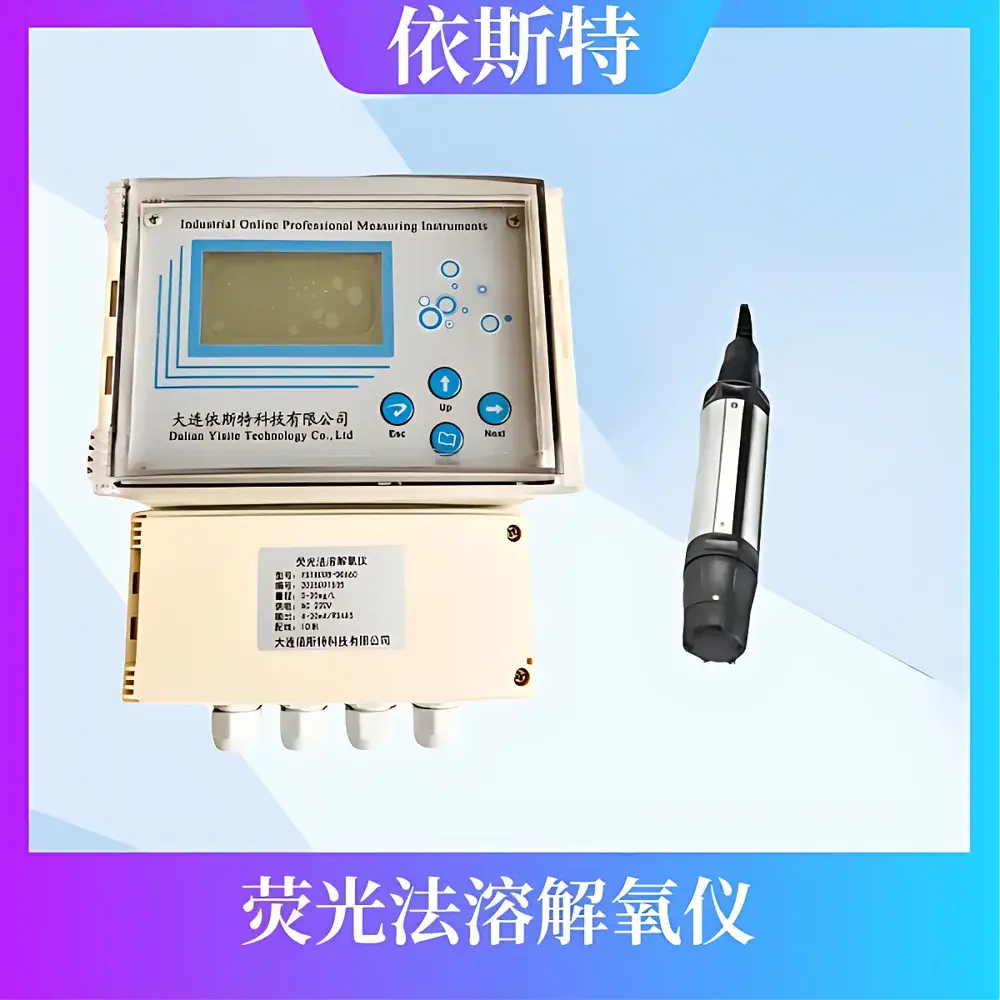
YST809B-DO660 Fluorescence-Based Dissolved Oxygen Meter
| Brand | YST (Dalian Yist Instrument Co., Ltd.) |
|---|---|
| Origin | Liaoning, China |
| Model | YST809B-DO660 |
| Measurement Principle | Fluorescence Quenching (Pt-porphyrin sensor) |
| Excitation Wavelength | 470 nm |
| Emission Detection | Phase-shift analysis of red fluorescence |
| Range | 0–20 mg/L (0–20,000 ppb) |
| Accuracy | ±0.2 mg/L (0–20 mg/L), ±1 ppb + 2% (ppb range) |
| Resolution | 0.01 mg/L or 1 ppb |
| Response Time (t₉₀) | ≤30 s |
| Operating Temperature | −5 to 50 °C |
| IP Rating | IP68 |
| Submersible Depth | Up to 30 m |
| Compensation | Automatic temperature, atmospheric pressure, and salinity compensation |
| Output | RS485 (Modbus RTU), 4–20 mA analog |
| Sensor Lifetime | 1–3 years (fluorescent cap) |
| Drift | <1% per year |
| Calibration | Air-saturated water auto-calibration |
| Installation Options | Immersion, flow-through, buoy-mounted |
Overview
The YST809B-DO660 is a fluorescence-based dissolved oxygen (DO) meter engineered for continuous, high-reliability measurement in diverse aqueous environments—from municipal wastewater treatment plants and aquaculture ponds to industrial cooling loops and marine monitoring buoys. Unlike electrochemical DO sensors that rely on oxygen diffusion through membranes and consumption at electrodes, the YST809B-DO660 employs optical fluorescence quenching technology. A solid-state Pt-porphyrin sensing element is excited by 470 nm blue LED light; emitted red fluorescence undergoes phase shift proportional to molecular oxygen concentration. This non-consumptive, membrane-free method eliminates drift caused by electrolyte depletion, membrane fouling, or cathode poisoning—ensuring stable baseline performance across extended deployment cycles.
Key Features
- Optical Sensing Architecture: No membranes, no electrolytes, no moving parts—reducing failure modes associated with traditional Clark-type sensors.
- Triple Environmental Compensation: Real-time correction for temperature, barometric pressure, and salinity ensures accuracy across freshwater, seawater, and variable-density industrial effluents.
- Rapid Dynamic Response: Achieves 90% response (t90) in ≤30 seconds without warm-up time—critical for process control applications requiring timely feedback.
- Robust Mechanical Design: IP68-rated housing with 30-meter submersion capability; chemically resistant casing suitable for prolonged exposure to chlorinated, sulfidic, or hydrocarbon-laden waters.
- Low-Maintenance Operation: Fluorescent cap replacement takes <60 seconds and requires no calibration recalibration—ideal for remote or unattended stations where service intervals must be maximized.
- Flexible Integration: Dual output interfaces—RS485 (Modbus RTU protocol) and isolated 4–20 mA analog—enable seamless integration into SCADA, PLC, or centralized water quality monitoring platforms.
Sample Compatibility & Compliance
The YST809B-DO660 demonstrates consistent performance across heterogeneous sample matrices. It is unaffected by hydrogen sulfide, heavy metal ions (e.g., Fe²⁺, Cu²⁺), oils, surfactants, or suspended solids that commonly interfere with amperometric sensors. Its optical design avoids zero-point drift under stagnant or low-flow conditions, making it suitable for lagoons, sediment pore water, and recirculating aquaculture systems (RAS). While not certified to ISO 5814 or ASTM D888 as a standalone device, its measurement methodology aligns with the optical principles referenced in these standards. The instrument supports audit-ready data logging when paired with compliant host software, facilitating GLP-aligned recordkeeping in regulated environmental laboratories.
Software & Data Management
Data acquisition and configuration are managed via onboard menu-driven interface with Chinese-language display (configurable firmware options available for English UI upon request). Air-saturation calibration is performed automatically using ambient air reference—eliminating dependency on standardized buffer solutions or manual zero/span procedures. For networked deployments, Modbus RTU enables polling of DO concentration, temperature, pressure, salinity, sensor status, and cap age counter. When integrated with third-party SCADA or cloud telemetry gateways (e.g., MQTT-enabled edge devices), the YST809B-DO660 supports time-stamped data transmission, threshold-based alerting, and historical trend visualization—compatible with FDA 21 CFR Part 11 requirements when implemented with appropriate electronic signature and audit trail infrastructure.
Applications
- Municipal Wastewater Treatment: Real-time DO monitoring in aerobic basins and oxidation ditches to optimize blower energy use and maintain nitrification efficiency.
- Marine & Freshwater Aquaculture: Continuous DO surveillance in shrimp hatcheries and finfish raceways, with programmable low-oxygen alarms (e.g., 3.0 mg/L threshold) to trigger aerator activation.
- Industrial Water Systems: Corrosion-sensitive monitoring of cooling tower make-up water and closed-loop recirculation systems where electrochemical interference is prevalent.
- Environmental Field Monitoring: Deployment on moored buoys, riverbed mounts, or portable sondes for long-term ecological assessment campaigns.
- Research & Education: Stable, low-drift measurements for laboratory-scale bioreactor studies, sediment flux experiments, and undergraduate water chemistry labs.
FAQ
How does fluorescence quenching differ from electrochemical DO measurement?
Fluorescence-based detection measures phase shift or intensity decay of light emitted from an oxygen-sensitive fluorophore—no oxygen is consumed during measurement. Electrochemical sensors consume O₂ at the cathode, requiring diffusion-limited operation and frequent maintenance.
Is field calibration required after fluorescent cap replacement?
No. The YST809B-DO660 retains factory calibration coefficients; only air-saturation verification is recommended post-replacement.
Can this sensor operate in highly turbid or biofouling-prone water?
Yes. The optical path is sealed within the cap; routine cleaning with soft cloth and mild detergent restores signal integrity—even after weeks of exposure to algal blooms or sludge layers.
What is the expected lifetime of the fluorescent sensing cap?
1–3 years depending on UV exposure, mechanical abrasion, and chemical environment; annual drift remains below 1% under normal operating conditions.
Does the instrument support salinity compensation for estuarine or brackish water applications?
Yes. User-input or auto-detected salinity values (0–70 ppt) are applied in real time to correct for oxygen solubility variations per ISO 5814 Annex B guidelines.







