
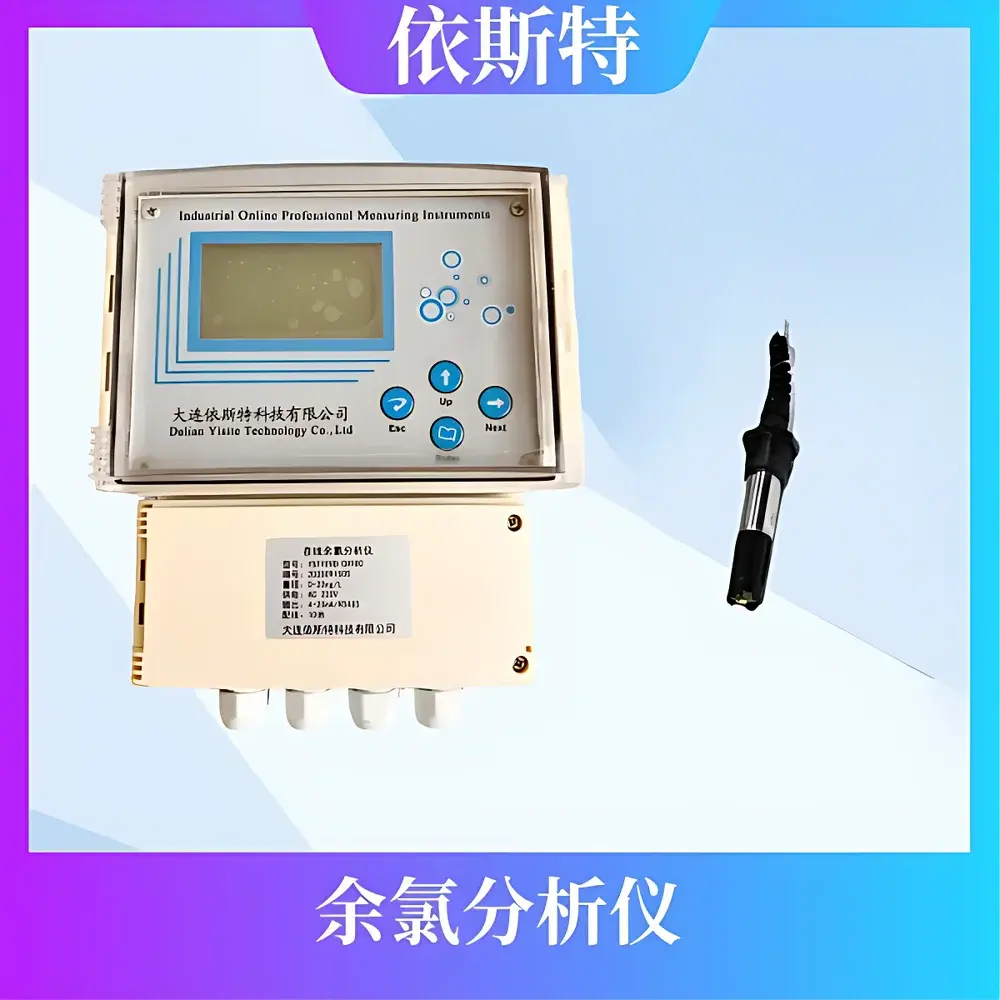
YST909B-CH980 Fixed-Mount Online Residual Chlorine Analyzer
| Brand | YST (Dalian Yistek) |
|---|---|
| Origin | Liaoning, China |
| Model | YST909B-CH980 |
| Measurement Range | 0.01–200 mg/L as Cl₂ |
| Resolution | 0.001–0.1 mg/L |
| Accuracy | ±0.15% of full scale |
| Response Time (T90) | ≤120 s |
| Operating Temperature | 0–60 °C |
| Humidity Limit | <95% RH (non-condensing) |
| Sample Temp. | 0–45 °C |
| Sample Flow Rate | ≈500 mL/min |
| Sample Pressure | 0.1–0.3 bar |
| Power Supply | AC 100–240 V / DC 18–36 V |
| Power Consumption | 12–120 W |
| Enclosure Rating | IP65 |
Overview
The YST909B-CH980 Fixed-Mount Online Residual Chlorine Analyzer is an industrial-grade electrochemical monitoring system engineered for continuous, real-time quantification of free chlorine and total chlorine concentrations in potable water, wastewater effluent, and recirculating process streams. It operates on amperometric sensing principles with a membrane-covered chlorine-selective electrode, enabling selective detection of dissolved hypochlorous acid (HOCl) and hypochlorite ion (OCl⁻) across a broad dynamic range. Unlike colorimetric or DPD-based benchtop analyzers, the YST909B-CH980 delivers stable, reagent-free measurement without consumables—making it suitable for unattended operation in remote or resource-constrained infrastructure environments. Its design conforms to fundamental requirements for continuous emission monitoring systems (CEMS) under water quality regulatory frameworks, including ISO 7888 (water quality — determination of residual chlorine), ASTM D1253 (standard test method for residual chlorine in water), and US EPA Method 334.0 (amperometric titration for chlorine species).
Key Features
- Amperometric chlorine sensor with integrated temperature compensation circuitry, minimizing drift due to ambient or sample thermal fluctuations.
- Configurable sampling interval (1–999 minutes) and programmable auto-calibration cycles aligned with operational maintenance schedules.
- Dual-output interface: isolated 4–20 mA analog signal for PLC/SCADA integration and RS-232/RS-485 serial communication supporting Modbus RTU protocol for bidirectional data exchange.
- Onboard non-volatile memory storing up to 14,000 timestamped measurement records and 100 entries of service history—including calibration logs, sensor diagnostics, and cleaning events.
- Modular dry/wet compartment architecture isolates electronics from wet chemistry zones, enhancing long-term reliability in high-humidity or outdoor deployments (IP65-rated enclosure).
- Three-level alarm system (warning, alert, critical) with configurable thresholds and relay outputs for actuating dosing pumps, valve controls, or audible/visual notification devices.
Sample Compatibility & Compliance
The analyzer is validated for use with municipal drinking water, secondary-treated wastewater effluent, cooling tower make-up water, and food-grade process water. It accommodates inlet pressures between 0.1–0.3 bar and requires a consistent sample flow rate of approximately 500 mL/min—achievable via built-in peristaltic sampling pump or external pressurized loop. The sensor head tolerates sample temperatures from 0–45 °C and exhibits minimal interference from common ions such as nitrate, sulfate, and chloride at typical utility concentrations. While not certified to UL/cUL or ATEX standards, its electrical isolation and ingress protection meet IEC 60529 IP65 requirements for indoor/outdoor wall-mount or pipe-tap installations. Data integrity protocols support audit-ready operation under GLP-aligned workflows, with optional time-stamped event logging compatible with 21 CFR Part 11-compliant data management platforms when interfaced via secure serial gateway.
Software & Data Management
The YST909B-CH980 supports seamless integration into centralized supervisory control systems through native Modbus RTU over RS-485. Raw measurement values, status flags (e.g., sensor fault, low flow, calibration overdue), and diagnostic codes are mapped to standard register addresses for direct ingestion by SCADA historians or cloud-based IoT platforms. Optional configuration software (Windows-based, USB-connected) enables advanced parameter tuning—including slope/offset adjustment, alarm hysteresis, and T90 response damping. All logged data adhere to UTC timestamps with millisecond resolution, facilitating temporal correlation with upstream disinfection dosing events or downstream compliance reporting periods. When deployed in municipal smart water networks, the device routinely feeds into dashboards compliant with ISO 55000 asset management principles and WEF’s Smart Water Utility Framework.
Applications
- Municipal wastewater disinfection control: Closed-loop feedback to sodium hypochlorite dosing systems, ensuring consistent effluent chlorine residuals while minimizing chemical overfeed and DBP formation.
- Drinking water distribution monitoring: Installation at treatment plant outlets and critical nodes in aging pipe networks to track chlorine decay kinetics and optimize booster station dosing strategies.
- Rural and off-grid water supply: Solar-powered deployment with 4G LTE telemetry enables real-time monitoring across geographically dispersed small-scale treatment facilities lacking grid connectivity.
- Industrial process water assurance: Continuous verification of residual biocide levels in pharmaceutical clean-in-place (CIP) rinse water, semiconductor ultrapure water loops, and food processing line sanitation validation.
FAQ
Does the YST909B-CH980 require reagents or consumable kits for routine operation?
No—this is a reagent-free amperometric analyzer; only periodic sensor membrane replacement (typically every 6–12 months depending on water matrix) and electrolyte refills are required.
Can the device be calibrated remotely via digital interface?
Yes—zero and span calibration can be initiated and verified through Modbus commands or local keypad input; calibration results are stored with full traceability metadata.
Is the sensor compatible with seawater or high-salinity brackish water?
Not recommended—elevated chloride concentrations (>5,000 mg/L) may accelerate electrode polarization and reduce measurement linearity; application-specific validation is advised prior to deployment.
What is the expected service life of the chlorine sensor under typical municipal water conditions?
Under continuous operation with regular cleaning and proper storage during shutdowns, functional lifespan exceeds 24 months with maintained accuracy within specification limits.
How does the analyzer handle air bubbles or particulate interference in the sample stream?
An integrated flow cell with laminar flow geometry and bubble trap chamber minimizes transient artifacts; optional inline filtration (50 µm) is recommended for turbid or suspended-solid-laden samples.
Related Products







