
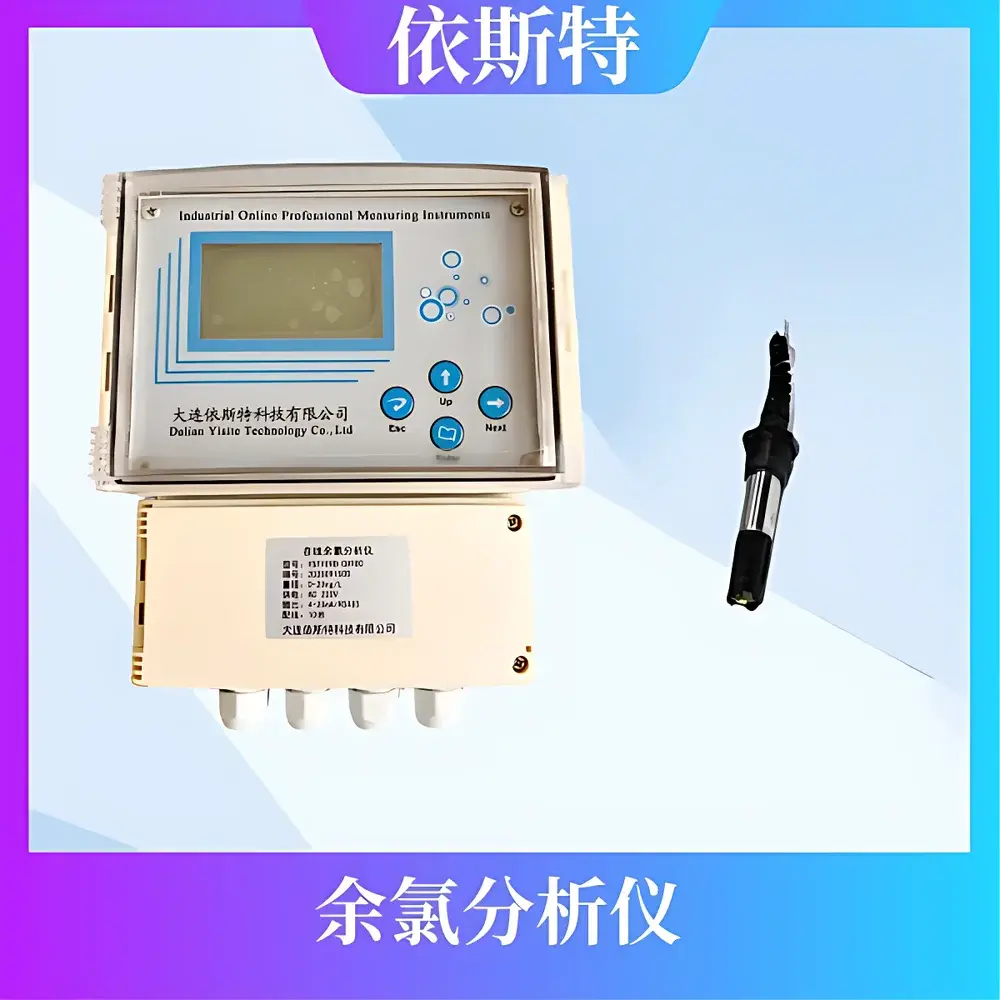
YST909B-CH980 Online Residual Chlorine and Chlorine Dioxide Analyzer by YST (Dalian Yist Instrument Co., Ltd.)
| Brand | YST (Dalian Yist Instrument Co., Ltd.) |
|---|---|
| Origin | Liaoning, China |
| Model | YST909B-CH980 |
| Measurement Principle | Electrochemical and DPD-based Spectrophotometric Methods |
| Range (Electrochemical) | 0.01–200 mg/L as Cl₂ |
| Range (Spectrophotometric) | 0.0–10.0 mg/L as Cl₂ |
| Resolution (Electrochemical) | 0.001–0.1 mg/L |
| Resolution (Spectrophotometric) | 0.01 mg/L |
| Accuracy | ±0.15% of full scale or ±0.05 mg/L (whichever is greater) |
| Response Time (T90) | ≤120 s (electrochemical), ≤2.5 min (free chlorine), ≤3.5 min (total chlorine) |
| Operating Environment | 0–60 °C, <95% RH (non-condensing), vibration-free, well-ventilated indoor space |
| Power Supply | AC 100–240 V / DC 18–36 V |
| Power Consumption | ≤120 W |
| Enclosure Rating | IP65/IP66 |
| Output Interfaces | RS-232, RS-485, 4–20 mA analog output |
| Data Storage Capacity | 14,000 records |
| Auto-calibration & Self-diagnostic Functions | Yes |
| Sampling Interval | Programmable from 1 to 999 minutes |
Overview
The YST909B-CH980 Online Residual Chlorine and Chlorine Dioxide Analyzer is an industrial-grade, dual-mode water quality monitoring instrument engineered for continuous, real-time measurement of free chlorine, total chlorine, and chlorine dioxide concentrations in potable water, wastewater effluent, cooling water, and process water systems. Designed in accordance with fundamental electrochemical sensor principles and standardized DPD (N,N-diethyl-p-phenylenediamine) spectrophotometric methodology, the analyzer supports two independent operational modes—electrochemical detection for broad-range, reagent-free monitoring (0.01–200 mg/L as Cl₂), and spectrophotometric analysis for high-precision low-concentration applications (0.0–10.0 mg/L as Cl₂). Its architecture integrates temperature and pH compensation algorithms, ensuring measurement stability across variable water matrices and ambient conditions. The device is intended for permanent installation in municipal drinking water distribution networks, wastewater treatment plants, industrial cooling towers, and decentralized rural water supply systems where regulatory compliance, long-term reliability, and minimal operator intervention are critical.
Key Features
- Dual-measurement capability: Simultaneous support for electrochemical and DPD-based spectrophotometric detection—enabling flexible deployment based on application-specific accuracy, range, and maintenance constraints.
- Robust environmental resilience: IP65/IP66-rated enclosure with dry/wet compartment separation ensures reliable operation in outdoor, semi-industrial, and high-humidity environments—including unheated pump stations and rooftop installations.
- Intelligent self-management: Built-in auto-calibration routines, sensor health diagnostics, and drift compensation reduce manual oversight and extend calibration intervals without compromising traceability.
- Low-power design: Optimized power architecture supports solar-battery hybrid configurations (DC 18–36 V input), making it suitable for off-grid or energy-constrained sites such as remote source water intakes and village-level water kiosks.
- Modular hardware layout: Field-replaceable sensor cartridges, optical cells, and electronic modules facilitate rapid maintenance with standard tools—minimizing downtime during routine servicing or component upgrades.
- Flexible mounting options: Compatible with both wall-mount and inline pipe-mount configurations, accommodating varying spatial constraints and hydraulic requirements without flow disruption.
Sample Compatibility & Compliance
The YST909B-CH980 is validated for use with clarified, low-turbidity aqueous samples typical of treated drinking water and secondary-treated effluents. It accommodates inlet pressures up to 6 bar and tolerates moderate fluctuations in conductivity (up to 2,000 µS/cm) and suspended solids (<10 mg/L). While not certified to ISO/IEC 17025 for accredited testing, its measurement methodology aligns with established reference protocols including Standard Methods for the Examination of Water and Wastewater (Method 4500-Cl G and 4500-Cl I) and EPA Method 334.0 for chlorine determination. The device’s data logging and alarm functions support basic GLP-compliant recordkeeping, and its 4–20 mA and Modbus RTU outputs enable integration into SCADA platforms that comply with IEC 62443 cybersecurity frameworks. For regulated utilities, the analyzer serves as a primary or secondary monitoring node in systems governed by national drinking water standards (e.g., China’s GB 5749-2022, U.S. EPA CFR Title 40 Part 141).
Software & Data Management
The embedded firmware provides local configuration via intuitive LCD interface and keypad navigation, supporting parameter setup, calibration history review, and diagnostic status reporting. All measurements—including timestamps, raw sensor values, compensated results, and system event logs—are stored internally in non-volatile memory (14,000-entry capacity) with time-stamped integrity. Data export is supported through RS-232/RS-485 serial interfaces using ASCII or Modbus RTU protocols, enabling seamless ingestion into centralized water management platforms (e.g., OSIsoft PI, Ignition SCADA, or custom cloud dashboards). Audit trails include calibration events, sensor fault codes, and user-initiated actions—facilitating internal QA reviews and periodic regulatory inspections. No proprietary software license or cloud subscription is required; integration relies solely on open industrial communication standards.
Applications
- Municipal drinking water distribution: Continuous verification of disinfectant residual at entry points, storage reservoirs, and critical junctions to ensure microbial safety and regulatory compliance.
- Wastewater disinfection control: Monitoring post-chlorination or chlorine dioxide contact basins to optimize dosing and prevent under-/over-chlorination.
- Industrial process water: Real-time tracking of biocide residuals in cooling towers, boiler feedwater pretreatment, and pharmaceutical purified water loops.
- Rural and decentralized water supply: Low-cost, low-maintenance monitoring for small-scale water associations lacking dedicated laboratory infrastructure or trained technicians.
- Emergency response and temporary deployments: Rapid-installation capability supports disaster recovery operations, field laboratories, and construction site water safety verification.
FAQ
Does the YST909B-CH980 require routine reagent replacement?
For the electrochemical mode: No reagents are consumed. For the DPD spectrophotometric mode: Reagent cartridges are replaceable every 3–6 months depending on sampling frequency and water matrix; onboard reagent level monitoring alerts users prior to depletion.
Can the analyzer distinguish between free chlorine and total chlorine?
Yes—via sequential DPD reaction kinetics: Free chlorine reacts immediately with DPD reagent (Stage 1), while total chlorine requires iodide-catalyzed oxidation (Stage 2). The instrument performs both measurements automatically within a single cycle.
Is the device compatible with existing SCADA or IoT platforms?
Yes—through native RS-485 Modbus RTU and isolated 4–20 mA analog outputs. Configuration files and register maps are provided in standard documentation for third-party system integrators.
What is the recommended calibration frequency?
Initial calibration is performed at installation. Subsequent verification is advised every 7–30 days depending on application criticality and water stability; automated zero/span checks can be scheduled daily to monitor drift.
Does the analyzer meet any international certification standards (e.g., CE, UL)?
The unit complies with China’s CCC marking requirements for electrical safety and EMC (GB/T 17626 series). CE marking is not currently held; however, electromagnetic compatibility and insulation performance conform to IEC 61326-1 Class A criteria for industrial environments.
Related Products







