
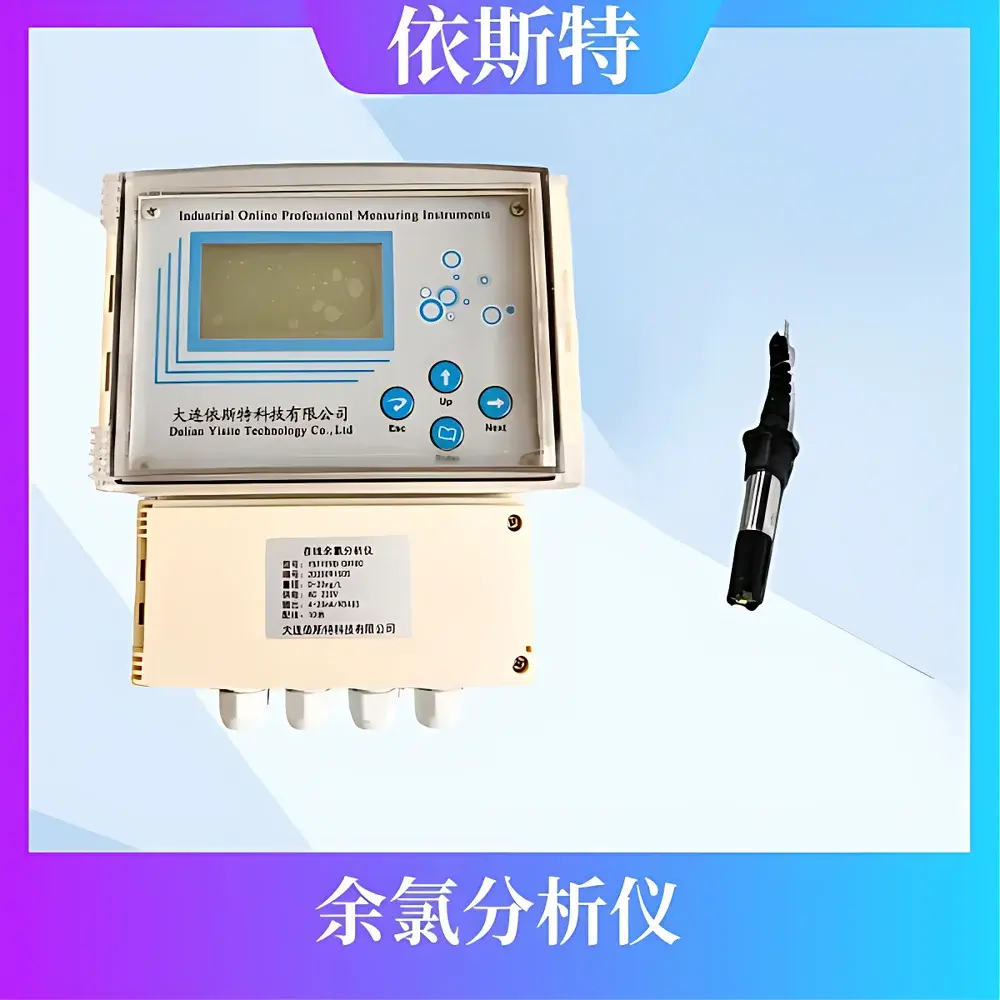
YST909B-CH980 Residual Chlorine and Chlorine Dioxide Analyzer by YST (Dalian Yist Instrument Co., Ltd.)
| Brand | YST (Dalian Yist Instrument Co., Ltd.) |
|---|---|
| Origin | Liaoning, China |
| Model | YST909B-CH980 |
| Measurement Range | 0–10 mg/L free chlorine |
| Accuracy | ±2% FS (0–5 mg/L) |
| Response Time | ≤60 s (T90) |
| Zero Drift | ≤±0.05 mg/L over 30 days |
| Span Drift | ≤±2% FS over 30 days |
| Operating Temperature | 0–50 °C |
| Relative Humidity | ≤85% RH (non-condensing) |
| Power Supply | AC 220 V ±10%, 50 Hz |
| Output Signals | 4–20 mA analog output |
| Data Storage | 6-month timestamped history (local), USB export supported |
Overview
The YST909B-CH980 Residual Chlorine and Chlorine Dioxide Analyzer is a dedicated electrochemical online analyzer engineered for continuous, real-time monitoring of free chlorine concentration in potable water, process water, and recreational water systems. It operates on the amperometric principle, utilizing a membrane-covered chlorine-selective electrode that generates a current proportional to the dissolved hypochlorous acid (HOCl) concentration under controlled pH and temperature conditions. The instrument is calibrated to report total free chlorine as mg/L Cl₂ equivalent, with built-in compensation for temperature (via integrated Pt100 sensor) and optional pH input for enhanced accuracy in variable-pH environments. Designed for unattended operation in fixed-installation settings, the YST909B-CH980 meets functional requirements for regulatory compliance in drinking water distribution (e.g., WHO Guidelines for Drinking-water Quality, EPA Method 334.0), swimming pool management (CDC Model Aquatic Health Code), and food processing hygiene control (FDA Food Code §3-201.11).
Key Features
- Continuous online measurement with T90 response time ≤60 seconds, enabling rapid detection of disinfectant depletion or overdosing events.
- Stability-optimized sensor architecture: zero drift ≤±0.05 mg/L and span drift ≤±2% FS over 30-day continuous operation—validated under ISO 5667-3 compliant test conditions.
- Integrated dual-point automatic calibration system: programmable zero (dechlorinated water) and span (standard chlorine solution) calibration intervals from 1 to 30 days, reducing manual intervention and operator dependency.
- Robust interference mitigation: proprietary hydrophobic membrane and selective electrolyte formulation minimize cross-sensitivity to oxidants (e.g., ozone, hydrogen peroxide), organic chloramines, and turbidity up to 100 NTU—performance verified across pH 6.0–9.0 range per ASTM D1253.
- Dual-output architecture: isolated 4–20 mA analog output for PLC/SCADA integration and RS485 interface supporting Modbus RTU protocol for bidirectional communication and remote configuration.
- Onboard non-volatile memory storing ≥180 days of timestamped measurement records (15-minute default interval); data export via standard USB-A port using FAT32-formatted flash drives—no proprietary software required.
Sample Compatibility & Compliance
The YST909B-CH980 is validated for use with clear to moderately turbid aqueous samples meeting the following physicochemical constraints: temperature 0–50 °C, pH 6.0–9.0, conductivity < 2000 µS/cm, and suspended solids < 100 mg/L. It is not intended for seawater, high-organic wastewater, or highly acidic/alkaline industrial effluents without pre-treatment. While not certified to IEC 61508 SIL or ATEX standards, its electrical design complies with IEC 61000-6-2 (immunity) and IEC 61000-6-4 (emissions). For regulated environments, the device supports audit-ready operation when paired with external data loggers compliant with FDA 21 CFR Part 11 (electronic records/signatures) and GLP/GMP traceability requirements—timestamped calibration logs, alarm events, and maintenance flags are stored with immutable metadata.
Software & Data Management
No proprietary PC software is required for basic operation. Configuration, calibration, and alarm threshold setting are performed via the front-panel keypad and LCD interface with multilingual (English/Chinese) menu navigation. All operational parameters—including calibration dates, sensor status, alarm history, and output scaling—are accessible locally. For enterprise-level integration, the RS485 port enables seamless connection to industry-standard SCADA platforms (e.g., Ignition, Siemens Desigo, Honeywell Experion) using native Modbus mapping tables provided in the technical manual. Historical data exported via USB follows CSV format with ISO 8601 timestamps (YYYY-MM-DDTHH:MM:SS), facilitating import into LIMS, Excel, or Python-based analytics pipelines without format conversion.
Applications
- Municipal drinking water distribution: Continuous monitoring at finished water contact tanks and critical points in the distribution network to ensure residual disinfectant persistence per WHO and national regulatory thresholds (e.g., ≥0.2 mg/L at consumer tap).
- Commercial swimming pools and spas: Real-time control of chlorine dosing systems in high-bather-load facilities, where rapid decay necessitates sub-minute responsiveness to maintain CDC-recommended 1–3 mg/L free chlorine levels.
- Food and beverage processing: Verification of sanitizing rinse water in CIP systems and post-rinse validation for equipment surfaces, supporting HACCP prerequisite programs and third-party audits (SQF, BRCGS).
- Hospital and pharmaceutical utilities: Monitoring of purified water loops where low-level chlorine residuals must be maintained during storage and distribution to prevent biofilm formation—aligned with USP <1231> Water for Pharmaceutical Purposes guidance.
FAQ
What sample pretreatment is required before installation?
No filtration or chemical conditioning is needed for typical municipal or pool water. For applications with >50 NTU turbidity or >20 mg/L suspended solids, inline 5–10 µm cartridge filtration is recommended upstream of the flow cell.
Does the analyzer measure combined chlorine (chloramines)?
No—the YST909B-CH980 is optimized for free chlorine (HOCl/OCl⁻) only. Combined chlorine requires separate colorimetric analysis (e.g., DPD method) or a dual-sensor platform.
Can the device operate in outdoor enclosures without climate control?
Yes, provided ambient temperature remains within 0–50 °C and relative humidity stays below 85% non-condensing; NEMA 4X-rated mounting housings are advised for exposed installations.
How often must the chlorine sensor membrane be replaced?
Under continuous operation in clean water, the membrane and electrolyte typically require replacement every 6–12 months—service intervals are logged automatically and displayed as maintenance alerts on the front panel.
Is firmware upgrade capability available?
Yes—field-upgradable firmware is delivered via USB stick; version history, release notes, and upgrade procedures are published in the Technical Support Portal accessible to registered end users.
Related Products







