
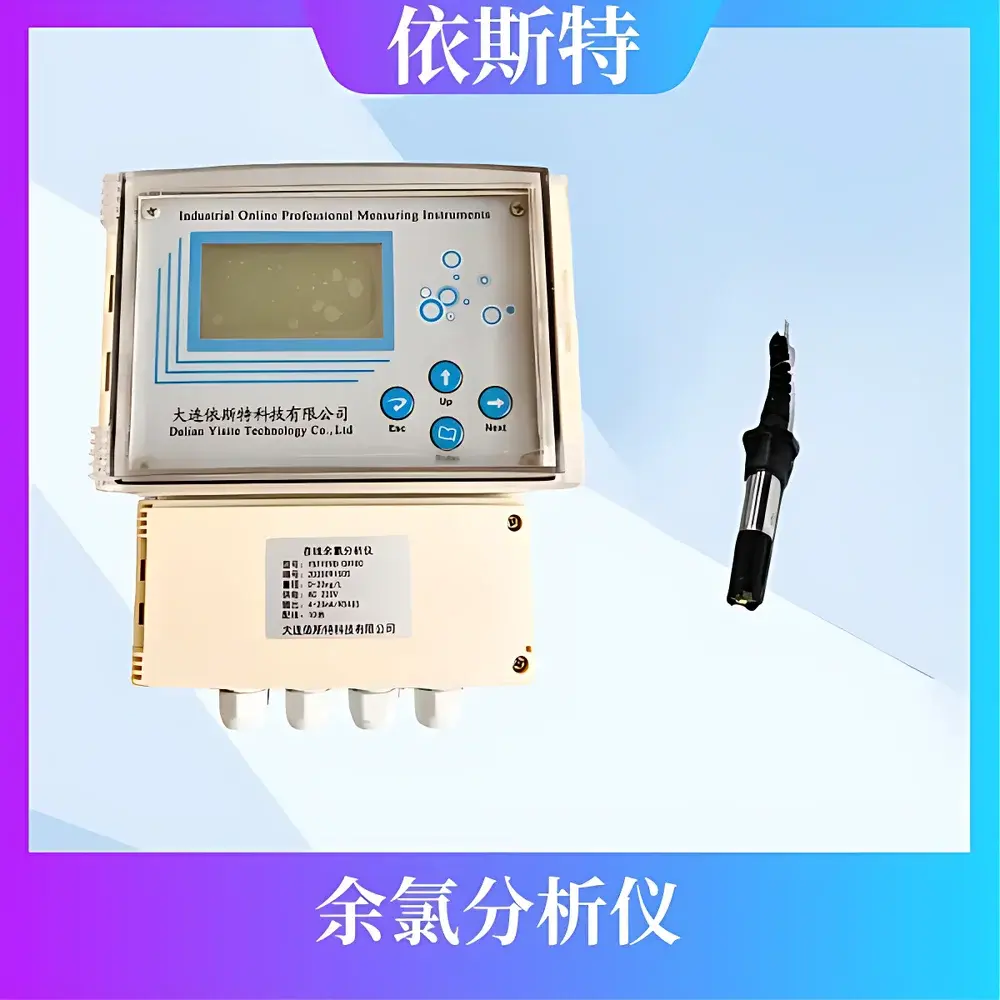
YST909B-CH980 Split-Type Online Residual Chlorine Analyzer
| Brand | YST (Dalian Yisite) |
|---|---|
| Origin | Liaoning, China |
| Model | YST909B-CH980 |
| Measurement Range | 0–1 mg/L / 0–5 mg/L / 0–10 mg/L (selectable) |
| Resolution | 0.001 mg/L (low range), 0.01 mg/L (mid/high range) |
| Repeatability | ≤1% |
| Response Time (T90) | ≤60 s |
| Operating Temperature | 0–50°C (indoor), –10–60°C (outdoor explosion-proof version) |
| Humidity | ≤90% RH (non-condensing) |
| Sample Temp. | 0–50°C |
| Sample Pressure | 0.1–0.6 MPa |
| Output | 4–20 mA analog, RS485/RS232 (Modbus RTU) |
| Relay Outputs | 2 configurable (NO/NC, 220 VAC/5 A) |
| Power Supply | AC 220 V ±10%, 50 Hz or DC 24 V |
| Sampling Modes | Flow-through (50–300 mL/min) and Immersion |
| Auto-Cleaning | Yes |
| Compliance | Designed for ISO 9001-manufactured systems |
Overview
The YST909B-CH980 Split-Type Online Residual Chlorine Analyzer is an industrial-grade electrochemical monitoring system engineered for continuous, real-time quantification of free chlorine and total residual chlorine in potable water, wastewater effluent, and process streams. Unlike portable or lab-based colorimetric methods, this analyzer employs amperometric sensing technology—based on a three-electrode cell configuration—to deliver stable, drift-resistant measurements across variable water matrices. Its split architecture separates the sensor probe (submersible or flow-cell mounted) from the transmitter/controller unit, enabling flexible installation in confined spaces, hazardous zones (with optional explosion-proof housing), or remote locations where ambient conditions preclude integrated enclosures. The device operates under steady-state diffusion-controlled current principles, where chlorine species undergo catalytic reduction at the working electrode surface, generating a current linearly proportional to concentration. This principle ensures high specificity for oxidizing chlorine compounds while minimizing cross-sensitivity to common interferents such as bromide, nitrite, or ozone—provided appropriate membrane selection and calibration protocols are followed.
Key Features
- Multi-range electrochemical sensing: Selectable measurement spans (0–1, 0–5, or 0–10 mg/L Cl₂) accommodate diverse regulatory thresholds—from drinking water standards (e.g., US EPA 0.2–4.0 mg/L) to wastewater disinfection validation (e.g., WHO ≥0.5 mg/L post-contact).
- Robust environmental tolerance: IP65-rated transmitter housing; sensor variants rated for immersion in turbid, saline, or organically laden waters up to 50°C and 0.6 MPa pressure—validated per IEC 60529 and EN 61000-6-2 EMC standards.
- Dual sampling flexibility: Supports both flow-through mode (with integrated bypass manifold and sample conditioning) and direct immersion deployment—ideal for open-channel applications like reservoirs, distribution tanks, or irrigation canals.
- Automated maintenance protocol: Onboard programmable cleaning cycle activates mechanical wiper or air-pulse purge at user-defined intervals, reducing fouling-induced drift and extending calibration intervals to ≥7 days under typical municipal water conditions.
- Industrial connectivity stack: Native Modbus RTU over RS485 enables seamless integration into PLC-based SCADA, DCS, or cloud-native IIoT platforms; dual relay outputs support fail-safe dose control logic (e.g., interlock with sodium hypochlorite dosing pumps).
- Power resilience options: Dual-input power design accommodates AC mains or DC 24 V sources; optional solar-charged battery kits (with low-power sleep mode) extend operational autonomy for off-grid rural deployments.
Sample Compatibility & Compliance
The YST909B-CH980 is validated for use in chlorinated freshwater systems meeting ASTM D1253 (Standard Test Method for Total Chlorine in Water) and ISO 7393-2 (Water quality — Determination of free chlorine and total chlorine — Part 2: Colorimetric method using N,N-diethyl-p-phenylenediamine). While not a certified reference method per USP <645> or EPA Method 334.0, its performance characteristics—including ≤1% repeatability and T90 ≤60 s—align with field-deployable instrument specifications outlined in ISO 5667-3 and EN 14184-1 for continuous monitoring applications. Sensor membranes and electrolyte formulations are selected to mitigate interference from chloride ion concentrations up to 10,000 mg/L and turbidity levels exceeding 100 NTU. For regulated environments requiring data integrity compliance, the transmitter supports time-stamped event logging and change-history tracking—enabling alignment with FDA 21 CFR Part 11 when deployed with validated electronic record systems.
Software & Data Management
The embedded firmware provides local configuration via LCD keypad interface or remote access through ASCII command set over serial link. All measurement data—including raw mV output, temperature-compensated concentration values, sensor status flags (e.g., membrane integrity, electrolyte depletion), and relay activation logs—are timestamped with millisecond precision. When integrated into supervisory systems, the analyzer transmits structured datasets compliant with OPC UA Information Models for water quality monitoring (IEC 62541-100). Historical records export to CSV or XML formats compatible with LIMS, SAP EHS, or custom dashboards. Audit trails include operator ID (if authenticated), parameter modification timestamps, and calibration verification entries—supporting GLP documentation workflows in municipal utilities and contract laboratory settings.
Applications
- Municipal drinking water distribution: Real-time tracking of chlorine decay along transmission mains to optimize booster station dosing and prevent under-chlorination in terminal zones.
- Tertiary wastewater disinfection: Closed-loop control of UV/chlorine contact basins to maintain minimum CT values per EPA Guidance for Disinfection Byproduct Control.
- Rural and decentralized supply systems: Solar-powered, 4G-connected deployments for remote community wells and spring-fed reservoirs—meeting WHO Water Safety Plan monitoring requirements.
- Healthcare facility effluent management: Continuous verification of chlorine residuals in hospital wastewater prior to municipal sewer discharge, addressing local regulations on pathogen inactivation.
- Industrial process water loops: Monitoring of cooling tower make-up water and semiconductor fab ultrapure water polishing stages where residual oxidant carryover must be constrained below 0.05 mg/L.
FAQ
What chlorine species does the YST909B-CH980 measure?
It measures electrochemically active free chlorine (HOCl/OCl⁻) and total residual chlorine (including chloramines) depending on membrane permeability and operating pH—calibration must be performed against standard iodometric or DPD-based reference methods for traceability.
Is the sensor suitable for seawater or brackish water applications?
Yes—the sensor variant with reinforced PTFE membrane and Ag/AgCl reference electrode demonstrates stable operation in salinities up to 35 g/kg; however, frequent cleaning and quarterly electrolyte replacement are recommended.
How often does the system require calibration?
Initial factory calibration is traceable to NIST-certified standards; field recalibration is advised every 7–14 days in high-fouling environments or monthly under clean municipal water conditions—using freshly prepared DPD standard solutions.
Can the analyzer interface with legacy SCADA systems lacking Modbus support?
Via optional analog-to-digital signal converters or protocol gateways, it can map 4–20 mA outputs to proprietary PLC register maps; technical documentation includes register address tables for Allen-Bradley, Siemens S7, and Schneider EcoStruxure platforms.
Does the device comply with explosion-proof certification for chemical plant installations?
The outdoor-rated YST909B-CH980-EX variant carries CE ATEX II 2G Ex db IIB T4 Gb certification and IECEx approval for Zone 1 hazardous areas—subject to proper conduit sealing and grounding per IEC 60079-14.
Related Products







