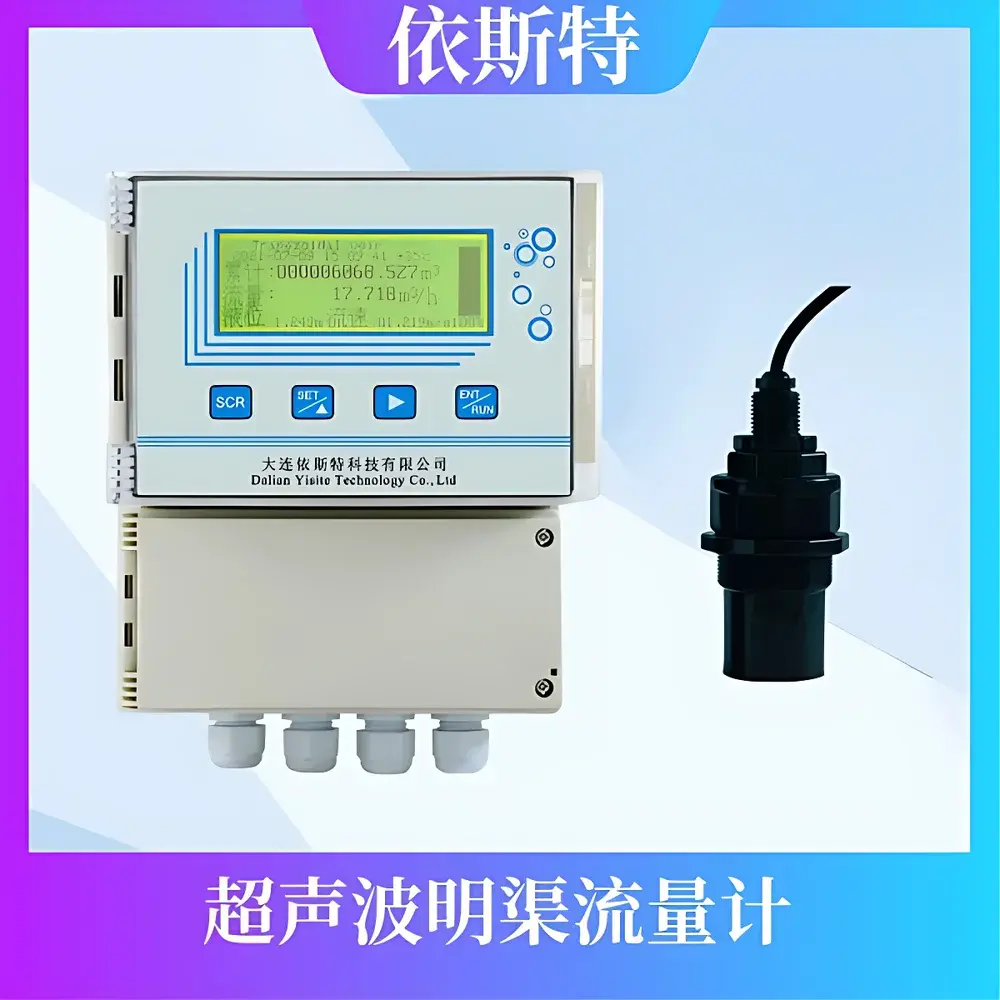
YST940M-3CY10 Corrosion-Resistant Ultrasonic Open-Channel Flowmeter for Rural Wastewater Treatment Plants
| Brand | YST (Dalian Yisite) |
|---|---|
| Origin | Liaoning, China |
| Model | YST940M-3CY10 |
| Flow Range | 0.01–1000 m³/h |
| Level Range | 0.1–10 m |
| Flow Accuracy | ±1.0% to ±2.5% FS |
| Level Accuracy | ±0.5% FS |
| Operating Temperature | −20 °C to +60 °C |
| Enclosure Rating | IP67 |
| Power Supply | 220 V AC (solar option available) |
| Communication | RS485, Modbus RTU |
| Data Storage | 8 GB internal flash (≥5 years at 1-min logging interval) |
| Sensor Material | PTFE-coated transducer |
| Housing Material | Corrosion-resistant engineering plastic |
Overview
The YST940M-3CY10 is an ultrasonic open-channel flowmeter engineered specifically for continuous, non-intrusive flow monitoring in decentralized rural wastewater treatment facilities. It operates on the principle of time-of-flight ultrasonic measurement: dual transducers mounted above the channel emit and receive ultrasonic pulses across the water surface, enabling precise determination of water level (via echo transit time) and surface velocity (via Doppler shift or cross-correlation analysis of successive level profiles). These primary measurements are then processed using built-in hydraulic algorithms—calibrated for standard open-channel geometries including rectangular, trapezoidal, and U-shaped weirs and flumes—to compute real-time volumetric flow rate (m³/h) and cumulative flow (m³). Designed for long-term deployment in uncontrolled outdoor environments, the instrument integrates corrosion mitigation, thermal resilience, and low-maintenance architecture without compromising metrological integrity.
Key Features
- Non-contact ultrasonic sensing: Transducers mounted externally above the channel eliminate exposure to abrasive solids, biofilm accumulation, and chemical corrosion—significantly reducing sensor fouling and extending service intervals.
- Multi-geometry hydraulic calibration: Preloaded algorithms support ANSI/AWWA, ISO 4359, and DIN 19511-compliant discharge equations for common primary devices (e.g., Palmer-Bowlus, Parshall, Palmer-Bowlus, and rectangular weirs), ensuring traceable flow computation under varying hydraulic conditions.
- Robust environmental protection: IP67-rated housing with UV-stabilized engineering plastic enclosure and PTFE-coated transducer faces resist degradation from H₂S, organic acids, chlorinated effluents, and high-humidity atmospheres typical of rural wastewater infrastructure.
- Flexible power architecture: Standard 220 V AC operation with optional solar-charged battery backup (external module), enabling deployment in off-grid pumping stations or remote lift stations where grid reliability is limited.
- Industrial-grade data integrity: Internal 8 GB flash memory maintains timestamped records of level, velocity, flow rate, temperature, and diagnostic flags—retaining ≥5 years of 1-minute-interval data without external storage dependency.
Sample Compatibility & Compliance
The YST940M-3CY10 is validated for use with municipal and rural wastewater streams containing suspended solids (up to 500 mg/L SS), moderate oil/grease content, and variable pH (4.5–9.5). Its measurement performance meets the functional requirements outlined in EPA Method 160.1 (open-channel flow monitoring), ASTM D5942 (field verification of ultrasonic level sensors), and ISO 748:2022 (measurement of liquid flow in open channels). While not certified to IEC 61508 SIL levels, its hardware design incorporates watchdog timers, EEPROM-based parameter retention, and self-diagnostic routines aligned with GLP-aligned field instrumentation practices. The device supports audit-ready data logging with UTC-synchronized timestamps and immutable firmware-level event logs—facilitating compliance with local environmental regulatory reporting frameworks requiring traceability and data authenticity.
Software & Data Management
Data acquisition and configuration are managed via a local LCD interface (backlit, 4-button navigation) and a secure serial protocol over RS485. The embedded Modbus RTU slave implementation (function codes 03h/04h for registers, 06h/10h for writes) enables seamless integration into SCADA systems, PLC-based control panels, or cloud telemetry gateways (e.g., MQTT-to-Modbus bridges). All configuration parameters—including channel geometry, weir coefficient, zero offset, and alarm thresholds—are stored in write-protected memory sectors. Firmware updates are performed via UART bootloader using signed binary images; no proprietary software is required. Exported CSV datasets include ISO 8601 timestamps, SI units, and metadata headers compliant with EN 13306:2017 (R&M terminology) for interoperability with third-party analytics platforms.
Applications
- Continuous inflow/outflow monitoring at decentralized package treatment plants (PTPs) serving populations <5,000 PE
- Real-time hydraulic load assessment for adaptive aeration control and sludge return ratio optimization
- Regulatory compliance reporting for discharge permits (e.g., China’s “Rural Sewage Discharge Standard” GB 18918-2002 Class I-A)
- Leak detection and infiltration/inflow (I/I) analysis in gravity-fed collection networks feeding small-scale treatment units
- Performance validation of constructed wetlands and stabilization ponds through upstream/downstream flow differentials
FAQ
Does the YST940M-3CY10 require periodic recalibration?
No scheduled recalibration is required under normal operating conditions. The ultrasonic time-of-flight measurement principle is inherently stable and drift-free; however, annual verification against a portable ultrasonic level reference or physical dip tape is recommended per ISO/IEC 17025-aligned field maintenance protocols.
Can it operate reliably in channels with floating scum or surface foam?
Yes—the PTFE-coated transducers maintain consistent acoustic coupling even with thin (<5 mm) organic films. For persistent heavy scum layers, optional mechanical wiper accessories (not included) may be integrated during installation.
Is the device compatible with existing telemetry systems using NB-IoT or LoRaWAN?
The unit itself does not include cellular or LPWAN radios; however, its RS485/Modbus output is fully interoperable with industry-standard protocol converters (e.g., Modbus-to-NB-IoT gateways from Siemens Desigo CC or Advantech ECU-1251) for edge-to-cloud transmission.
What is the minimum recommended channel width for accurate measurement?
For trapezoidal and rectangular channels, a minimum top width of 0.3 m is advised to ensure sufficient acoustic path stability and avoid near-field interference; installation guidelines specify optimal mounting height (0.5–1.5 m above maximum anticipated water level) and beam alignment tolerances (±2° pitch/yaw).
How is firmware updated in the field?
Using a standard FTDI USB-to-serial adapter and terminal emulator (e.g., PuTTY), users initiate bootloader mode via hardware reset sequence, then upload signed firmware binaries via XMODEM protocol—no vendor-specific tools or internet connectivity required.