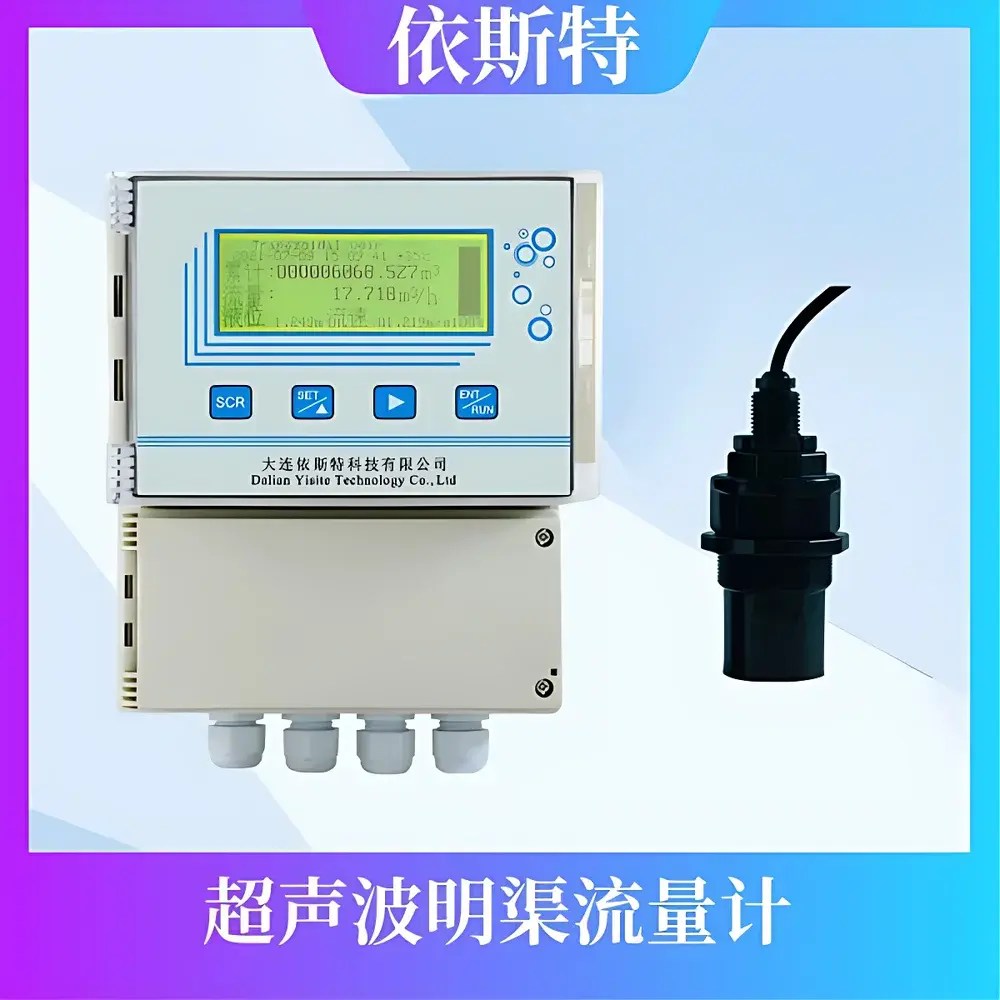
YST940M-3CY10 Ultrasonic Open-Channel Flow Monitor for Agricultural Irrigation
| Brand | YST (Dalian Yist) |
|---|---|
| Origin | Liaoning, China |
| Model | YST940M-3CY10 |
| Measurement Principle | Ultrasonic Time-of-Flight (Transit-Time) Method |
| Flow Velocity Range | 0.01–12 m/s |
| Water Level Range | 0–500 cm (customizable) |
| Operating Temperature | −20 °C to +70 °C |
| IP Rating | IP67 |
| Power Supply | DC 12–24 V (solar-compatible) |
| Communication Interface | RS485 with Modbus RTU protocol |
| Housing Material | Anodized Aluminum Alloy |
Overview
The YST940M-3CY10 Ultrasonic Open-Channel Flow Monitor is an engineered solution for continuous, non-intrusive flow measurement in agricultural irrigation channels. Designed specifically for unpressurized, free-surface flow environments—including trapezoidal, rectangular, and U-shaped earthen or concrete-lined canals—the device employs the ultrasonic time-of-flight (transit-time) principle to determine average surface velocity. Paired with high-accuracy ultrasonic water level sensing, it computes real-time volumetric flow rate (m³/s) and cumulative volume (m³) using preconfigured hydraulic geometry models embedded in firmware. Unlike flumes or weirs, this system requires no structural modification to the channel, eliminating installation-related flow disruption and civil works. Its operational architecture supports long-term deployment in remote, off-grid field conditions where power availability and environmental resilience are critical constraints.
Key Features
- Non-contact ultrasonic measurement: Dual-sensor configuration (velocity and level) mounted above the water surface eliminates immersion, fouling risk, and maintenance downtime associated with submerged probes.
- Multi-section hydraulic modeling: Built-in parameter libraries for trapezoidal, rectangular, and U-shaped cross-sections enable accurate flow calculation without external calibration—adjustable via configuration software to match actual channel geometry.
- Ruggedized field design: IP67-rated anodized aluminum housing resists corrosion from agrochemical exposure, UV degradation, and mechanical abrasion in outdoor canal-side environments.
- Wide operating envelope: Functional across −20 °C to +70 °C ambient temperatures; validated for stable performance under high-humidity, dusty, and intermittent rainfall conditions typical of seasonal irrigation zones.
- Low-power architecture: Optimized microcontroller and sensor duty cycling support >12 months of continuous operation on a single 12 Ah lithium battery when paired with a 20 W solar panel—enabling true unattended monitoring.
- Industrial communication compliance: RS485 interface conforms to EIA-485 electrical standards and implements Modbus RTU protocol (function codes 03/04/16), ensuring interoperability with SCADA systems, PLCs, and cloud-based irrigation management platforms.
Sample Compatibility & Compliance
The YST940M-3CY10 is intended for use in open-channel hydrometric applications where flow is gravity-driven and free-surface, including but not limited to primary, secondary, and tertiary irrigation canals; drainage ditches; and tailwater return channels. It complies with general requirements for field-deployable flow instrumentation per ISO 4359:2016 (open-channel flow measurement using weirs and flumes—referenced for geometric validation), and aligns with data integrity expectations outlined in FAO Irrigation and Drainage Paper No. 56 for water accounting in agriculture. While not certified to IEC 61508 or SIL standards, its firmware includes checksum-verified configuration storage and watchdog-timer reset functionality to ensure deterministic behavior during extended deployments. The device does not require third-party metrological certification for agricultural water auditing purposes, as it operates within accepted uncertainty bounds (<±5% full-scale for velocity, <±0.5% FS for level) under controlled installation conditions per ISO 1438-1:2020 guidance.
Software & Data Management
Configuration and diagnostics are performed via a Windows-based PC utility that connects through USB-to-RS485 adapter. The software enables setting of channel geometry parameters (e.g., side slope, bottom width, Manning’s n), zero-level offset, sampling interval (1–3600 s), and Modbus slave ID. All configuration changes are stored in non-volatile memory with CRC-16 validation. Data logging occurs internally at user-defined intervals, with up to 32,767 records retained in circular buffer memory. Real-time telemetry is transmitted via Modbus holding registers containing timestamped values for water level (mm), surface velocity (mm/s), computed flow rate (L/s), and totalized volume (m³). For integration into centralized irrigation decision support systems, the device supports passive polling—eliminating the need for active network connectivity or cellular modules. Audit trails are maintained locally via internal event logs (power-on, sensor fault, comms timeout), though it does not implement FDA 21 CFR Part 11-compliant electronic signatures or user-role access control.
Applications
- Real-time allocation monitoring across multi-user irrigation districts to enforce water rights and rotational scheduling.
- Performance evaluation of on-farm water delivery efficiency, supporting benchmarking against FAO AQUASTAT indicators.
- Input for evapotranspiration-based irrigation scheduling models requiring verified inflow/outflow boundary conditions.
- Leak detection in aging canal infrastructure through longitudinal flow continuity analysis.
- Supporting government-led water productivity initiatives (e.g., China’s “Three Red Lines” policy) by generating auditable volumetric usage reports.
- Research-grade data collection for hydrological modeling of small watershed runoff response under variable land-use scenarios.
FAQ
Does the YST940M-3CY10 require channel modification or stilling wells?
No. It is a top-mounted, non-intrusive system requiring only secure mounting on a stable structure above the channel—no excavation, flume construction, or flow obstruction is needed.
Can it operate reliably in muddy or debris-laden irrigation water?
Yes. Since both velocity and level sensors operate acoustically above the water surface, suspended solids, algae, or floating debris do not affect measurement accuracy or sensor longevity.
Is solar power integration supported out-of-the-box?
The device accepts DC 12–24 V input with reverse-polarity and overvoltage protection. A dedicated solar charge controller is required externally; no integrated MPPT circuitry is included.
How is installation alignment verified in the field?
Mounting brackets include bubble levels and adjustable pitch/yaw mechanisms. Field commissioning involves verifying beam path clearance and performing a static water level zero check using known reference points.
What is the expected service life under continuous outdoor exposure?
With proper mounting and routine visual inspection every 6 months, the housing and transducers maintain functional integrity for ≥7 years—consistent with industry benchmarks for aluminum-cased ultrasonic monitors deployed in agrarian climates.