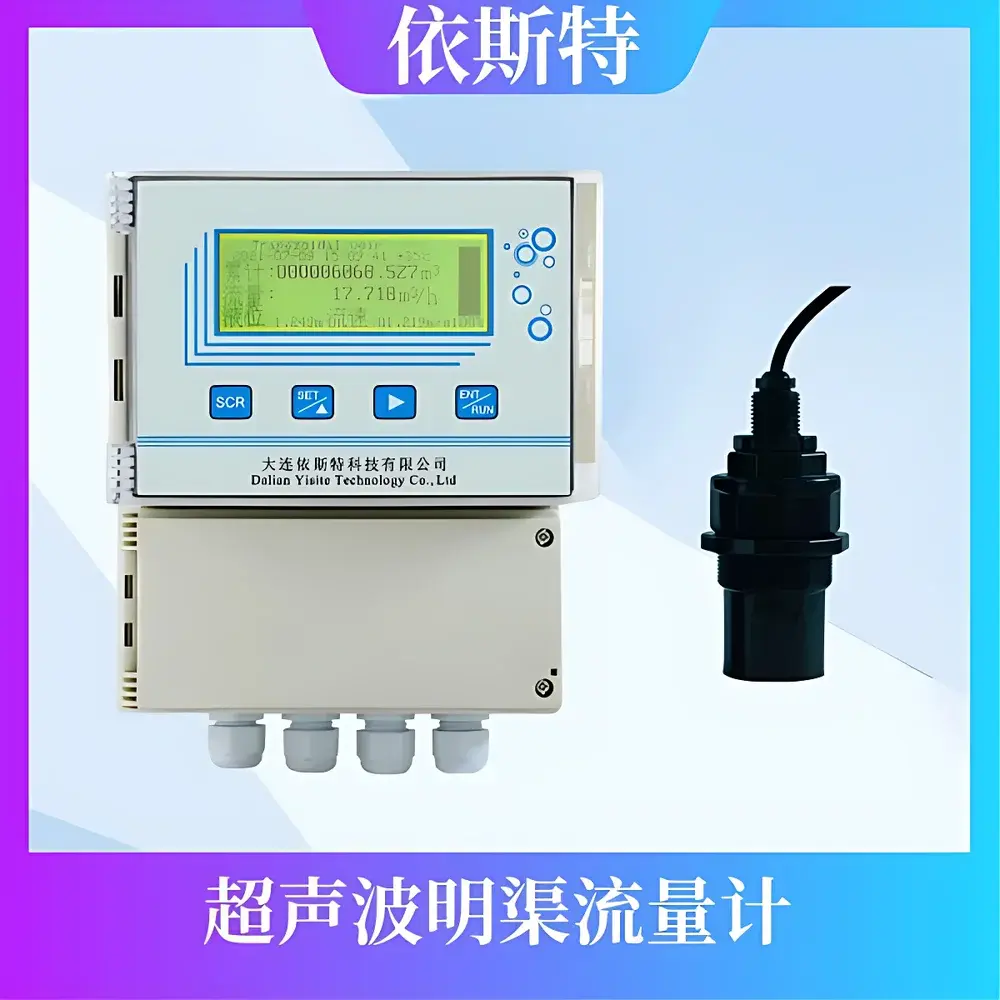
YST940M-3CY10 Ultrasonic Open-Channel Flowmeter for Municipal Wastewater Monitoring
| Brand | YST (Dalian Yisite) |
|---|---|
| Origin | Liaoning, China |
| Model | YST940M-3CY10 |
| Measurement Range | 0.01–10,000 m³/h |
| Accuracy | ±1.0% (with standard flume) |
| Level Range | 0.1–5 m |
| Power Supply | 24 VDC (100 mA), optional 220 VAC or solar |
| Communication | RS485 (Modbus RTU), optional 4G/NB-IoT |
| Enclosure Rating | IP65 (transmitter), IP68 (sensor) |
| Operating Temperature | −20 °C to +60 °C (transmitter), −20 °C to +80 °C (sensor) |
| Data Storage | ≥100,000 records in onboard Flash memory |
| Compatible Flumes | Palmer-Bowlus (Parshall), V-notch (triangular), and rectangular weirs |
Overview
The YST940M-3CY10 Ultrasonic Open-Channel Flowmeter is an engineered solution for continuous, non-intrusive flow monitoring in municipal wastewater infrastructure. Designed specifically for open-channel applications—such as gravity-fed sewers, primary/secondary treatment influent and effluent channels, and stormwater outfalls—the instrument operates on the principle of time-of-flight ultrasonic level measurement. By emitting high-frequency acoustic pulses toward the water surface and precisely measuring the return echo transit time, the device calculates real-time liquid level height. When paired with a calibrated primary device (e.g., Parshall flume, V-notch weir, or rectangular weir), this level data is converted into volumetric flow rate using standardized hydraulic equations defined in ISO 1438, ASTM D1941, and ISO 4359. The system’s non-contact architecture eliminates sensor submersion, mitigating fouling, corrosion, and mechanical wear associated with submerged pressure transducers or electromagnetic sensors—critical advantages in high-turbidity, high-suspended-solid wastewater streams.
Key Features
- Non-contact ultrasonic level sensing: Stainless steel transducer mounted above the channel surface ensures zero exposure to wastewater, eliminating clogging risks from sediment, grease, or biofilm accumulation.
- Multi-flume compatibility: Pre-configured calibration tables support Parshall (Palmer-Bowlus), V-notch (60° or 90°), and rectangular weirs per ISO 4359 Annex A, enabling rapid deployment across diverse civil infrastructure.
- Robust environmental resilience: IP68-rated sensor withstands immersion and aggressive chemical exposure; transmitter housing rated IP65 for outdoor enclosure integrity; integrated temperature compensation corrects speed-of-sound drift across −20 °C to +80 °C operational range.
- Flexible power architecture: Standard 24 VDC operation with low quiescent current (≤100 mA); optional 220 VAC input or solar-charged battery configuration supports off-grid installations in remote pump stations or rural distribution networks.
- Industrial-grade communications: Native RS485 interface compliant with Modbus RTU protocol (slave mode, addressable up to 247) enables seamless integration with SCADA, PLC, or central telemetry systems; NB-IoT and LTE-M variants provide cellular backhaul where wired infrastructure is unavailable.
- Long-term data integrity: Onboard Flash memory stores ≥100,000 timestamped level and calculated flow records with automatic rollover; all stored data retains validity for ≥10 years without power, satisfying GLP-aligned audit requirements.
Sample Compatibility & Compliance
The YST940M-3CY10 is validated for use with conventional hydraulic primary devices installed in concrete, brick, or fiberglass-lined open channels. It accommodates channel widths from 0.3 m to 6 m and maximum headwater depths up to 5 m. Calibration traceability aligns with ISO/IEC 17025-accredited laboratory practices when deployed with NIST-traceable flume geometry verification. While not certified to IEC 61508 or SIL2 for safety-critical control loops, the device meets EMC Directive 2014/30/EU (EN 61326-1) and Low Voltage Directive 2014/35/EU. Its measurement uncertainty profile (±1.0% of reading, under controlled flume conditions per ISO 1438:2021 Annex B) supports regulatory reporting under EPA Method 160.1 and EU Urban Wastewater Treatment Directive (91/271/EEC) compliance frameworks.
Software & Data Management
Configuration and diagnostics are performed via local keypad navigation and backlit LCD display (Chinese language interface only). All parameters—including flume type, throat width, discharge coefficient, damping time, and communication settings—are editable without firmware update. Data export is supported through ASCII-formatted SD card dump (optional module) or Modbus register polling. For centralized management, the device integrates natively with industry-standard platforms including Ignition SCADA, Siemens Desigo CC, and Schneider EcoStruxure Water. Audit trail functionality includes write-protected event logs capturing parameter changes, power cycles, and alarm states—consistent with FDA 21 CFR Part 11 principles for electronic record integrity in regulated utilities.
Applications
- Municipal wastewater treatment plant influent and effluent flow monitoring for process control and regulatory discharge reporting
- Combined sewer overflow (CSO) and stormwater detention basin outflow quantification
- Rural drinking water distribution network branch-line flow surveillance with solar/NB-IoT telemetry
- Hospital and industrial pretreatment facility effluent metering under local environmental permit conditions
- Real-time leakage detection and water loss assessment in aging municipal pipe networks
FAQ
Does the YST940M-3CY10 require periodic recalibration?
No routine field recalibration is required. However, annual verification against a certified reference level gauge and hydraulic validation of flume geometry are recommended per ISO 1438 Clause 8.2.
Can it operate reliably in high-foam or turbulent flow conditions?
Yes—adaptive echo filtering and programmable signal averaging suppress false echoes from surface turbulence or foam layers; optimal performance requires minimum stilling well depth of 150 mm upstream of the sensor mounting point.
Is the device compatible with third-party cloud platforms such as AWS IoT Core or Microsoft Azure IoT Hub?
When equipped with the NB-IoT option, raw Modbus registers can be mapped to MQTT payloads via edge gateway translation; native cloud ingestion requires custom middleware integration.
What maintenance intervals are recommended for long-term deployment?
Visual inspection and optical face cleaning every 3–6 months; ultrasonic transducer face must remain free of dust, ice, or biological growth to maintain acoustic coupling efficiency.
Does it support pulse output or analog 4–20 mA signals?
No—this model provides digital-only output via RS485 or cellular protocols. Analog or pulse outputs are available in the YST940M-3CY10A variant series.