
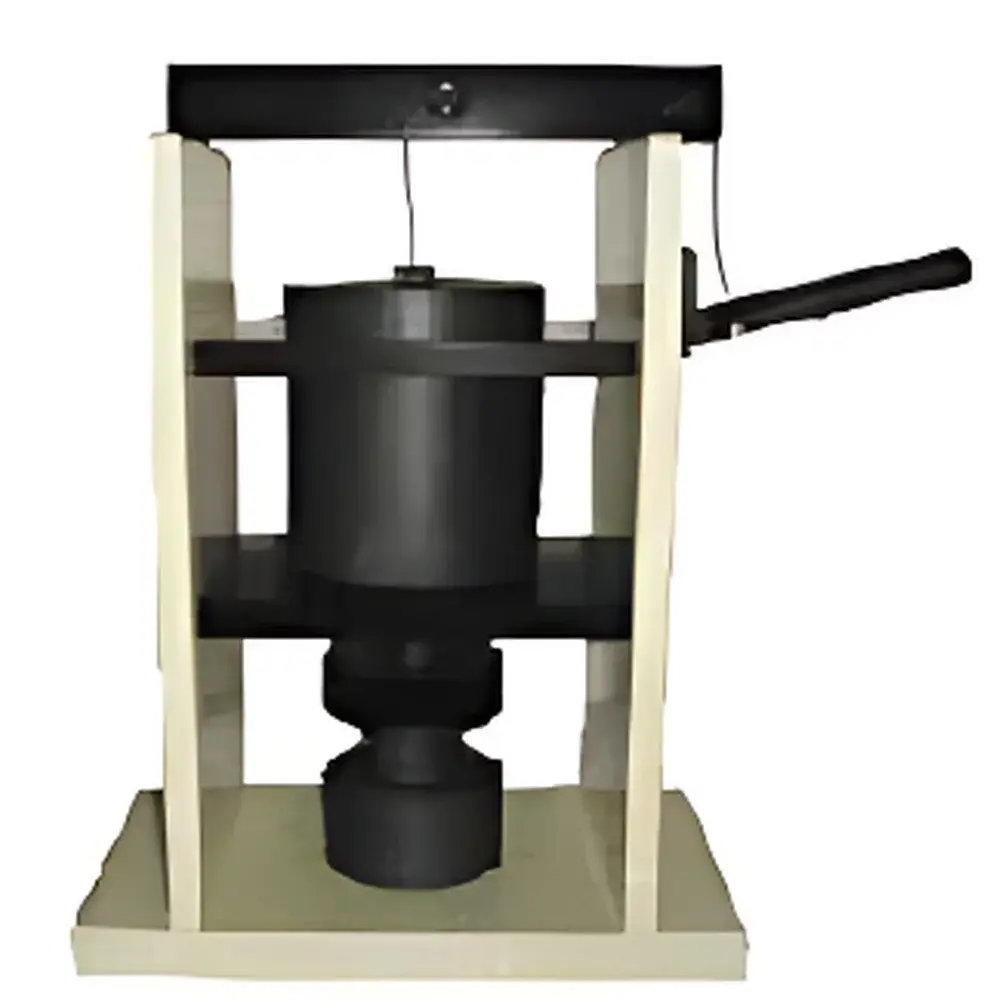
YT110 Lens Strength Tester
| Origin | Taiwan |
|---|---|
| Manufacturer Type | Authorized Distributor |
| Regional Classification | Asia-Pacific Sourced |
| Model | YT110 |
| Pricing | Available Upon Request |
Overview
The YT110 Lens Strength Tester is an engineered mechanical testing system designed specifically for evaluating the mechanical integrity and impact resistance of ophthalmic lenses—primarily plastic (CR-39, polycarbonate, Trivex) and glass lenses used in prescription eyewear, safety goggles, and occupational protective eyewear. It operates on the principle of controlled static load application followed by standardized drop-ball impact assessment, aligned with the core mechanical test requirements defined in EN 168:2022 (“Personal eye-protection — Specifications”). The device implements a calibrated vertical drop tower mechanism with adjustable height and standardized steel ball mass (16 g ± 0.1 g), enabling repeatable simulation of low-velocity impact events relevant to real-world lens failure modes such as cracking, chipping, or delamination at the lens edge or surface.
Key Features
- Compliance-driven test platform: Fully configured to execute Clause 4.3 (Impact Resistance) and Clause 4.4 (Resistance to Static Load) of EN 168:2022, including fixture geometry, support ring dimensions (Ø 30 mm ± 0.2 mm), and loading rate specifications.
- Adjustable drop height mechanism: Precision-machined guide column with digital height indicator (range: 50–130 mm in 1 mm increments), traceable to NIST-traceable calipers.
- Dual-mode operation: Supports both static load testing (via calibrated spring-loaded plunger with force sensor feedback) and dynamic impact testing (free-fall steel ball method).
- Integrated lens clamping system: Self-centering, low-deformation aluminum alloy chuck with elastomeric contact pads to prevent surface marring during fixation.
- Fail-safe interlock design: Mechanical and optical sensors ensure test initiation only when lens is correctly seated and safety shield is fully closed—meeting EN 61000-6-2/6-4 EMC and EN ISO 13857 guarding requirements.
- Modular base frame: Bolt-down configuration compatible with standard optical lab workbenches; optional vibration-dampening feet available for high-sensitivity environments.
Sample Compatibility & Compliance
The YT110 accommodates plano and curved lenses with diameters from 50 mm to 80 mm and thicknesses up to 12 mm. It supports single-vision, bifocal, and progressive addition lenses (PALs), provided the optical zone is centered within the 30 mm test aperture. All test fixtures and load elements are manufactured to dimensional tolerances specified in EN 168 Annex B. The system is routinely verified using certified reference lenses (e.g., ISO 8980-3 compliant CR-39 calibration standards) and participates in interlaboratory comparison programs coordinated by EU Notified Bodies (e.g., TÜV Rheinland, SGS). While not itself CE-marked as a standalone medical device, the YT110 is intended for use in quality control laboratories operating under ISO 13485:2016 and EN ISO 17025:2017 accreditation frameworks.
Software & Data Management
The YT110 operates in standalone mode without embedded firmware or proprietary software. Test execution is manual and operator-guided per EN 168 procedures, ensuring full transparency and auditability. All test parameters—including drop height, ball mass verification record, lens identification, date/time stamp, and pass/fail determination—are documented in a structured paper-based or LIMS-integrated test report template. For laboratories requiring electronic records, the instrument is compatible with common ELN platforms via manual data entry or barcode-scanned lens ID integration. Audit trails, user access logs, and calibration history must be maintained externally in accordance with GLP principles and FDA 21 CFR Part 11 requirements where applicable.
Applications
- Pre-certification validation of ophthalmic lenses prior to submission to EU Notified Bodies for CE marking under Regulation (EU) 2016/425 (PPE).
- In-process quality assurance during lens manufacturing—particularly for polycarbonate injection molding lines where edge stress and annealing consistency affect impact performance.
- Root cause analysis of field failures: correlating fracture patterns observed post-test with material batch data, coating adhesion metrics, and thermal history.
- Supplier qualification testing for lens raw materials (e.g., sheet stock tensile modulus, residual stress via photoelasticity).
- Supporting technical documentation for ISO 148-1 Charpy impact correlation studies in polymer optics R&D labs.
FAQ
Does the YT110 comply with ANSI Z87.1-2020 for industrial safety eyewear?
No—the YT110 is configured exclusively for EN 168:2022. ANSI Z87.1 requires higher impact energy (e.g., 500 mm drop height with 0.25″ steel ball), necessitating a separate test rig with reinforced drop tower and energy-absorbing base.
Can it test coated lenses without damaging anti-reflective layers?
Yes—provided the clamping pressure is adjusted per lens substrate hardness (e.g., ≤ 1.2 MPa for AR-coated polycarbonate); fixture contact surfaces are PTFE-coated to minimize shear-induced coating delamination.
Is calibration certification included with delivery?
A factory calibration certificate (traceable to NPL or ITRI standards) is supplied with each unit, covering drop height linearity, ball mass verification, and plunger force linearity (±1.5% FS). Annual recalibration is recommended per ISO/IEC 17025 Clause 6.6.
What maintenance intervals are specified?
Daily visual inspection of guide rails and ball surface; monthly lubrication of linear bearings with ISO VG 32 synthetic oil; biannual torque verification of clamping assembly fasteners per manufacturer’s torque table.



