
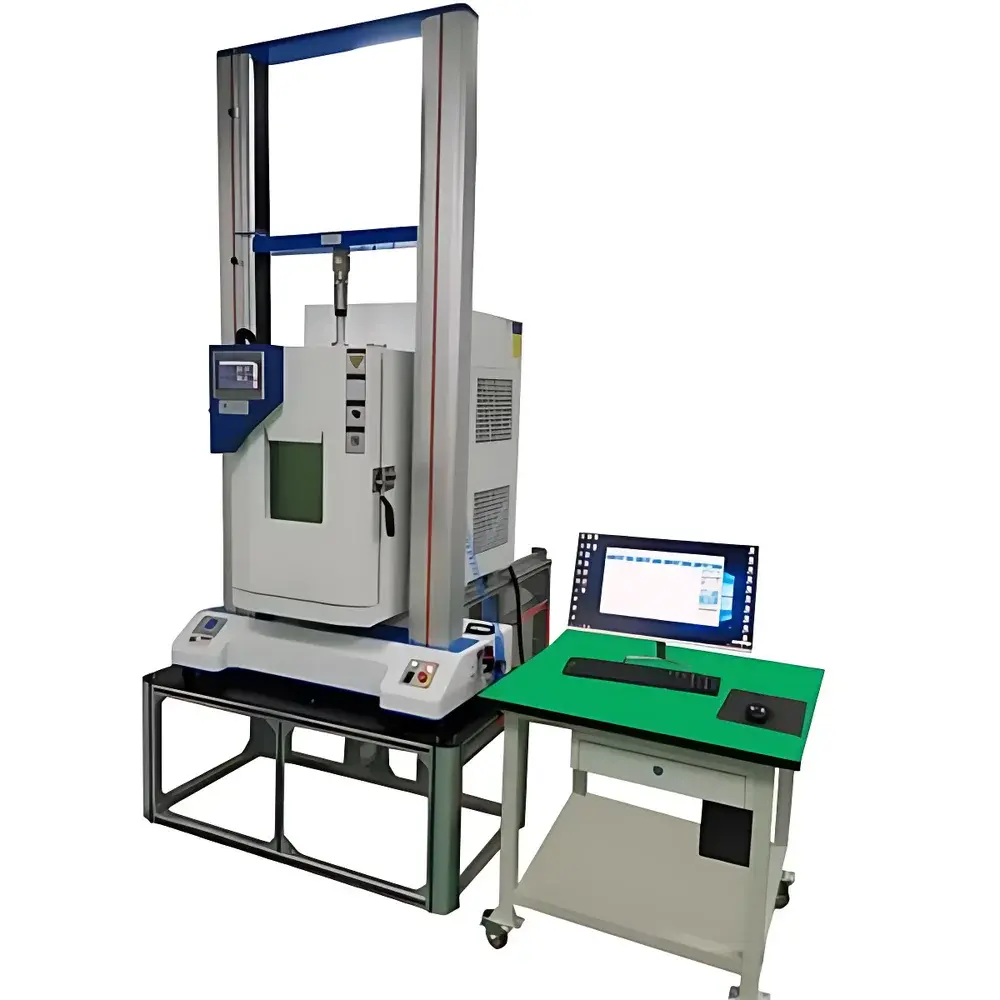
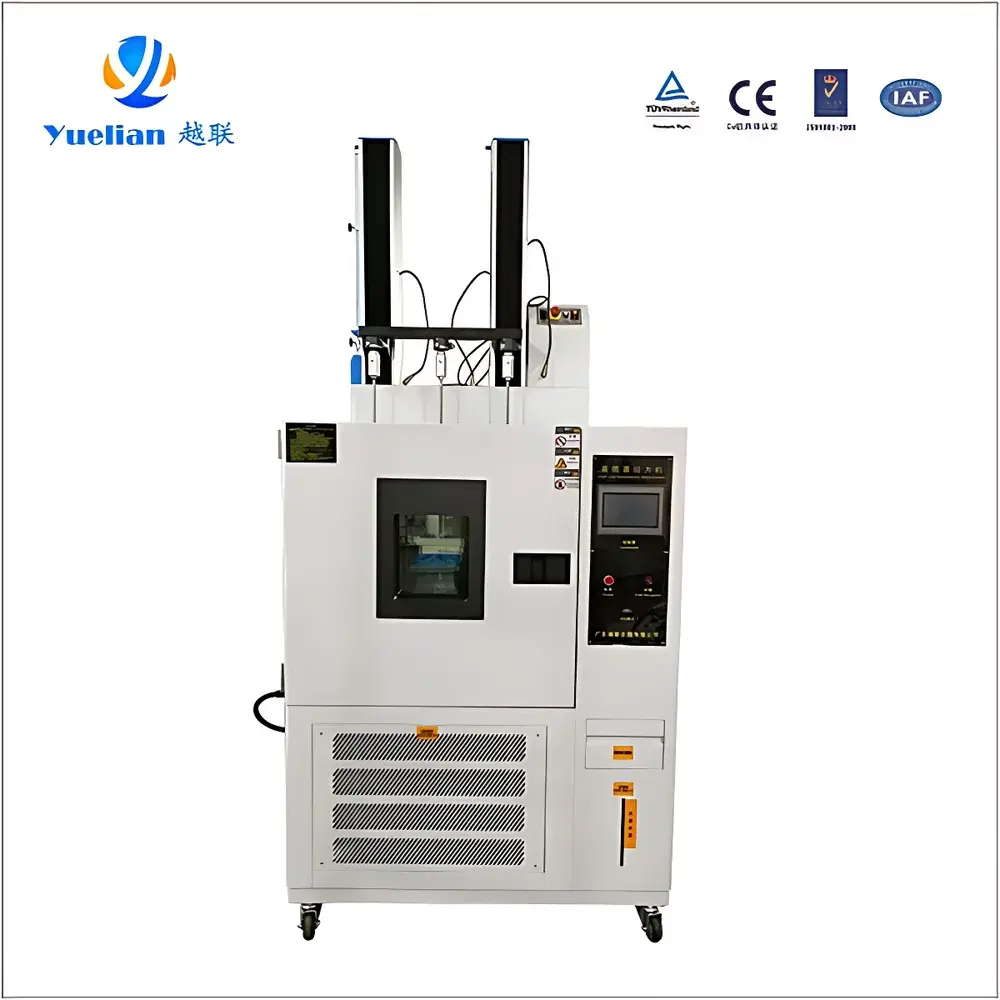
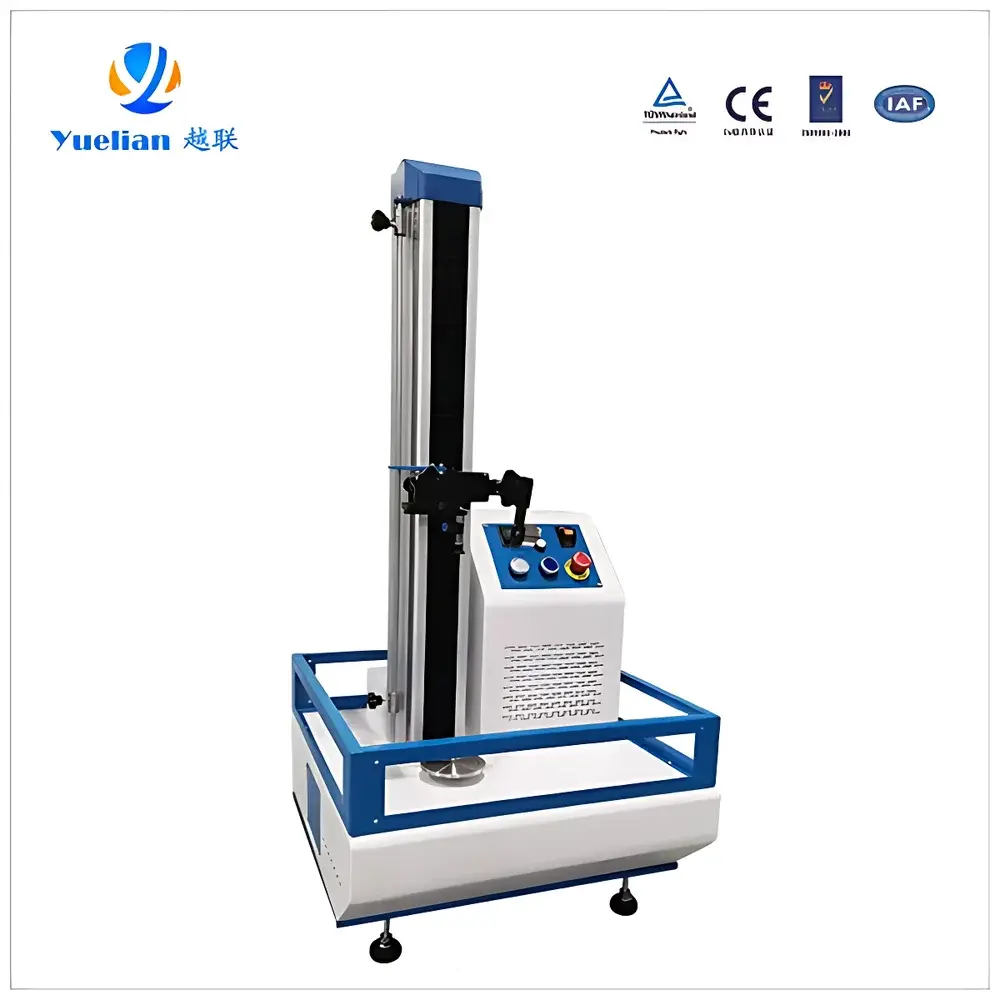
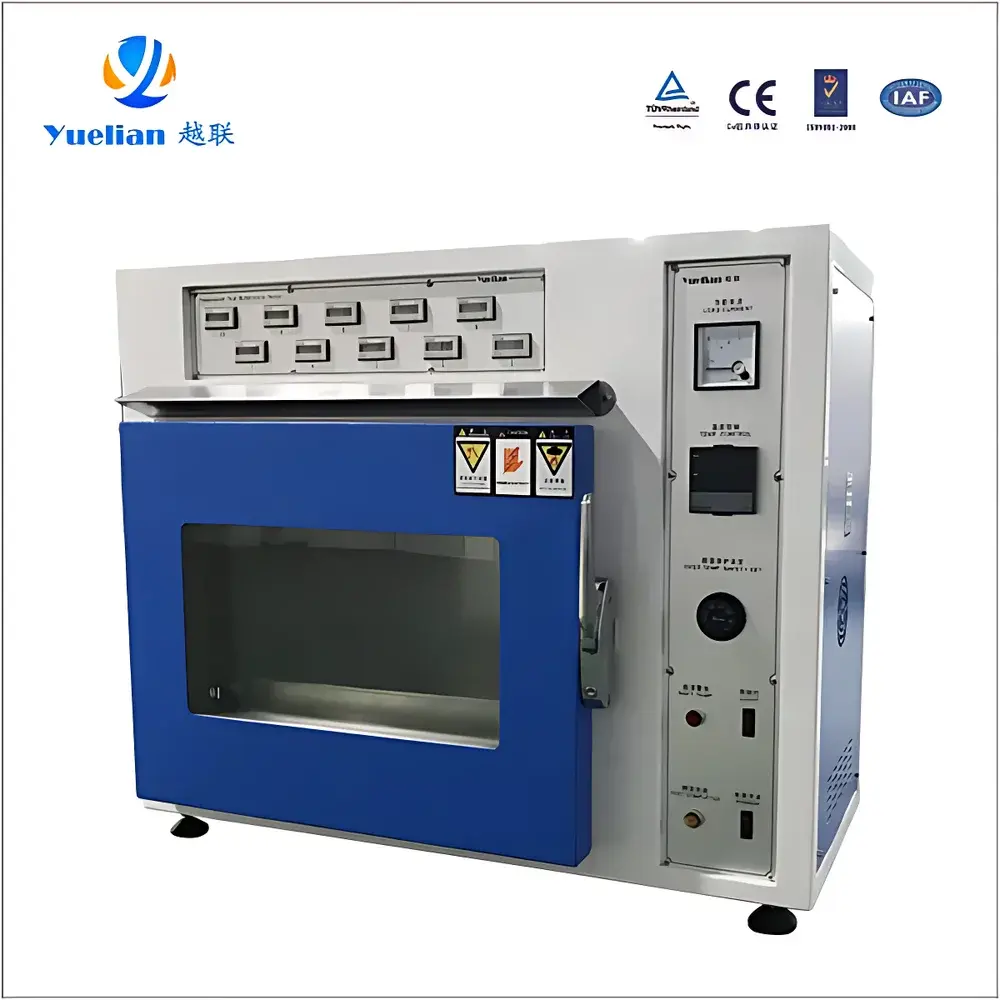
Yuelian PW-UCD80-40T3 Advanced Environmental Tensile Testing System
| Brand | Yuelian |
|---|---|
| Origin | Guangdong, China |
| Manufacturer Type | Authorized Distributor |
| Country of Origin | China |
| Model | PW-UCD80-40T3 |
| Max Load Capacity | 20 kN |
| Temperature Range | −40 °C to 350 °C (optional −70 °C to 350 °C) |
| Force Resolution | 1/1,000,000 full scale |
| Force Accuracy | ±0.03% of reading |
| Accuracy Class | ISO 7500-1 Class 0.5 |
| Displacement Resolution | 1/1,000,000 full stroke |
| Temperature Control Accuracy | ±1 °C |
| Temperature Display Resolution | 0.1 °C |
| Test Speed Range | 0.01–500 mm/min |
| Crosshead Travel | 600 mm |
| Chamber Internal Dimensions | 350 × 350 × 800 mm (W×D×H) |
| Drive System | Servo motor + precision ball screw + synchronous timing belt |
| Cooling System | Tecumseh (France) hermetic compressor with electronic expansion valve |
| Heating System | SUS304 stainless steel finned heater |
| Circulation | Forced-air convection via axial fan |
| Control Interface | 7-inch industrial touchscreen with multi-step program editing |
| Power Supply | 380 V / 50 Hz / 30 A (3-phase) |
| Total Power Consumption | ~8 kW |
| Net Weight | ~350 kg |
| Standard Accessories | One set of tensile grips, control software, USB/RS232 interface cable |
Overview
The Yuelian PW-UCD80-40T3 Advanced Environmental Tensile Testing System is a fully integrated electromechanical testing platform engineered for high-fidelity mechanical characterization of polymeric, elastomeric, adhesive, and composite materials across extreme thermal conditions. It operates on the fundamental principle of uniaxial force application under precisely controlled environmental conditions—combining servo-driven displacement control with PID-regulated thermal chambers to deliver reproducible stress–strain data per ASTM D412, ISO 37, ISO 527, and ASTM D638 standards. Unlike conventional ambient-only testers, this system integrates a dual-zone thermal chamber capable of continuous operation from cryogenic −40 °C (optionally −70 °C) to elevated 350 °C, enabling direct correlation between microstructural transitions (e.g., glass transition, crystallinity loss, thermal degradation onset) and macroscopic mechanical response. Its rigid frame architecture, low-backlash ball-screw transmission, and real-time load-cell feedback loop ensure compliance with ISO 7500-1 Class 0.5 static calibration requirements and support both open-loop speed control and closed-loop strain-rate or load-rate regulation.
Key Features
- Wide thermal envelope: Standard −40 °C to 350 °C operation; optional extended range down to −70 °C using enhanced refrigeration circuitry and insulated chamber design.
- High-resolution force measurement: 20 kN capacity load cell with 1/1,000,000 internal resolution and certified accuracy of ±0.03% of reading—traceable to national metrology institutes.
- Precision motion control: Servo motor coupled to ground ball screw and synchronous belt drive delivers smooth, repeatable crosshead movement from 0.01 to 500 mm/min, with programmable acceleration/deceleration profiles.
- Intelligent thermal management: PID auto-tuning algorithm with independent chamber temperature monitoring; forced-air circulation ensures uniformity ≤±1.5 °C across test volume (per ASTM E2202).
- Modular chamber configuration: Removable front panel and rear-sliding thermal enclosure allow rapid reconfiguration for ambient testing—effectively converting the system into a high-capacity universal tester without recalibration.
- Industrial HMI interface: 7-inch capacitive touchscreen with intuitive drag-and-drop test sequence editor, real-time curve overlay, and embedded data logging at up to 1 kHz sampling rate.
Sample Compatibility & Compliance
The PW-UCD80-40T3 accommodates standard dumbbell, dog-bone, and strip geometries per ISO 527-2, ASTM D638 Type I–V, and GB/T 1040 series. Its 350 × 350 × 800 mm (W×D×H) test chamber accepts specimens up to 300 mm in gauge length while maintaining full thermal stability during extension. Optional accessories include liquid nitrogen cooling inserts, humidity-controlled enclosures (for hygrothermal studies), and custom-designed grips for fiber bundles or thin films. The system complies with ISO 17025 laboratory accreditation requirements for mechanical testing, supports GLP-compliant audit trails (via optional software module), and meets electromagnetic compatibility (EMC) directives per IEC 61326-1. All safety interlocks—including overtemperature cutoff, overload shutdown, emergency stop, and door-open detection—are hardwired and independently certified to EN ISO 13857.
Software & Data Management
Control and analysis are performed using Yuelian’s proprietary TensilePro v4.2 software suite, compatible with Windows 10/11 (64-bit). The software provides full 21 CFR Part 11 readiness when deployed with network authentication, electronic signatures, and immutable audit logs. Users can define multi-step thermal–mechanical protocols—for example: equilibrate at −20 °C for 15 min → ramp to 120 °C at 5 °C/min → hold for 10 min → perform tensile ramp at 10 mm/min. Raw data exports in CSV, XML, and ASTM E1392-compliant .tdf formats; post-processing includes Young’s modulus calculation (tangent/secant), yield point detection (0.2% offset), Poisson’s ratio estimation (via optional extensometer input), and time–temperature superposition (TTS) modeling. Data integrity is preserved through cyclic redundancy checksums and automatic backup to network drives or NAS devices.
Applications
This system serves as a primary tool for R&D laboratories and QC departments evaluating thermomechanical performance of advanced materials including silicone elastomers, thermoplastic polyurethanes (TPU), polyimide films, pressure-sensitive adhesives (PSA), epoxy encapsulants, and biomedical hydrogels. Typical use cases include: quantifying cold-embrittlement thresholds in automotive sealants; assessing creep resistance of high-temperature aerospace composites; validating thermal cycling durability of flexible printed circuit board (FPCB) substrates; determining hot-tack strength of packaging laminates; and characterizing viscoelastic recovery after deformation in shape-memory polymers. Its ability to maintain thermal stability during active loading makes it especially suitable for studying rate-dependent phenomena such as stress relaxation above Tg or strain-induced crystallization in natural rubber.
FAQ
What is the maximum specimen temperature uniformity achievable within the chamber during active tensile testing?
Temperature uniformity remains within ±1.5 °C across the central 200 × 200 mm test zone during dynamic loading at speeds up to 100 mm/min, verified per ASTM E2202 Annex A3.
Can the system be integrated into an existing LIMS or MES environment?
Yes—via OPC UA server interface (included) or optional RESTful API module supporting JSON/XML payloads for bidirectional data exchange with LabWare, Thermo Fisher SampleManager, or Siemens Opcenter.
Is third-party calibration certification available?
Factory calibration certificates traceable to NIM (China National Institute of Metrology) are provided; UKAS-accredited calibration services are available upon request through authorized regional partners.
Does the system support extensometry for true strain measurement?
Yes—the controller features two analog inputs compatible with contact and non-contact extensometers (e.g., clip-on, video, or laser-based), enabling simultaneous acquisition of engineering and true stress–strain curves.
What maintenance intervals are recommended for the refrigeration subsystem?
Compressor oil and filter-drier replacement every 24 months under continuous operation; annual verification of refrigerant charge and electronic expansion valve calibration is advised.



