
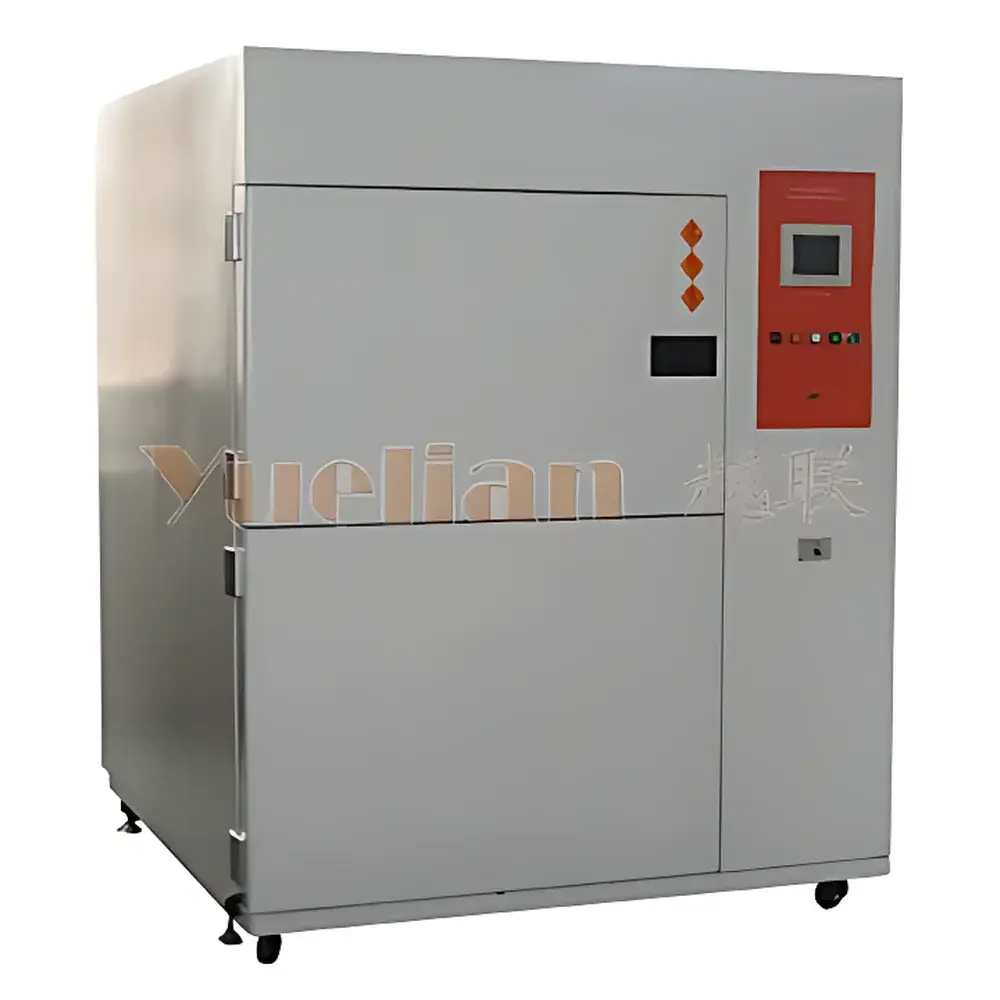
Yuelian YL-2231 Thermal Shock Test Chamber
| Brand | Yuelian |
|---|---|
| Origin | Guangdong, China |
| Model | YL-2231 |
| Temperature Range (High/Low Zones) | +60°C to +200°C / −10°C to −70°C |
| Shock Transition Time (2-tank mode) | ≤5 min (RT to −65°C or RT to +150°C) |
| Temperature Uniformity | ±2.00°C |
| Internal Chamber Material | SUS#304 Stainless Steel |
| Refrigeration System | Dual-stage cascade refrigeration with eco-friendly refrigerant |
| Control System | OYO-8226 PID controller with 320×240 LCD interface |
| Programmable Cycles | Up to 9999 cycles |
| Data Interface | RS-232 with PC software support |
| Power Supply | AC 3φ 380 V, 50 Hz |
| Cooling Method | Water-cooled |
Overview
The Yuelian YL-2231 Thermal Shock Test Chamber is an industrial-grade environmental test system engineered for accelerated reliability assessment of materials and electronic components under rapid, repetitive thermal transitions. It operates on the principle of controlled gas-phase thermal shock—utilizing physically isolated high-temperature, low-temperature, and test chambers (3-tank configuration) or a dual-chamber design (hot/cold reservoirs only), enabling precise, repeatable exposure to extreme temperature differentials. Unlike conventional cycling ovens, this chamber eliminates mechanical movement of test specimens; instead, it employs high-speed pneumatic damper systems (<10 s actuation) to redirect conditioned air streams into the static test zone. This architecture ensures minimal thermal inertia, high reproducibility of thermal ramp rates, and compliance with standardized shock profiles defined in MIL-STD-810H Method 503.7, IEC 60068-2-14, and JESD22-A104D. The system supports both qualification-level stress screening and process validation for industries where thermal expansion mismatch, intermetallic growth, solder joint fatigue, or polymer embrittlement are critical failure modes.
Key Features
- Tri-chamber architecture (preheat/precool/test zones) with vacuum-insulated stainless steel (SUS#304) construction for stable thermal mass retention and minimized cross-contamination between zones.
- Dual-stage cascade refrigeration system using environmentally compliant refrigerants (R404A/R23 blend), paired with water-cooled condensers for consistent sub-65°C operation and reduced ambient dependency (10–35°C operating range).
- OYO-8226 microprocessor-based controller with 320 × 240 dot-matrix LCD interface, supporting bilingual (English/Chinese) operation, 120 programmable profiles, and up to 9999 cycles per profile.
- Real-time thermal profiling with four calibrated PT100 sensors (T-type), including dedicated placement within the test zone—not ducts—to ensure measurement validity per ISO 17025 traceability requirements.
- Automated thermal recovery verification: achieves ≤5-minute transition from ambient to −65°C or +150°C in 2-tank mode; ≤5-minute stabilization post-transfer confirmed via internal sensor feedback loop.
- Integrated anti-condensation protocol: automatic return-to-ambient sequence at test completion prevents dew formation and surface oxidation on sensitive PCBAs or optical substrates.
- RS-232 serial interface with proprietary Windows-compatible software for remote program editing, live data logging (temperature/time/cycle), audit trail generation, and export to CSV or PDF formats.
Sample Compatibility & Compliance
The YL-2231 accommodates rigid and semi-rigid samples up to 10 kg (model-dependent), including printed circuit board assemblies (PCBAs), automotive ECUs, aerospace connectors, molded polymers, metal alloys, and ceramic substrates. Its static test zone design eliminates vibration-induced artifacts during shock transitions—critical for MEMS device validation. The chamber meets structural and operational criteria outlined in ASTM D5229/D5229M (low-temperature impact), IPC-9701A (solder interconnect reliability), and JEDEC J-STD-020 (moisture sensitivity level classification). Optional LN₂ assist module enables ultra-fast cooling for tin whisker acceleration per NASA-HDBK-8739.3 and IPC-TM-650 2.6.25. All control logic adheres to GLP-compliant event logging: timestamped start/stop, fault codes, setpoint deviations >±1.5°C, and manual override records—all retained onboard for ≥30 days.
Software & Data Management
Yuelian’s proprietary PC software provides full lifecycle test management: drag-and-drop profile builder, real-time multi-channel graphing (up to 4 sensor inputs), automated pass/fail evaluation against user-defined tolerance bands, and batch report generation with digital signature support. Data exports comply with FDA 21 CFR Part 11 requirements when configured with user authentication, electronic signatures, and immutable audit trails. The system supports integration into enterprise LIMS environments via ASCII-based RS-232 command sets, enabling automated job dispatch and result ingestion without middleware. Firmware updates are performed via USB port with version-locked checksum verification to prevent unauthorized modification.
Applications
- Qualification testing of lead-free solder joints per IPC-J-STD-020 and JEDEC JESD22-A104D.
- Thermal fatigue life prediction of power semiconductor modules in EV inverters.
- Validation of encapsulant adhesion strength in optoelectronic packaging under repeated ΔT >200°C.
- Accelerated aging of lithium-ion battery cells to assess SEI layer stability.
- Material compatibility screening for aerospace composites exposed to stratospheric re-entry thermal gradients.
- Process capability analysis of conformal coating curing protocols across production lots.
FAQ
What is the difference between 2-tank and 3-tank thermal shock configurations?
The 2-tank system uses one hot and one cold reservoir with a shared test zone; the 3-tank variant adds a thermally neutral intermediate chamber, reducing residual heat transfer and improving repeatability for ultra-low-temperature shocks below −55°C.
Does the YL-2231 support unattended overnight operation?
Yes—equipped with auto-restart after power interruption, emergency thermal cutoff at ±205°C/−75°C limits, and continuous voltage monitoring with graceful shutdown on brownout detection.
Can the chamber be validated per IQ/OQ protocols?
Full IQ/OQ documentation templates—including sensor calibration certificates, door seal integrity tests, and temperature mapping reports—are provided with each unit; third-party 21 CFR Part 11 validation support available upon request.
Is humidity control available as an option?
Standard configuration maintains dry-air conditions (<10% RH) during shock phases; optional integrated desiccant drying system available for <5% RH operation in pre-conditioning sequences.
What maintenance intervals are recommended for the refrigeration system?
Compressor oil and filter replacement every 12 months; refrigerant leak check and pressure verification every 6 months; full cascade system performance validation annually per ASHRAE Guideline 3-2021.



