
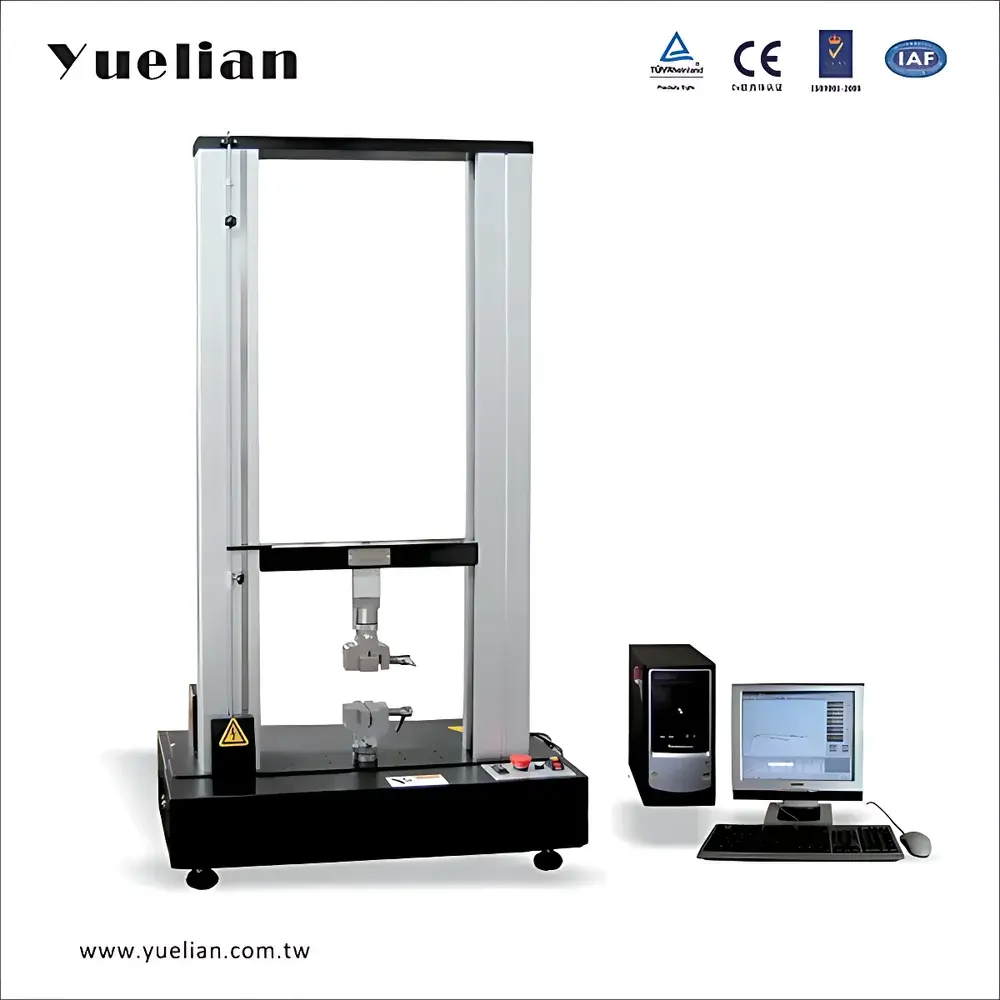
Yuelian YL-D20 Universal Tensile Testing Machine for Strapping and Packaging Materials
| Brand | Yuelian |
|---|---|
| Origin | Guangdong, China |
| Manufacturer Type | Authorized Distributor |
| Country of Origin | China |
| Model | YL-D20 |
| Load Capacity Options | 10 N, 20 N, 50 N, 100 N, 200 N, 500 N, 1 kN, 2 kN, 5 kN (dual-range configuration available) |
| Force Resolution | 1/500,000 full scale |
| Force Accuracy | ±0.3% of reading |
| Crosshead Travel | 600 mm |
| Test Width | 420 mm |
| Speed Range | 0.01–500 mm/min (computer-controlled, programmable) |
| Position Resolution | 1/500,000 full stroke |
| Drive System | Servo motor with precision ball screw and synchronous belt transmission |
| Power Supply | 220 V, 50/60 Hz, 10 A |
| Power Consumption | 400 W |
| Dimensions (W×D×H) | 80 × 45 × 136 cm |
| Weight | Approx. 220 kg |
| Standard Accessories | One set of universal grips, PC-based control software, USB interface cable |
| Optional | Customer-supplied Windows PC (Windows 10/11, 64-bit, ≥8 GB RAM, ≥256 GB SSD recommended) |
Overview
The Yuelian YL-D20 Universal Tensile Testing Machine is an electromechanical force-testing system engineered for high-reproducibility mechanical characterization of packaging strapping materials—including polypropylene (PP), polyester (PET), polyethylene (PE), steel, and composite straps—as well as films, tapes, adhesives, foils, and laminates used in industrial packaging, logistics, and transport applications. Based on the fundamental principle of uniaxial force application under controlled displacement or load rate, the system complies with standardized tensile test methodologies defined in ISO 527, ASTM D638, ASTM D882, and ISO 1184. Its rigid frame architecture, coupled with a high-resolution servo-driven actuation system and real-time digital signal acquisition, ensures consistent compliance with GLP-aligned testing workflows in QC laboratories and R&D environments.
Key Features
- High-precision dual-range load cell options (10 N to 5 kN), enabling traceable measurement across low-force peel/separation tests and high-strength strap rupture evaluation
- Computer-controlled speed regulation from 0.01 mm/min (for creep and relaxation studies) to 500 mm/min (for high-speed burst testing), with programmable multi-step profiles
- Integrated automatic stop logic: overload protection, specimen fracture detection, upper/lower limit enforcement, emergency stop activation, and auto-return-to-initial-position functionality
- Force resolution of 1 part in 500,000 full scale and certified force accuracy of ±0.3%—meeting calibration traceability requirements per ISO/IEC 17025
- Modular grip interface accommodating wedge-action, pneumatic, and custom fixtures for flat straps, round cords, and irregular cross-sections
- Real-time data acquisition at up to 1 kHz sampling rate, synchronized with position and time stamps for dynamic event capture
Sample Compatibility & Compliance
The YL-D20 supports standardized mechanical testing of diverse packaging substrates per globally recognized specifications: tensile strength and elongation at break per ISO 1184 for plastic strapping; peel adhesion per ASTM D3330 and GB/T 2792; shear strength per GB/T 7124 (2008); and bond integrity per HG/T 2-163. It is routinely deployed in supplier qualification labs, third-party certification bodies, and internal packaging engineering departments to validate conformance with ISTA 1A/2A protocols, UN Regulation No. 111 for dangerous goods packaging, and EU Directive 94/62/EC on packaging waste. All hardware and firmware components are designed to support audit-ready documentation in accordance with FDA 21 CFR Part 11 (when paired with validated software configurations) and ISO 9001:2015 quality management systems.
Software & Data Management
The included Windows-based control and analysis suite provides ISO 17025-compliant test sequence definition, real-time curve visualization (force vs. displacement, stress vs. strain), and automated parameter extraction—including peak load, yield point, modulus of elasticity, elongation at break, average peel force, and energy-to-break. Raw data is stored in native binary format with embedded metadata (operator ID, timestamp, environmental conditions, calibration status), and exportable to CSV, PDF, or MS Access databases for LIMS integration. Audit trail functionality records all user actions, method modifications, and result edits. Software supports multi-sensor input (e.g., extensometer, environmental chamber feedback), customizable report templates, and configurable pass/fail thresholds aligned with internal SOPs or customer specifications.
Applications
- Quality assurance of PP/PET strapping used in palletizing, bundling, and container securing
- Comparative evaluation of hot-melt vs. solvent-based adhesive bonds in tape lamination
- Mechanical validation of shrink-wrap film weld seams and heat-seal integrity
- Creep resistance assessment of heavy-duty woven polypropylene sacks under sustained load
- Development testing of biodegradable strapping alternatives under variable humidity and temperature conditions
- Supplier incoming inspection against contractual tensile performance clauses (e.g., minimum breaking strength ≥ 1200 N for 12 mm PET strap)
FAQ
Is the YL-D20 compliant with ASTM D638 for tensile testing of plastics?
Yes—the machine’s force accuracy, speed control fidelity, and data acquisition resolution meet the instrumentation requirements specified in ASTM D638 Annex A2 for Type I–V specimens. Calibration certificates are provided per ISO/IEC 17025-accredited standards.
Can the system be integrated into an existing LIMS or MES platform?
Yes—raw test data files and summary reports can be exported programmatically via COM/ActiveX interfaces or scheduled file drops to network locations. Custom API integration is supported upon request.
What maintenance intervals are recommended for long-term accuracy retention?
Annual recalibration of the load cell and position encoder is advised. Routine checks include lubrication of the ball screw assembly every 6 months and verification of grip jaw alignment prior to each test series.
Does the software support multi-language UI and report generation?
The base software interface is English-only; however, report templates are fully editable in Microsoft Word or Excel formats, allowing localization of headers, units, and terminology per regional regulatory requirements.



