
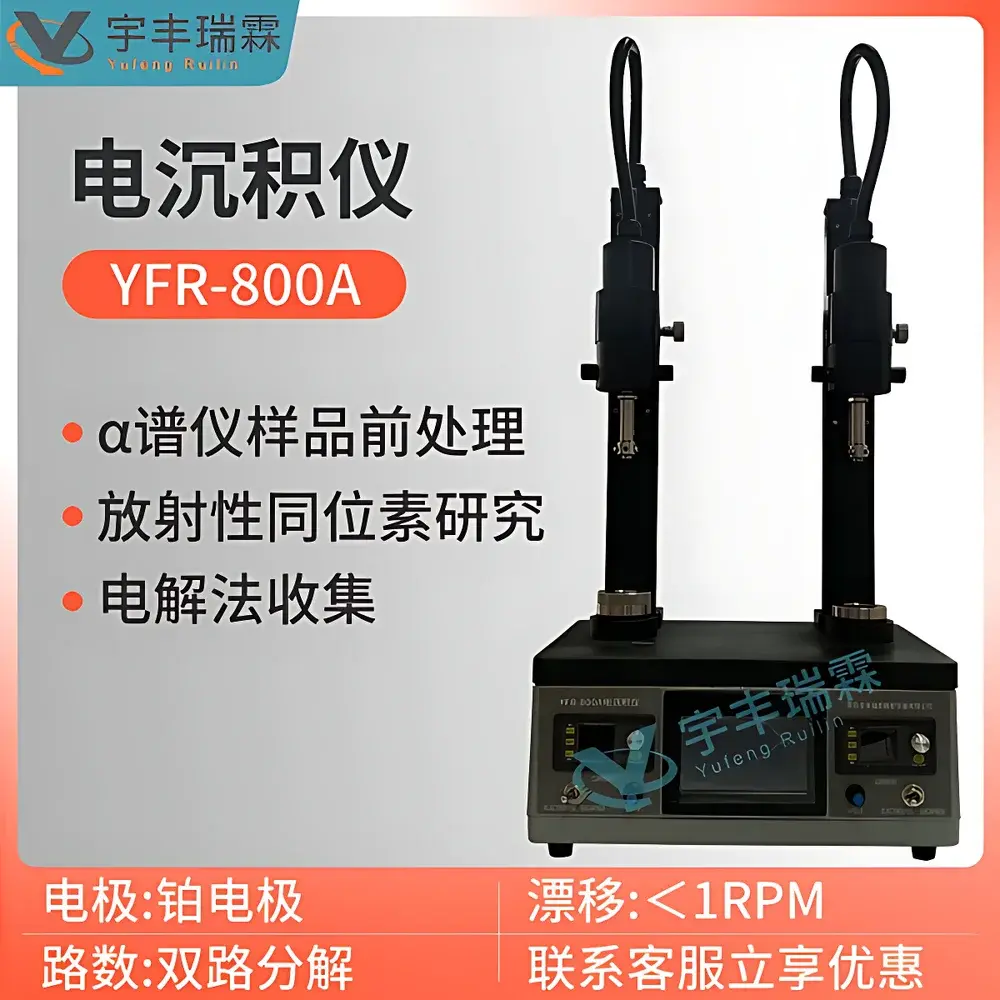
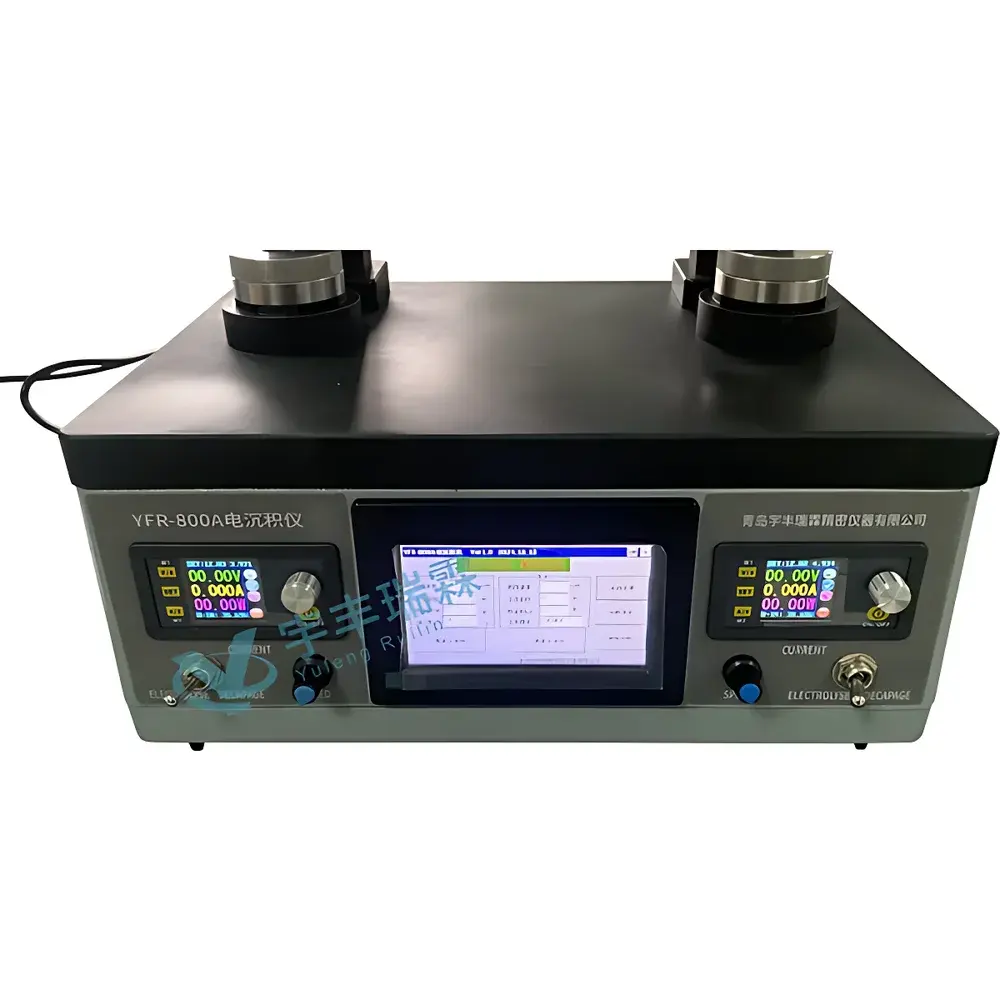
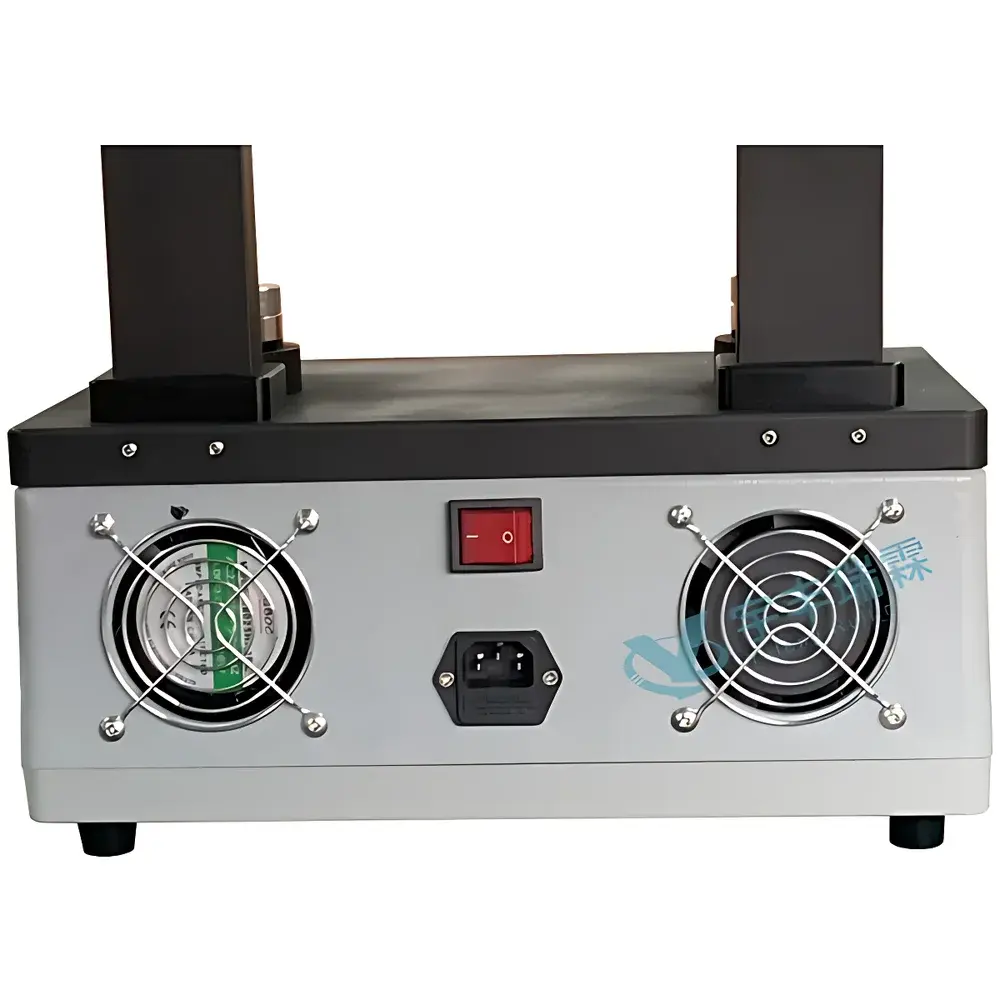
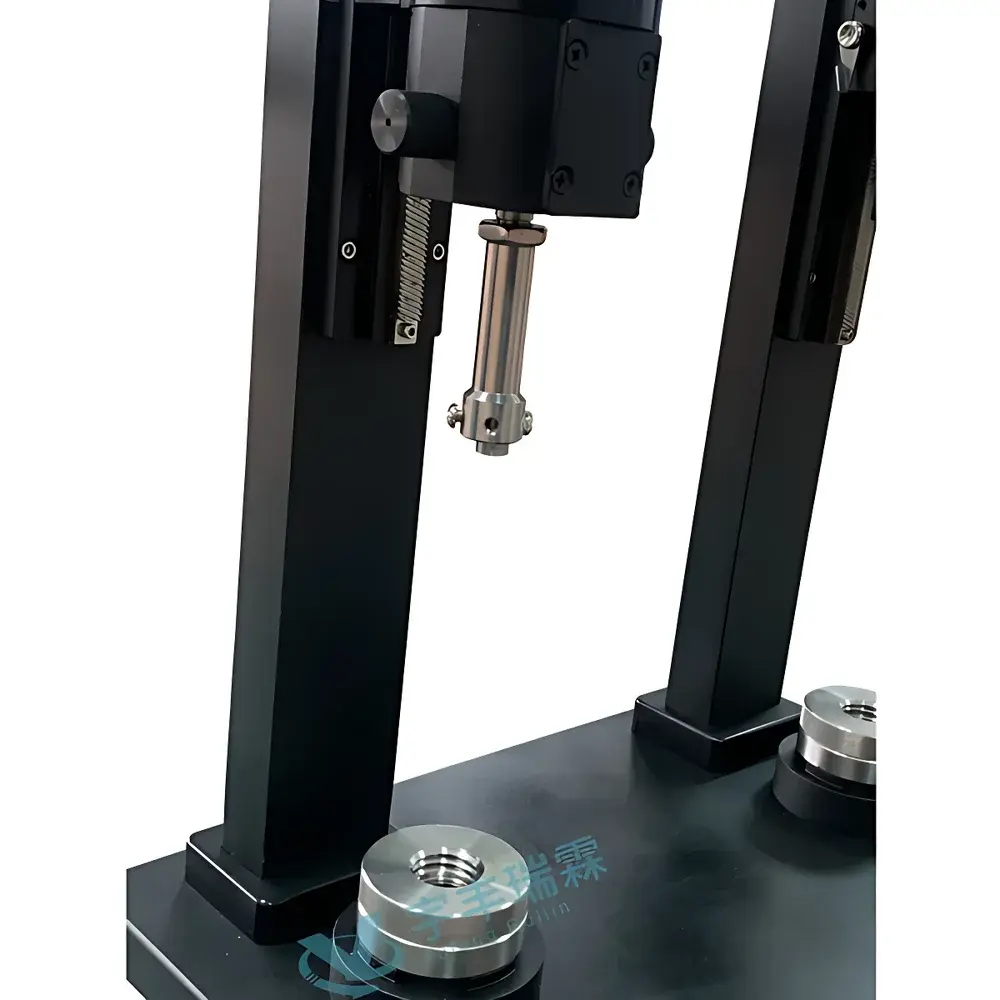
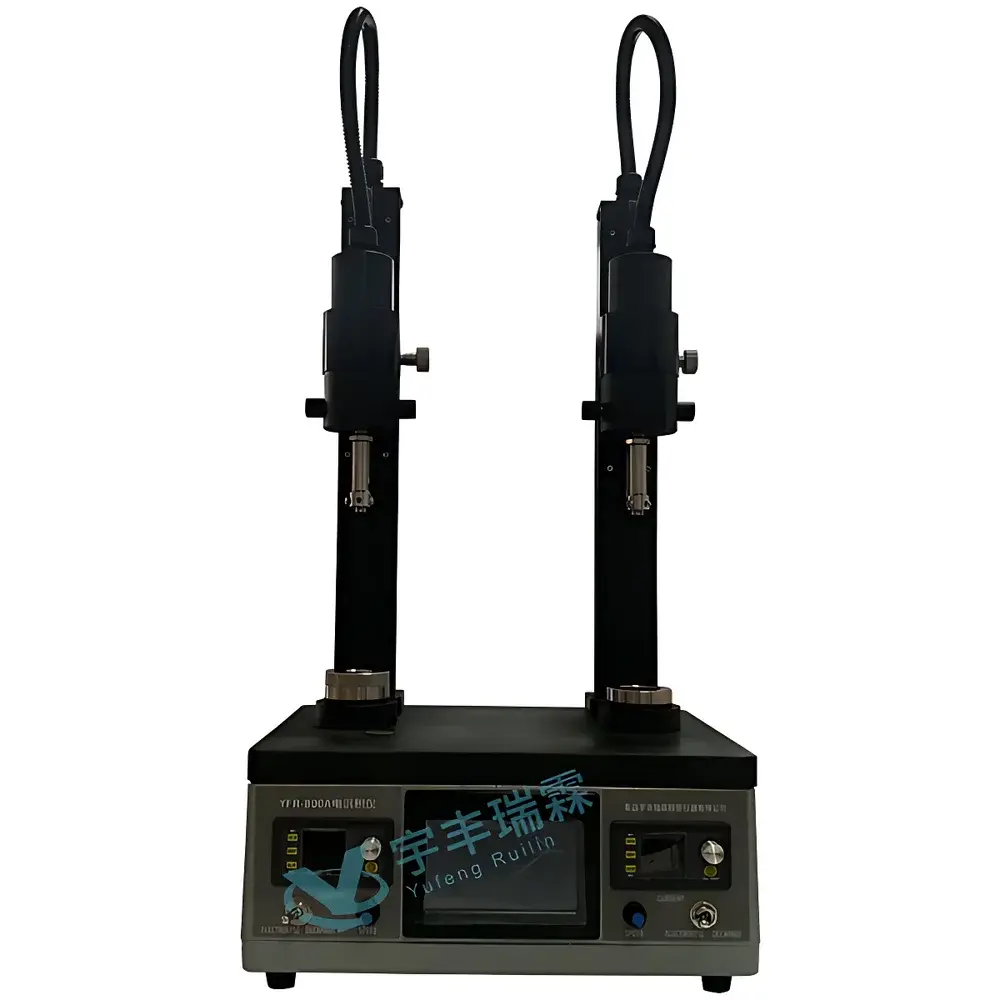
YUFENGRUILIN YFR-800A Dual-Channel Electrodeposition System for Alpha Spectrometry Sample Preparation
| Brand | YUFENGRUILIN |
|---|---|
| Origin | Shandong, China |
| Manufacturer Type | Direct Manufacturer |
| Country of Origin | China |
| Model | YFR-800A |
| Instrument Category | Alpha Spectrometry Sample Preparation System |
| Instrument Type | Laboratory Benchtop Unit |
| Sample Form | Aqueous Solutions |
| Input Voltage | 220 V ±10% AC, 50 Hz |
| Power Consumption | 200 W |
| Electrolysis Current Range | 0.1–5.0 A (adjustable in 0.02 A increments) |
| Current Stability | < ±0.2 A under load |
| Current Display Resolution | 0.01 A (LCD) |
| Electrode Rotation Speed | 60–600 rpm (continuously adjustable) |
| Speed Stability | ±5% (torque-dependent) |
| Speed Drift | < 1 rpm |
| Speed Display | Digital rpm readout (LCD) |
| Electrode Material | XM150 Platinum Disk Electrode with Protective Cap |
| Anode/Cathode Configuration | Rotating Pt anode + Fixed stainless steel cathode disk |
| Ventilation Rate | 200 L/min |
| Operating Temperature | 0–45 °C |
| Storage Temperature | −25–60 °C |
| Dimensions (W×H×D) | 325 × 650 × 325 mm |
| Weight | 7 kg |
| Construction Materials | Polyethylene terephthalate (PET), polyoxymethylene (POM), nylon, PVC, stainless steel, copper, nickel-plated brass |
| Front Panel | AG4 anodized aluminum |
| Safety | Zero-current shutdown on main power disconnection |
| Included Accessories | 2 × Pt wire electrodes, 50 electroplating disks, adjustable electrode holder, sample bottle fixtures (20 mL & 50 mL options), passive timer (1 min–9 h 59 min with audible alert), high-flow ventilation option available |
Overview
The YUFENGRUILIN YFR-800A Dual-Channel Electrodeposition System is a precision-engineered laboratory instrument designed specifically for the quantitative recovery and micro-scale concentration of alpha-emitting radionuclides—such as 238Pu, 239/240Pu, 241Am, 234Th, and 210Po—from aqueous matrices prior to alpha spectrometric analysis. It operates on the principle of controlled electrolytic deposition: under constant direct current, target radionuclides are reduced and co-deposited onto a polished metal substrate (typically stainless steel or nickel-plated copper) acting as the cathode, while a rotating platinum anode ensures uniform mass transport and minimizes diffusion layer thickness. This electrochemical preconcentration method delivers high chemical yield (>95% for optimized actinide systems), excellent spatial homogeneity of the deposited layer (<5% activity distribution non-uniformity), and minimal self-absorption—critical prerequisites for achieving sub-keV energy resolution in subsequent alpha spectroscopy.
Key Features
- Dual independent channels enable parallel processing of two samples, improving throughput without cross-contamination risk—ideal for routine environmental monitoring labs handling multiple water or urine specimens per batch.
- Digitally stabilized DC current source (0.1–5.0 A, 0.02 A step resolution) with real-time LCD feedback ensures reproducible deposition kinetics across runs; current drift remains below ±0.2 A during extended operation.
- Motor-driven platinum anode rotation (60–600 rpm, ±5% torque stability, <1 rpm drift) enhances convective mass transfer, suppressing boundary layer effects and promoting uniform nucleation—essential for producing thin, adherent, and geometrically consistent deposits.
- Integrated passive timer (1 minute to 9 hours 59 minutes) with audible alert supports unattended operation while maintaining strict adherence to standardized protocols (e.g., ASTM D3648-18 Annex A1 for plutonium electrodeposition).
- Front-panel AG4 anodized aluminum housing provides EMI shielding and mechanical durability; internal construction utilizes chemically inert polymers (POM, PET, PVC) and corrosion-resistant metals (stainless steel, nickel-plated brass) compatible with acidic electrolytes (e.g., 0.1 M HNO3/0.02 M (NH4)2SO4).
- Zero-residual-current safety architecture: full circuit de-energization upon main switch disengagement eliminates risk of unintended electrolysis or thermal runaway.
- Modular sample fixture system accommodates both 20 mL (19.6 mm disk) and 50 mL (24.5 mm disk) standard electropolishing bottles; custom geometries available for specialized radiochemical separation workflows.
Sample Compatibility & Compliance
The YFR-800A is validated for use with low- to medium-activity liquid samples—including groundwater, seawater, urine, acid-digested soil leachates, and nuclear effluents—across pH 1–3 and total dissolved solids ≤5 g/L. Its design conforms to key regulatory and methodological frameworks governing radiometric sample preparation: ISO 11929:2019 (evaluation of measurement uncertainty in ionizing radiation), ASTM D3648-18 (standard test methods for alpha- and beta-particle radioactivity), and IAEA Technical Reports Series No. 295 (“Preparation of Sources for Alpha Spectrometry”). All electrical components meet CE/IEC 61010-1:2010 safety requirements for laboratory equipment. The system supports GLP-compliant documentation when paired with external lab information management systems (LIMS) via timestamped operator logs and manual parameter recording.
Software & Data Management
The YFR-800A operates as a standalone hardware platform with no embedded firmware or proprietary software—eliminating cybersecurity vulnerabilities and licensing dependencies. All operational parameters (current setpoint, rotation speed, timer duration) are manually configured and visually confirmed via dual LCD displays. For laboratories requiring audit trails, users may integrate the instrument into existing electronic lab notebooks (ELN) or LIMS using standardized SOP templates that capture operator ID, sample ID, electrolyte composition, deposition time, and final deposit geometry. While not FDA 21 CFR Part 11 compliant out-of-the-box, the device’s deterministic analog control architecture allows full traceability when used within documented quality management systems (QMS) aligned with ISO/IEC 17025:2017 accreditation criteria.
Applications
- Environmental surveillance: Preconcentration of transuranic isotopes from large-volume (1–10 L) drinking water or wastewater samples prior to alpha spectrometric quantification.
- Nuclear medicine quality control: Recovery and purification of 225Ac or 213Bi generator eluates for radiopharmaceutical purity assessment.
- Decommissioning and waste characterization: Solid-phase extraction of actinides from decontamination solutions for isotopic fingerprinting.
- Geochemical tracer studies: Isolation of natural 210Po/210Pb disequilibria in sediment pore waters.
- Health physics bioassay: Urinary plutonium/americium monitoring in occupational exposure programs per ANSI N13.30-2022.
FAQ
What sample volume ranges does the YFR-800A support?
Standard configurations accommodate 20 mL and 50 mL electrolyte volumes. Custom bottle and disk assemblies can be fabricated for volumes between 5–100 mL upon request.
Is the platinum electrode reusable?
Yes—the XM150 Pt disk anode is chemically inert and mechanically robust. Routine cleaning with dilute nitric acid followed by ultrasonic rinsing restores performance for ≥200 deposition cycles.
Can the system handle organic-based electrolytes?
No. The YFR-800A is validated exclusively for aqueous acidic media (e.g., HNO3, HCl, (NH4)2SO4). Organic solvents may degrade polymer components and compromise electrical insulation.
Does it comply with ISO/IEC 17025 method validation requirements?
The instrument itself is not certified, but its performance characteristics (current stability, rotational repeatability, temperature tolerance) are fully characterizable per ISO/IEC 17025 Clause 7.2.2. Laboratories must perform in-house verification using reference standards (e.g., NIST SRM 4357) as part of their method validation package.
What maintenance is required?
Quarterly inspection of electrode alignment (≤0.5 mm tolerance), annual calibration of current and rpm sensors using NIST-traceable meters, and replacement of ventilation filters every 6 months under continuous use.
Related Products







