
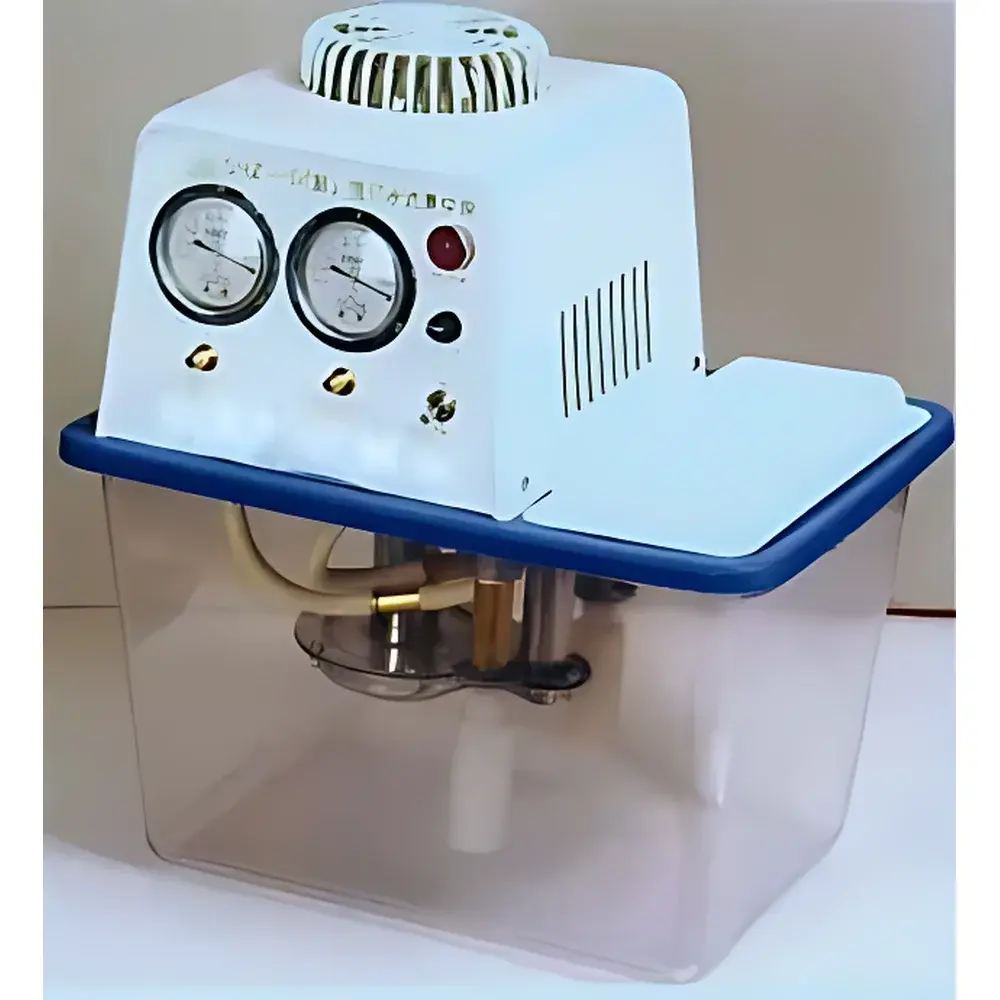
YUHUA SHZ-D(III) Circulating Water Vacuum Pump
| Brand | YUHUA |
|---|---|
| Origin | Henan, China |
| Model | SHZ-D(III) |
| Construction | Dual-head, dual-vacuum-gauge design |
| Pump Body Options | Stainless steel housing or corrosion-resistant polymer housing |
| Water Reservoir | Transparent, chemically resistant acrylic tank |
| Additional Features | Ice-addition port, optional vacuum regulating valve |
| Noise Level | Low-noise operation |
| Mobility | Integrated carrying handles, compact footprint |
| Compliance | Designed for general laboratory vacuum applications under ambient conditions |
Overview
The YUHUA SHZ-D(III) Circulating Water Vacuum Pump is an engineered solution for generating stable, low-to-medium vacuum levels (typically 0.095–0.1 MPa, equivalent to ~71–76 kPa absolute pressure) in academic, pharmaceutical, and industrial laboratory environments. It operates on the principle of water-ring vacuum generation: rotating water within a sealed chamber forms a liquid piston that entrains air from connected apparatus, evacuating gas through continuous circulation and heat dissipation via an open-loop or recirculated water reservoir. Unlike oil-sealed rotary vane pumps, this system eliminates hydrocarbon contamination risk—making it suitable for solvent recovery, rotary evaporation, vacuum filtration, and distillation setups where sample purity and operator safety are critical. Its compact form factor (approx. 340 × 280 × 420 mm) and lightweight construction (<15 kg) address spatial constraints common in teaching labs and QC workstations without compromising functional redundancy or operational reliability.
Key Features
- Dual independent suction ports with individual vacuum gauges—enables simultaneous operation of two vacuum-dependent instruments (e.g., a rotary evaporator and a vacuum desiccator) while monitoring each line’s pressure independently.
- Chemically inert, transparent acrylic water reservoir—allows real-time visual inspection of water level, clarity, and temperature stability; compatible with deionized water, ethanol-water mixtures, and other non-corrosive coolants.
- Modular housing options: stainless steel variant for enhanced mechanical durability and thermal stability; corrosion-resistant polymer housing for aggressive chemical environments involving organic solvents or mild acids.
- Integrated ice-addition port—permits direct insertion of ice cubes into the water bath to maintain sub-ambient operating temperatures during extended runs, reducing vapor pressure drift and improving vacuum consistency.
- Optional vacuum regulating valve—installed inline to fine-tune suction force for delicate applications such as gentle solvent removal from heat-sensitive biomolecules or controlled degassing of viscous samples.
- Low-noise impeller assembly and vibration-damped mounting—meets ISO 7779 sound pressure level guidelines for laboratory equipment (<55 dB(A) at 1 m distance), supporting shared lab spaces and noise-sensitive workflows.
Sample Compatibility & Compliance
The SHZ-D(III) is intended for use with non-explosive, non-toxic, and non-particulate-laden vapors generated during standard benchtop vacuum operations. It is not rated for explosive atmospheres (ATEX/IECEx), high-temperature steam, or abrasive particulates. While not certified to specific ISO or ASTM vacuum performance standards (e.g., ISO 21809, ASTM D2873), its design aligns with general laboratory safety expectations outlined in ANSI Z9.5–2022 (Laboratory Ventilation) and CLSI GP26-A4 (Good Laboratory Practice for Equipment Use). The pump complies with China’s GB/T 28290–2012 standard for circulating water vacuum pumps and supports GLP documentation requirements through consistent, repeatable vacuum output when operated within specified ambient temperature (10–30 °C) and water conductivity (<500 µS/cm) limits.
Software & Data Management
This is a manually operated, analog vacuum system with no embedded microcontroller, digital interface, or data logging capability. Vacuum level is monitored visually via dual Bourdon-tube vacuum gauges (0–0.1 MPa range, ±5% full-scale accuracy). No software drivers, USB connectivity, or cloud integration are provided. For laboratories requiring audit trails or electronic recordkeeping per FDA 21 CFR Part 11, external pressure transducers (e.g., Validyne DP15 or MKS Baratron series) may be installed downstream and interfaced with validated DAQ systems.
Applications
- Routine rotary evaporation of solvents including acetone, ethyl acetate, methanol, and dichloromethane.
- Vacuum-assisted gravity filtration using Buchner funnels and Hirsch funnels.
- Gas trapping and inert atmosphere purging prior to air-sensitive reactions.
- Supporting vacuum ovens and desiccators for moisture-sensitive material drying.
- Multi-step extraction workflows in natural product isolation and environmental sample preparation.
- Undergraduate chemistry and biology lab instruction—ideal for demonstrating vacuum principles, phase behavior, and mass transfer phenomena.
FAQ
Can the SHZ-D(III) be used with corrosive gases such as HCl or Cl₂?
No. The pump is not designed for acidic, oxidizing, or halogenated vapors. Exposure will degrade seals, impeller coatings, and the water reservoir. Use only with neutral, condensable, non-reactive vapors.
What is the recommended water replacement interval?
For continuous operation, replace water every 4–6 hours or when temperature exceeds 35 °C. In intermittent use, refresh before each session if residue or discoloration is observed.
Is the pump compatible with vacuum controllers or automated systems?
Not natively. It lacks electrical feedback signals or analog outputs. Integration requires third-party pressure sensors and relay-based control logic.
Does the unit include a built-in water level sensor or auto-shutoff?
No. Operators must visually verify water volume prior to startup and during extended use to prevent dry-running damage.
Can I connect more than two devices simultaneously?
Yes—but only via manifold distribution. Note that total conductance increases, reducing achievable vacuum level and response time across all ports. Performance validation is required per application.
Related Products



