
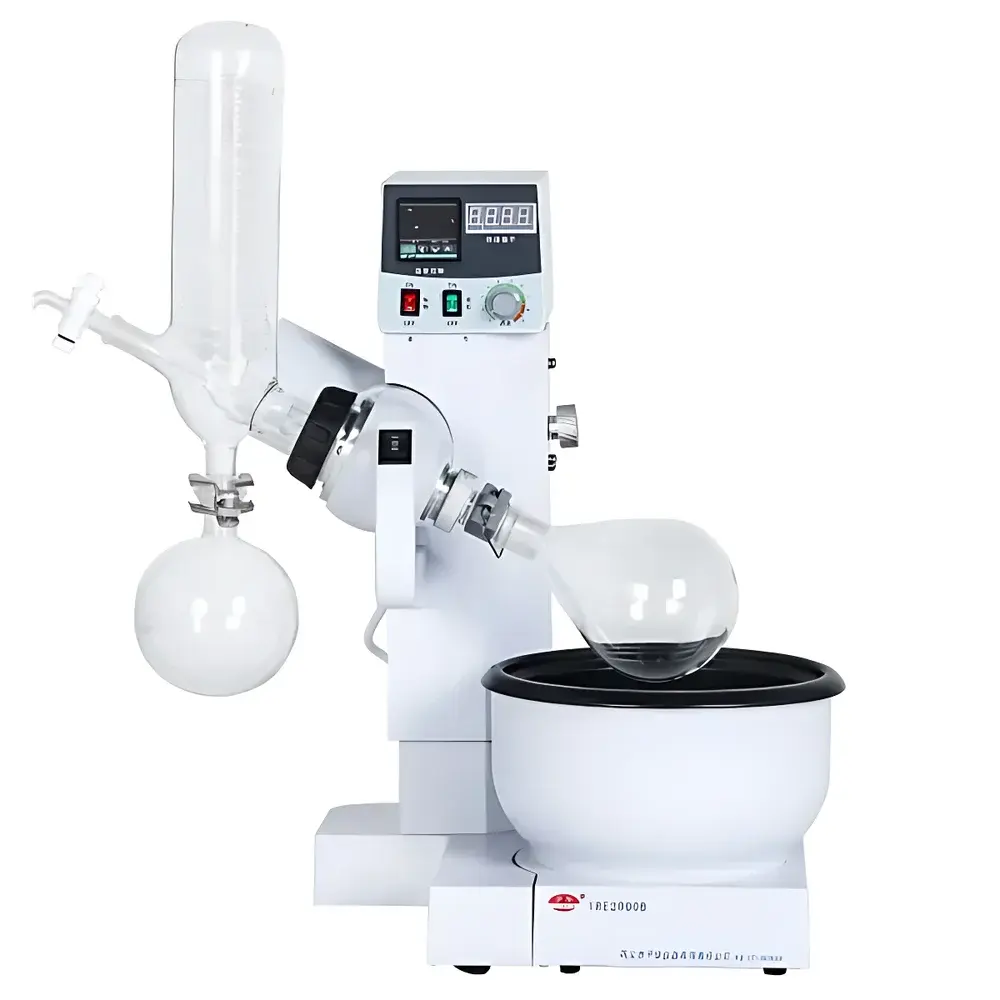
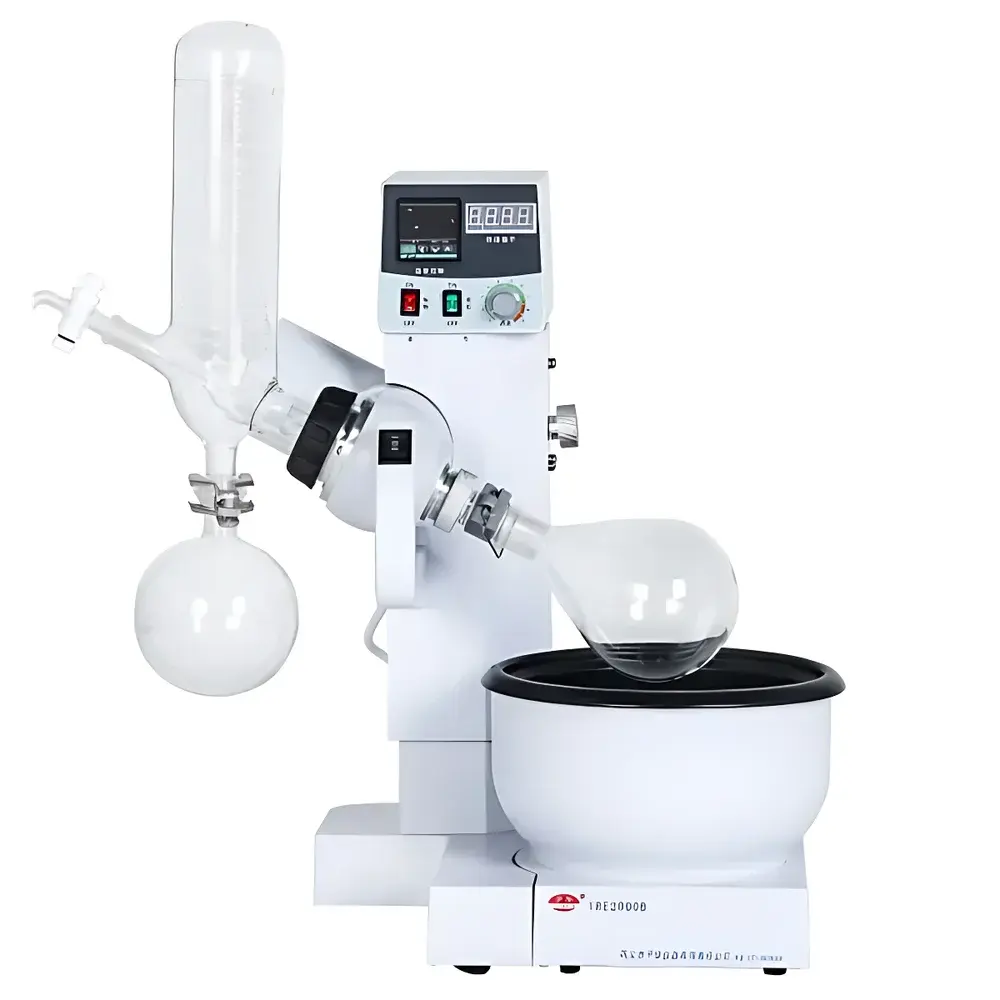
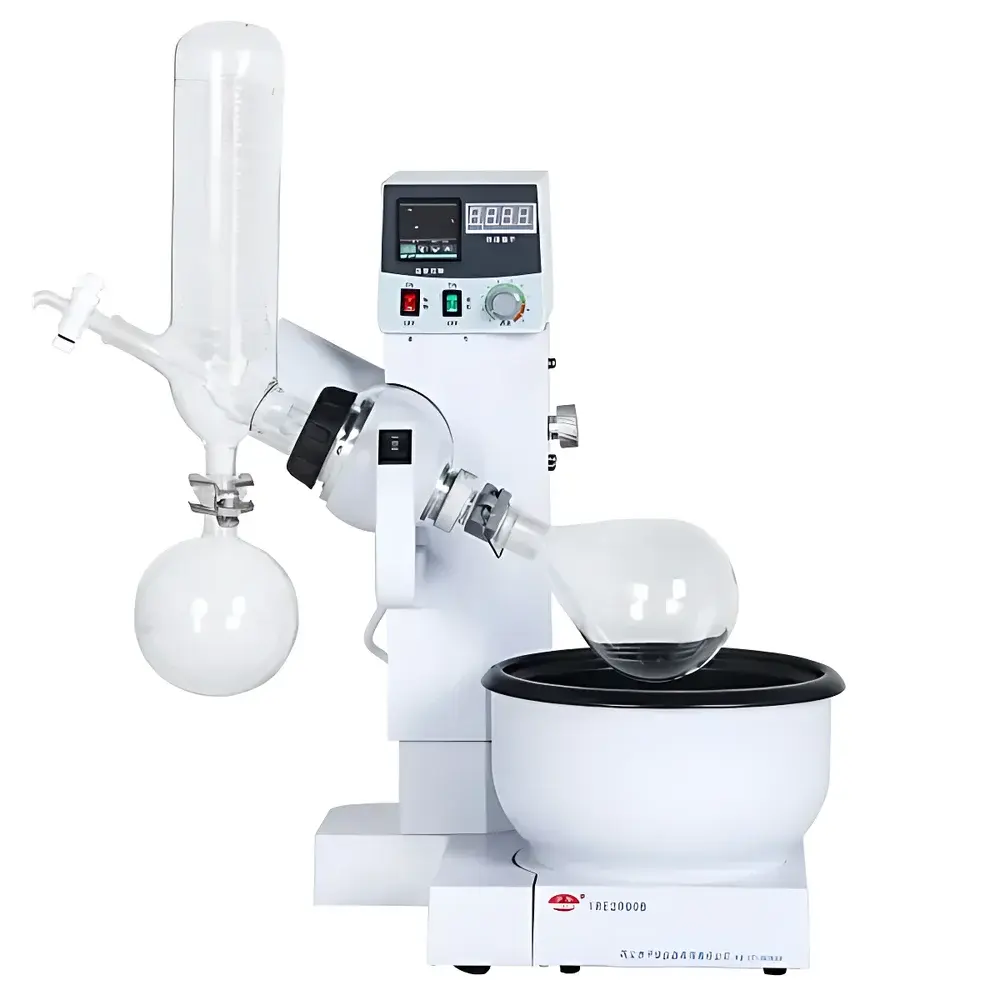
YUHUA YRE-2000A / YRE-2000B / YRE-2000E Automatic Lifting Rotary Evaporator
| Brand | YUHUA |
|---|---|
| Origin | Henan, China |
| Model | YRE-2000A / YRE-2000B / YRE-2000E |
| Capacity | 1 L |
| Ultimate Vacuum | −0.098 MPa |
| Rotational Speed | 20–200 rpm |
| Temperature Range | Ambient to 99 °C |
| Temperature Control Accuracy | ±1 °C |
| Heating Power | 1.4 kW |
| Motor Power | 40 W |
| Lifting Stroke | 0–150 mm |
| Condenser Dimensions | Φ85 × 415 mm |
| Rotating Flask | 1000 mL (Φ131 mm, 24/40 joint) |
| Collection Flask | 500 mL (standard) or 1000 mL (optional, 35/20 spherical joint) |
| Bath Volume | ~5.3 L |
| Overall Dimensions (raised) | 600 × 385 × 820 mm |
| Net Weight | 25 kg |
Overview
The YUHUA YRE-2000A / YRE-2000B / YRE-2000E Automatic Lifting Rotary Evaporator is an engineered solution for gentle, efficient solvent removal and sample concentration under reduced pressure. Operating on the principle of thin-film evaporation, it rotates a sample-containing flask in a temperature-controlled water or oil bath while maintaining a stable vacuum environment. This configuration maximizes surface area exposure, accelerates evaporation kinetics, and minimizes thermal stress—critical for thermally labile compounds such as pharmaceutical intermediates, natural product extracts, and polymer precursors. The system is constructed with high-borosilicate glass (operable from −80 °C to +250 °C) and PTFE-sealed joints, ensuring chemical compatibility with aggressive solvents including chlorinated hydrocarbons, esters, alcohols, and weak acids. Designed for routine use in QC laboratories, R&D settings, and pilot-scale synthesis, it supports reproducible process development aligned with GLP-compliant documentation practices.
Key Features
- Motor-driven automatic lifting mechanism with 0–150 mm vertical travel, enabling precise flask immersion control and safe, repeatable operation without manual adjustment.
- Three model variants: YRE-2000A (basic analog control, no speed display), YRE-2000B (digital RPM readout), and YRE-2000E (backlit LCD interface with dual-parameter monitoring of rotation speed and bath temperature).
- PTFE-coated heating bath with fluoropolymer composite inner pot (Teflon®-lined), resistant to corrosion from acidic, alkaline, or halogenated media; maximum rated temperature 99 °C (oil bath optional for extended range up to 180 °C).
- High-efficiency vertical condenser (Φ85 × 415 mm) with dual-layer cooling surface and optimized vapor path geometry, delivering consistent condensate recovery even at elevated feed rates.
- Integrated 40 W stirring motor (in rotating assembly) and 1.4 kW independent heating element, decoupled for independent optimization of agitation intensity and thermal input.
- Robust mechanical architecture: stainless steel frame, reinforced glass support rods, and IP20-rated electrical enclosure compliant with IEC 61010-1 for laboratory equipment safety.
Sample Compatibility & Compliance
The YRE-2000 series accommodates a broad spectrum of sample matrices—including aqueous solutions, organic extracts, emulsions, and viscous reaction mixtures—provided viscosity remains below 500 mPa·s at operating temperature. All wetted parts are fabricated from Class A borosilicate 3.3 glass (DIN ISO 3585) and FDA-listed PTFE (per 21 CFR 177.1550), rendering the system suitable for applications governed by USP , EP 2.6.13, and ISO 17025 traceability requirements. Vacuum integrity meets ASTM E2910-13 specifications for rotary evaporator performance validation. While not certified to UL or CE for direct EU market placement without local conformity assessment, the unit satisfies core mechanical and electrical safety benchmarks referenced in EN 61010-1:2010/A1:2013.
Software & Data Management
The YRE-2000B and YRE-2000E models support manual parameter logging via front-panel interface; however, the system does not include embedded data export, USB connectivity, or networked software integration. For audit-trail compliance (e.g., FDA 21 CFR Part 11), users are advised to pair the evaporator with external digital recorders or validated environmental monitoring systems that capture time-stamped RPM, bath temperature, and vacuum level via analog outputs (0–10 V or 4–20 mA, available on custom-configured units). Calibration certificates for temperature and rotational speed sensors can be supplied upon request, traceable to NIST or CNAS-accredited standards.
Applications
- Concentration of heat-sensitive bioactive compounds (e.g., flavonoids, peptides, enzyme fractions) without denaturation.
- Solvent exchange in nanoparticle synthesis workflows (e.g., THF → water transfer of PLGA nanoparticles).
- Removal of low-boiling solvents (acetone, dichloromethane, ethyl acetate) from synthetic reaction quenches prior to chromatographic analysis.
- Recovery and reuse of high-purity solvents in pharmaceutical manufacturing, supporting sustainability KPIs and reducing VOC emissions.
- Preparative-scale dehydration of food-grade extracts (e.g., citrus oils, hop resins) under controlled oxygen-limited conditions when coupled with inert gas purging kits.
FAQ
What vacuum level is required for optimal operation?
A stable vacuum of ≤ −0.095 MPa (≤ 71 torr) is recommended for most applications; deeper vacuum may accelerate evaporation but increases risk of bumping or foaming in volatile or surfactant-rich samples.
Can the unit operate with oil instead of water in the heating bath?
Yes—the Teflon®-composite bath is compatible with silicone and mineral oils up to 180 °C; however, temperature control accuracy degrades above 100 °C, and oil-level monitoring must be performed manually.
Is the rotating flask interchangeable with standard 24/40 ground-glass joints from other manufacturers?
Yes—all glassware uses ISO-standard 24/40 taper joints; however, dimensional tolerances of third-party flasks may affect seal integrity under vacuum—validation testing is advised.
What maintenance intervals are recommended for long-term reliability?
PTFE seals should be inspected every 200 operational hours; vacuum pump oil changed per manufacturer schedule; and bath fluid replaced quarterly or after contamination events.
Related Products



