
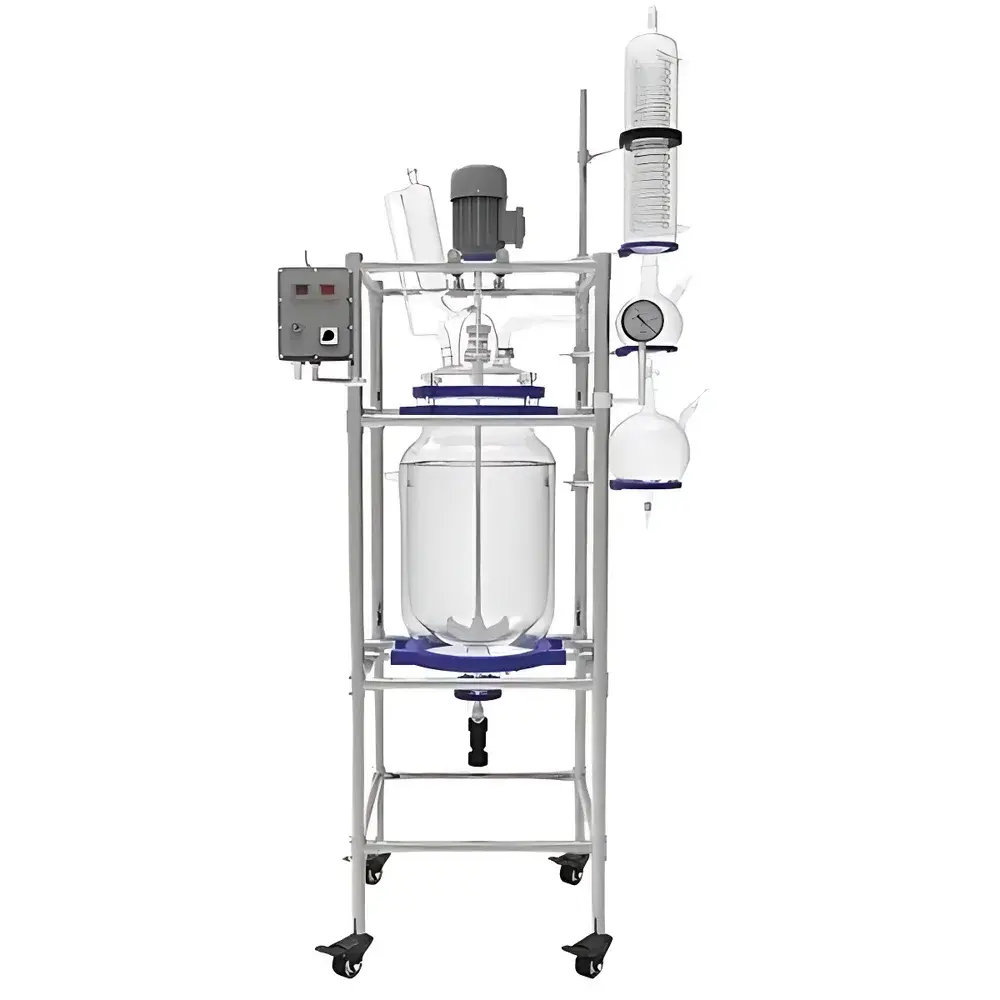
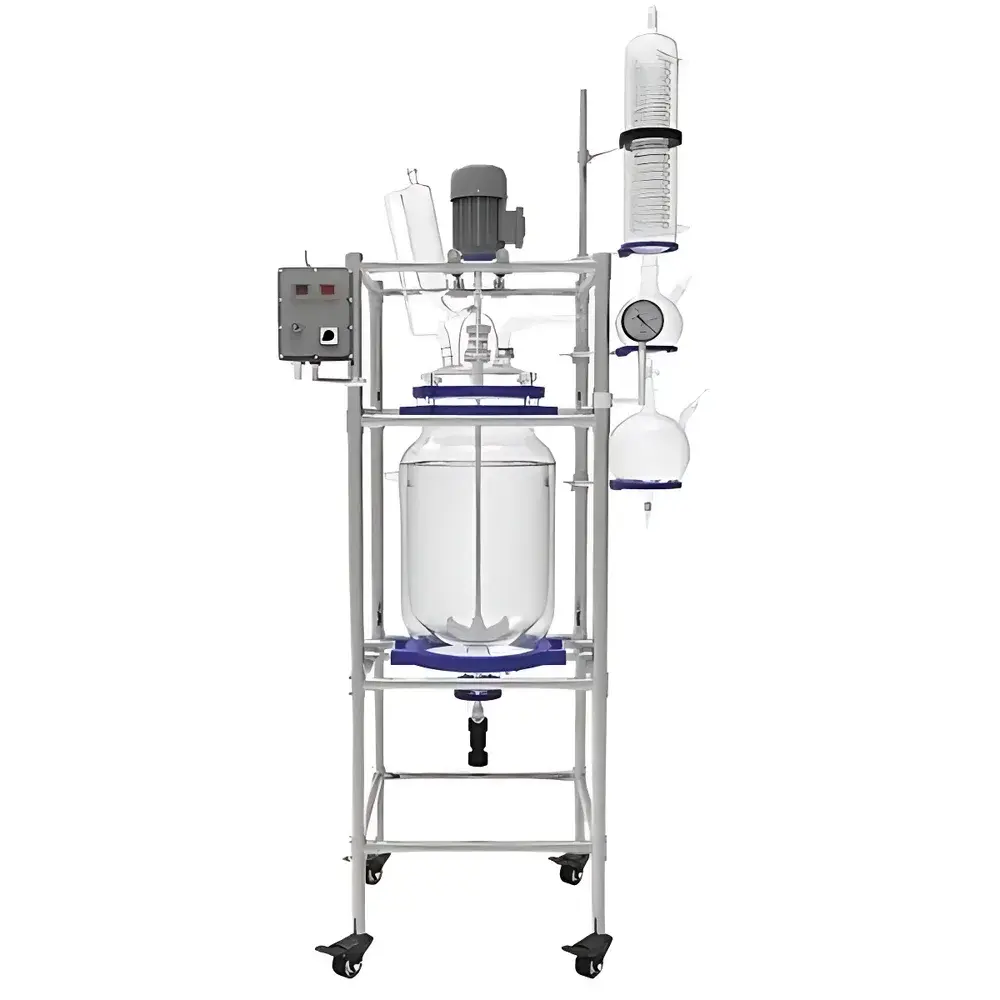
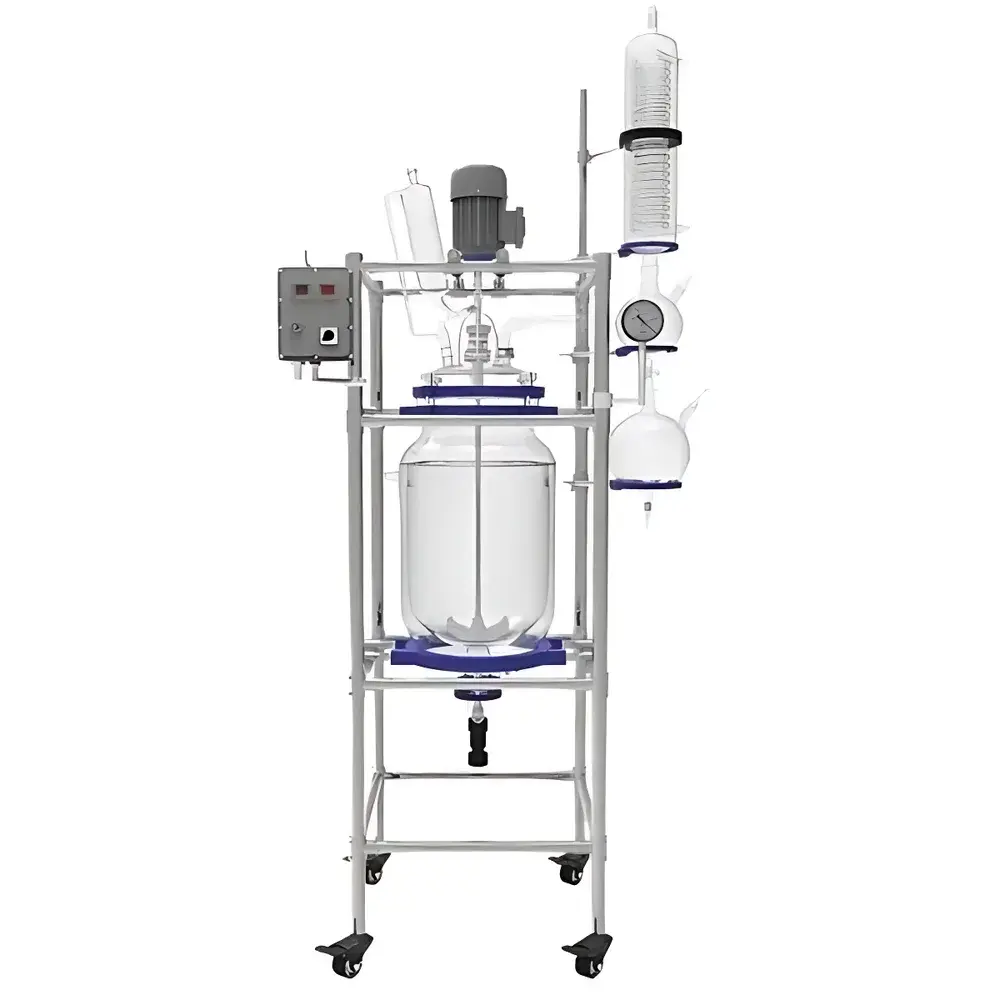
YUHUA YSF(EX)-100L Explosion-Proof Double-Jacketed Glass Reactor
| Brand | YUHUA (Gongyi Yuyi Instrument) |
|---|---|
| Origin | Henan, China |
| Model | YSF(EX)-100L |
| Capacity | 100 L (reaction vessel), 30 L (jacket) |
| Operating Temperature Range | −80 °C to +250 °C |
| Vacuum Level | −0.098 MPa |
| Stirring Speed | 0–650 rpm |
| Stirring Power | 370 W |
| Stirring Torque | 378 N·cm |
| Voltage/Frequency | 220 V / 50 Hz |
| Material | High-Borosilicate Glass (GG-17) |
| Sealing | Mechanical seal with PTFE components and ceramic bearing |
| Jacket Pressure Monitoring | Integrated pressure control system |
| Frame | 304 stainless steel mobile support with PTFE-coated surface |
| Compliance | Designed for ATEX/IECEx-aligned explosion-proof operation (EX-rated motor & inverter optional) |
Overview
The YUHUA YSF(EX)-100L Explosion-Proof Double-Jacketed Glass Reactor is an engineered laboratory-scale chemical processing system designed for safe, transparent, and precisely controlled reaction environments under vacuum, elevated temperature, or sub-ambient conditions. Built on the principle of double-jacketed thermal regulation—where a circulating heat transfer medium (e.g., silicone oil, glycol/water mix, or liquid nitrogen coolant) flows through the annular space between inner and outer glass walls—the reactor enables highly uniform heating or cooling of reaction contents while maintaining full visual access to the process. Its GG-17 borosilicate glass construction ensures exceptional thermal shock resistance (up to 250 °C operating temperature), chemical inertness against acids, alkalis, and organic solvents, and optical clarity for real-time observation of phase changes, crystallization, reflux behavior, or emulsion formation. The EX designation reflects integrated safety architecture—including optional ATEX-compliant explosion-proof motors (370 W), intrinsically safe frequency inverters, and certified electrical enclosures—making it suitable for use in hazardous areas classified as Zone 1 or Zone 2 per IEC 60079 standards. This design meets functional requirements for GLP-compliant pilot synthesis, process development, and scale-up studies where traceability, reproducibility, and operator safety are non-negotiable.
Key Features
- Double-jacketed GG-17 glass vessel (100 L working volume; 30 L jacket capacity) with vacuum-insulated third-layer option for enhanced thermal efficiency
- Explosion-proof configuration: Optional EX-rated 370 W low-speed high-torque motor with 1:3 gear reduction and IP65-rated variable-frequency drive (VFD) with vacuum-deposited corrosion-resistant internal components
- Precision mechanical stirring system featuring PTFE-sealed shaft, ceramic bearing support, and 50 mm flanged connection; maximum torque output of 378 N·cm at low speeds for viscous or heterogeneous mixtures
- Six standardized ground-glass ports (including 50# ball joint for discharge, 40# for addition funnel, 34# for vacuum line, DN36/29# for PT100 temperature probe, and 80 mm flange for solid charging)
- Digital temperature display via calibrated PT100 sensor (±0.5 °C accuracy) and digital RPM readout with encoder feedback for closed-loop speed control
- PTFE-lined stainless steel frame with triple-elastic support structure, PTFE coating for acid/alkali resistance, and casters for mobility and alignment flexibility
- Integrated jacket pressure monitoring system to prevent over-pressurization during thermal cycling; automatic pressure relief interface compatible with external regulators
- Complete drainage design: jacket fluid fully evacuable without residue; sloped bottom outlet with PTFE-coated stainless steel valve enabling quantitative discharge of slurries or viscous products
Sample Compatibility & Compliance
The YSF(EX)-100L accommodates a broad range of sample types—including corrosive reagents (e.g., concentrated H₂SO₄, HF solutions), moisture-sensitive organometallics, thermally labile biopolymers, and abrasive suspensions—without risk of metal contamination or catalytic side reactions. All wetted parts are constructed from GG-17 glass or fluoropolymer (PTFE, PFA), eliminating leachable ions and ensuring compliance with USP , ISO 10993-1 (biocompatibility screening), and FDA 21 CFR Part 11-ready data integrity protocols when paired with validated software. The reactor’s structural design conforms to ASTM E2500-13 (good engineering practice for equipment qualification) and supports IQ/OQ/PQ documentation packages. Optional EX certification packages include full test reports per EN 60079-0, -7, and -31, covering motor, enclosure, and control system integration.
Software & Data Management
While the base unit operates via standalone digital controllers, the YSF(EX)-100L is compatible with YUHUA’s optional LabControl™ v3.2 software suite—a Windows-based platform supporting multi-parameter logging (temperature, RPM, vacuum level, jacket pressure), time-stamped audit trails, electronic signatures, and automated report generation compliant with 21 CFR Part 11 Annex 11 requirements. Data export formats include CSV, PDF, and XML for integration into LIMS or MES systems. All firmware updates are digitally signed and version-controlled; configuration changes are logged with user ID, timestamp, and parameter delta values.
Applications
This reactor serves critical functions across regulated and research-intensive domains: small-batch API synthesis under inert atmosphere; solvent-free esterification or transesterification; cryogenic Grignard additions; continuous distillation/reflux with inline condensate collection; polymerization kinetics studies with in-situ viscosity monitoring; catalyst testing under varying redox potentials; and green chemistry process optimization (e.g., microwave-assisted reactions in hybrid configurations). Its transparency and modular port layout also support integration with Raman probes, pH electrodes, or automated sampling manifolds for PAT (Process Analytical Technology) deployment per ICH Q8/Q9 guidelines.
FAQ
Is the YSF(EX)-100L certified for use in Class I Division 1 hazardous locations?
No—certification is provided for Zone 1/Zone 2 (IEC 60079) environments only. For NEC Class I Div 1 compliance, custom engineering review and third-party certification are required prior to shipment.
Can the jacket accommodate both heating and cooling media simultaneously?
Yes—the jacket is a single continuous chamber optimized for sequential or alternating thermal cycles using compatible fluids (e.g., silicone oil for heating; ethylene glycol/water for cooling). Dual-fluid manifolds are available as an add-on.
What is the maximum allowable vacuum level during operation?
The reactor is rated for sustained operation at −0.098 MPa (≤2 mbar abs); prolonged exposure beyond this threshold may compromise seal integrity and requires validation per ISO 2859-1 sampling plans.
Are replacement glass components available with traceable calibration certificates?
Yes—GG-17 vessels, condensers, and adapters can be supplied with individual CoA (Certificate of Analysis) including hydrostatic test records, dimensional verification, and annealing cycle logs.
Does the system support GMP-compliant cleaning validation?
The fully drainable geometry, absence of dead legs, and smooth PTFE/glass surfaces enable rinse efficacy studies per PDA TR29; swab testing templates and CIP cycle parameters are included in the User Requirements Specification (URS) package.





