
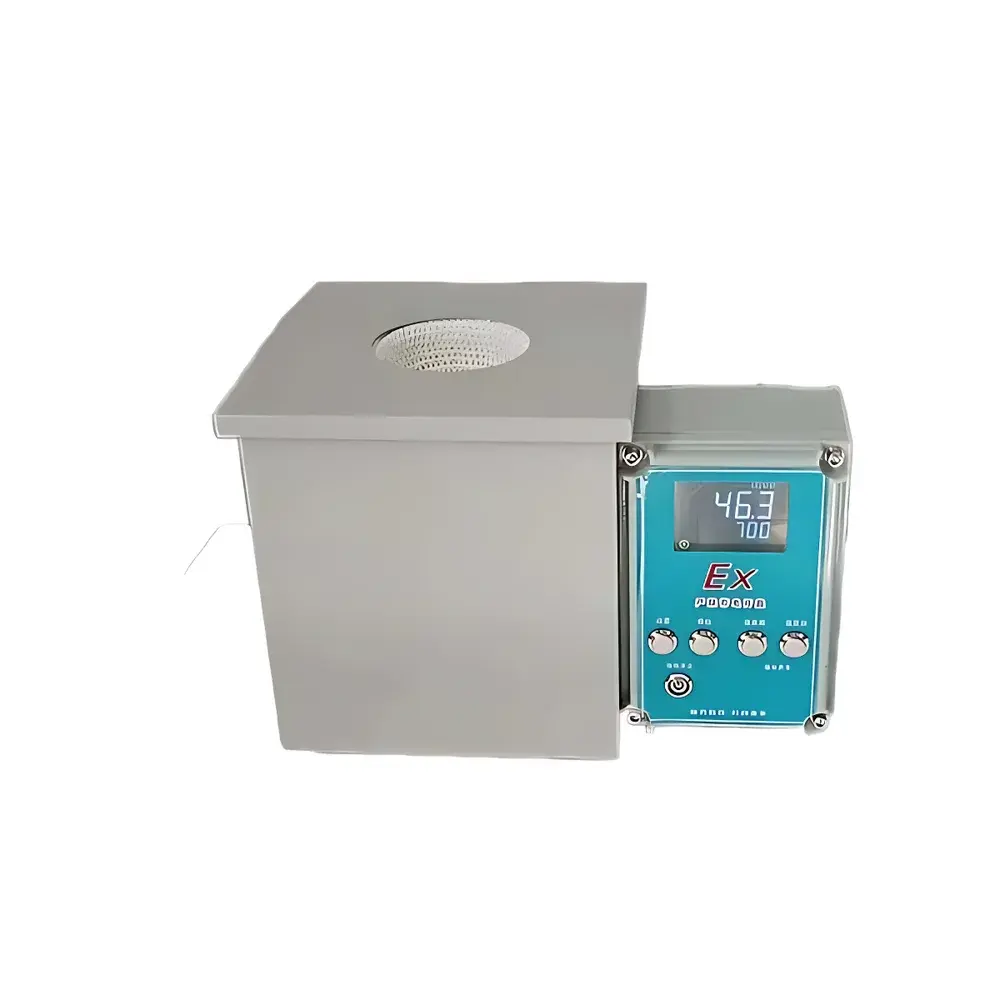
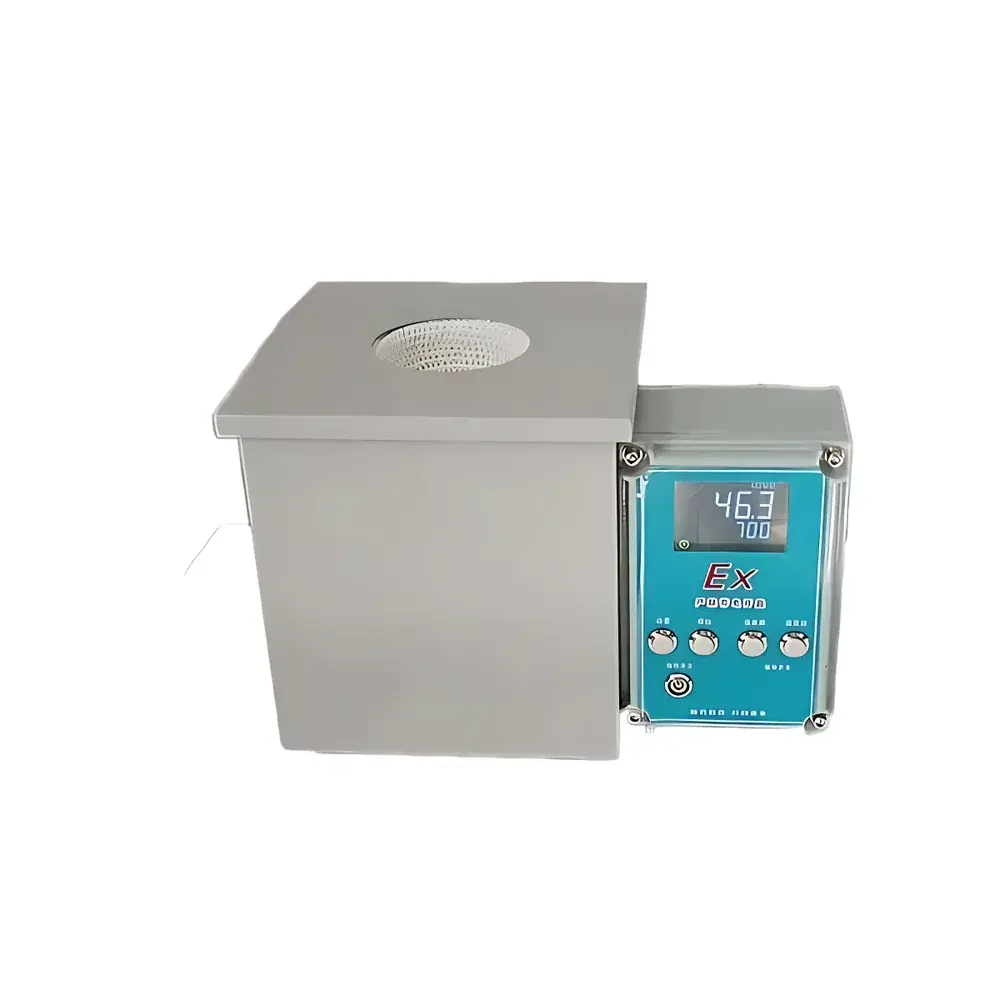
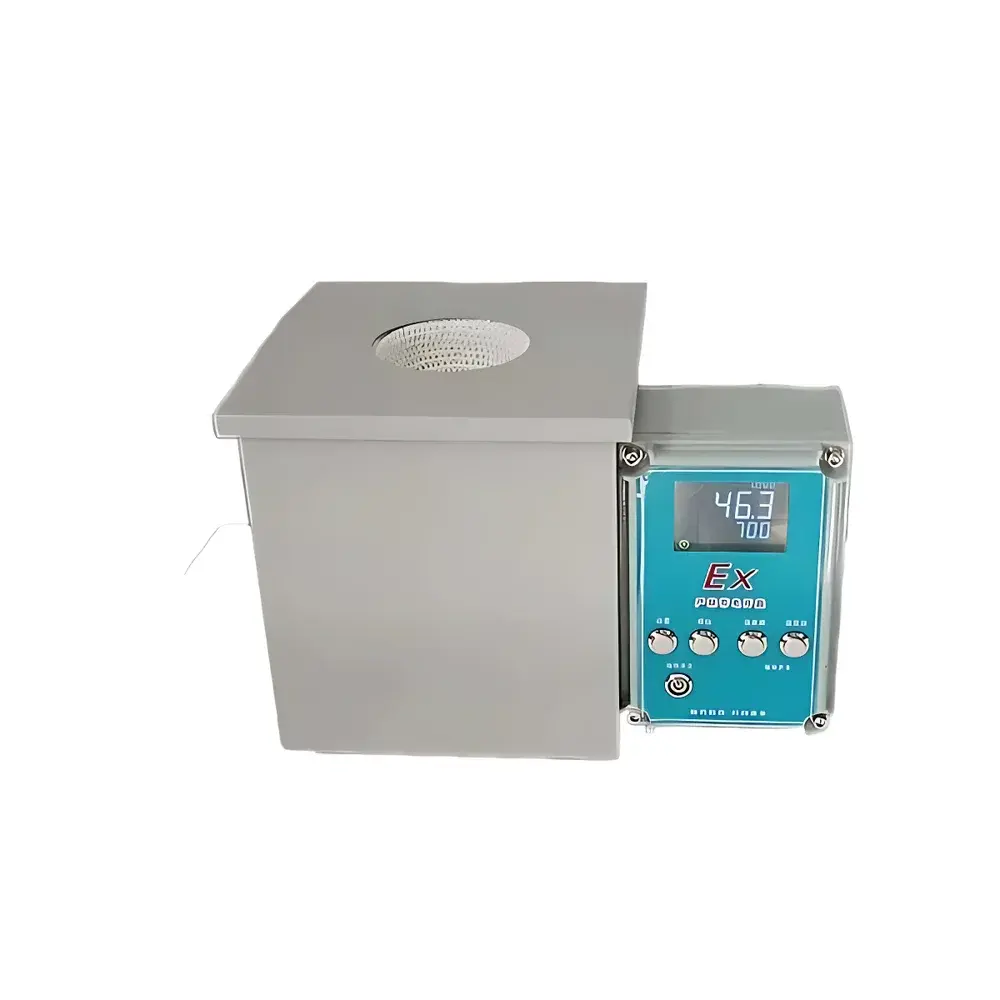
YUHUA EX-ZNHW Explosion-Proof Digital Temperature-Controlled Heating Mantle
| Brand | YUHUA (Gongyi Yuyi Instrument) |
|---|---|
| Origin | Henan, China |
| Model | EX-ZNHW |
| Capacity Options | 50–50,000 mL (0.05–50 L) |
| Heating Power | 110–6000 W |
| Temperature Range | Ambient to 380 °C |
| Temperature Accuracy | ±1 °C |
| Resolution | 0.1 °C |
| Control System | Microprocessor-based PID with auto-tuning, dual thermocouple inputs (internal & external), silicon-controlled rectifier (SCR) output |
| Safety Features | Thermocouple break protection, wide-input voltage (160–240 V AC), explosion-proof construction per IEC 60079-0 general requirements for electrical equipment for explosive atmospheres |
| Housing | One-piece molded polymer shell with electrostatic powder-coated lid |
| Insulation | Vacuum-formed alumina-silica ceramic fiber insulation |
| Heating Element | Cr20Ni80 (Nichrome) resistance wire coil embedded in alkali-free glass fiber matrix |
| Optional Functions | Digital timer, integrated magnetic stirring (model-dependent) |
Overview
The YUHUA EX-ZNHW Explosion-Proof Digital Temperature-Controlled Heating Mantle is an engineered thermal management solution designed for safe, precise, and reproducible heating of laboratory vessels—particularly in hazardous environments where flammable vapors, solvents, or dust may be present. Based on resistive heating principles, the unit employs a Cr20Ni80 alloy heating element uniformly distributed within an alkali-free glass fiber matrix, ensuring stable heat generation and long-term electrical insulation integrity. Heat transfer is optimized via spherical geometry, enabling ≥60% surface contact coverage with round-bottom flasks and other standard labware. Its explosion-proof enclosure complies with fundamental design principles outlined in IEC 60079-0 for general-purpose equipment intended for use in potentially explosive atmospheres (Zone 1/2, Group IIA–IIB, T4 maximum surface temperature class). The mantle operates without open flames or exposed heating elements, eliminating ignition sources while maintaining full compatibility with standard glassware across capacities from 50 mL to 50 L.
Key Features
- Explosion-resistant housing constructed from one-piece injection-molded polymer with electrostatically applied corrosion-resistant coating on the lid
- Vacuum-formed high-purity alumina-silica ceramic fiber insulation (density ≥128 kg/m³) providing low thermal conductivity (<0.08 W/m·K at 300 °C) and dimensional stability up to 1200 °C
- Dual-point temperature monitoring: independent internal thermocouple (embedded in mantle wall) and optional external thermocouple input for direct vessel-wall or solution-phase measurement
- Microprocessor-based digital controller featuring fuzzy logic PID algorithm with automatic parameter tuning, multi-stage digital filtering, and anti-integral windup compensation
- SCR-based power regulation delivering smooth, zero-crossing switching with ≤0.5% RMS current ripple and immunity to line voltage fluctuations (160–240 V AC, 50/60 Hz)
- Integrated safety protocols including thermocouple break detection, over-temperature cutoff (hardware-limited to 400 °C), and fail-safe relay deactivation
Sample Compatibility & Compliance
The EX-ZNHW series accommodates standard borosilicate glass reactors—including 50 mL to 50 L round-bottom flasks, distillation kettles, and jacketed vessels—with uniform thermal coupling achieved through conformal spherical contouring. No clamping or mechanical fastening is required beyond standard lab stands. The device meets general safety requirements for Class I, Division 2 (NEC/CEC) and ATEX Zone 2 applications when installed per manufacturer instructions and used with compatible grounding practices. While not certified to specific ATEX or IECEx directives out-of-box, its intrinsic design aligns with Clause 6.2 (Enclosure Protection) and Clause 7.3 (Temperature Classification) of IEC 60079-0:2017. It supports GLP-compliant workflows through traceable calibration records, audit-ready temperature logging (when paired with optional RS485/Modbus interface), and configurable data retention intervals.
Software & Data Management
Standalone operation requires no external software; however, optional communication modules enable integration into centralized lab control systems via Modbus RTU (RS485) or analog 4–20 mA output (0–380 °C range). Logged temperature profiles—including setpoint, actual internal/external readings, power output %, and alarm status—are timestamped with millisecond resolution and exportable as CSV files. Firmware supports user-defined calibration offsets per thermocouple channel and stores up to 10 programmable ramp-soak profiles. All configuration changes are recorded in an immutable system log meeting FDA 21 CFR Part 11 basic audit trail requirements (electronic signature not included; third-party validation recommended for regulated environments).
Applications
- Controlled solvent reflux and distillation in petrochemical QC labs handling hydrocarbons, ethers, or alcohols
- Accelerated aging studies of pharmaceutical intermediates under ISO 14644-1 Class 7 cleanroom-compatible conditions
- Viscosity stabilization during polymer synthesis where exothermic reaction control is critical
- Preparation of calibration standards in environmental testing (EPA Method 525.3, ASTM D86) requiring traceable thermal profiles
- Heating of digestion vessels in heavy-metal analysis (e.g., EPA 3050B) with simultaneous acid reflux containment
- Long-duration extraction processes in food safety labs (AOAC 992.15) where uninterrupted thermal consistency is mandated
FAQ
Is the EX-ZNHW certified to ATEX or IECEx standards?
It is not individually certified; however, its mechanical and electrical architecture conforms to IEC 60079-0 general requirements for equipment intended for explosive atmospheres. End-user certification may be pursued via notified body assessment of the complete installation.
Can it be used with stainless steel or PTFE-lined reactors?
Yes—provided the vessel exterior is non-ferromagnetic and thermally conductive. Contact area must remain ≥55% for optimal heat transfer efficiency.
What maintenance is required for long-term accuracy?
Annual verification of thermocouple calibration against NIST-traceable reference (e.g., dry-block calibrator) is recommended. Insulation integrity should be visually inspected for cracking or compression before each high-temperature (>300 °C) cycle.
Does the timer function support delayed start or multi-step programs?
The built-in timer offers simple countdown termination only. Multi-step ramp-soak sequences require external programmable logic controller (PLC) or optional PC-based software interface.
How is explosion protection achieved without purging or pressurization?
Through intrinsic design: sealed enclosure prevents ingress of combustible gases, surface temperature is limited to ≤135 °C under worst-case fault conditions (T4 classification), and all electronics operate below minimum ignition energy thresholds for common solvents.



