
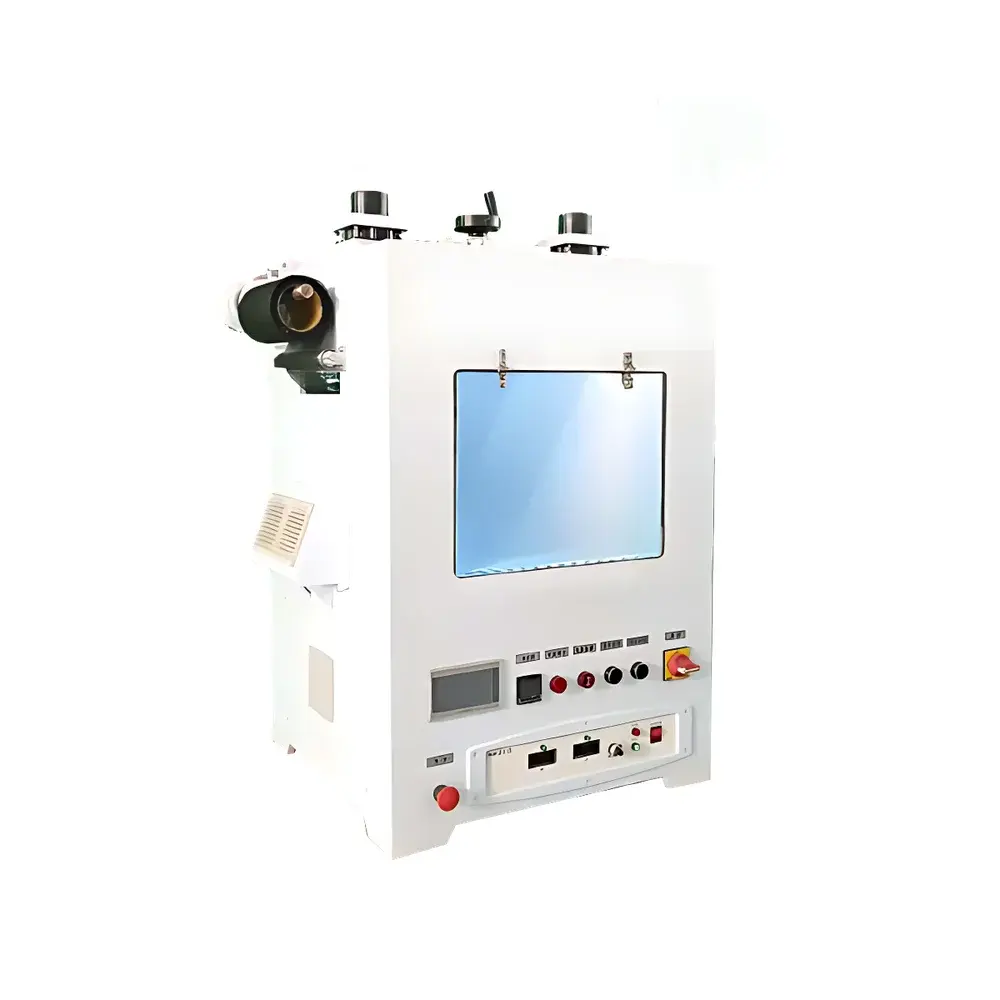
Yunfan NF-Lab Needleless Electrospinning System
| Brand | Yunfan |
|---|---|
| Origin | Tianjin, China |
| Model | NF-Lab Needleless Electrospinning System |
| Application | Laboratory-scale nanofiber fabrication for R&D in polymer science, biomaterials, and filtration media development |
| Design Type | Rotating drum–based needleless electrospinning platform |
| Key Advantage | Eliminates multi-needle clogging, improves fiber uniformity, suppresses “bead-on-string” and “lamp filament” artifacts |
Overview
The Yunfan NF-Lab Needleless Electrospinning System is an engineered laboratory-scale electrospinning platform designed for reproducible, high-throughput nanofiber production without the operational constraints of conventional multi-needle configurations. Unlike capillary-based systems relying on discrete spinnerets—prone to solvent evaporation, polymer precipitation, and tip clogging—the NF-Lab employs a continuous rotating drum electrode submerged in polymer solution. Under controlled high-voltage DC field (typically 15–30 kV), a stable Taylor cone forms along the liquid meniscus at the drum’s surface, enabling continuous jet initiation across the entire circumferential interface. This geometry inherently supports uniform charge distribution, reduced electric field distortion, and enhanced process stability—critical for achieving narrow fiber diameter distributions (CV < 12%) and minimizing structural defects such as beads, spindles, or lamp-filament morphology. The system is purpose-built for materials scientists, polymer engineers, and biomedical researchers requiring scalable, parameter-transparent nanofiber synthesis under ambient or controlled-humidity environments.
Key Features
- Rotating drum electrode architecture eliminates needle clogging and ensures uninterrupted operation over extended runtimes (>8 h continuous)
- Adjustable drum rotational speed (10–500 rpm) and voltage control (0–30 kV, ±0.1 kV resolution) enable precise tuning of jet initiation threshold and fiber morphology
- Modular collector stage compatible with grounded metal screens, rotating mandrels, or custom substrates (e.g., conductive fabrics, silicon wafers)
- Integrated environmental enclosure with optional humidity and temperature monitoring (20–80% RH, 15–35°C) to stabilize solvent evaporation kinetics
- CE-compliant high-voltage power supply with current-limiting protection (<100 µA output) and interlocked safety door
- Stainless-steel fluid reservoir with magnetic stirrer and level sensor to maintain homogeneous polymer solution viscosity during operation
Sample Compatibility & Compliance
The NF-Lab accommodates a broad range of polymer solutions—including polyacrylonitrile (PAN), polylactic acid (PLA), polyvinyl alcohol (PVA), polyethylene oxide (PEO), and gelatin-based blends—in common solvents such as DMF, THF, chloroform, and aqueous ethanol mixtures. Solution conductivity (0.1–5 mS/cm), viscosity (100–2000 cP), and surface tension (20–40 mN/m) are empirically validated within operational limits. The system conforms to IEC 61010-1:2010 for electrical safety in laboratory equipment and supports GLP-compliant documentation through audit-trail-enabled software logging. While not certified for GMP manufacturing, its design aligns with ASTM D7954-15 (Standard Guide for Electrospun Nanofiber Fabrication) and ISO 20785:2018 (Nanotechnologies — Characterization of Nanofibers) for method validation and reporting consistency.
Software & Data Management
The NF-Lab operates via Yunfan’s proprietary SpindleControl™ v3.2 software, running on Windows 10/11 platforms. The interface provides real-time monitoring of voltage, current, drum RPM, ambient RH/temperature, and solution level. All parameters are timestamped and saved in .csv and .xlsx formats with metadata tags (operator ID, batch ID, polymer lot number). Software supports FDA 21 CFR Part 11–compliant user authentication (role-based access), electronic signatures, and immutable audit trails. Exported datasets integrate seamlessly with MATLAB, Python (via Pandas), and ImageJ/Fiji for downstream fiber diameter analysis using automated thresholding and skeletonization algorithms.
Applications
- R&D of ultra-thin filtration membranes for HEPA/ULPA-grade air and liquid separation
- Electrospun scaffolds for tissue engineering (nerve regeneration, vascular grafts, wound dressings)
- Functionalized nanofiber mats for catalytic support, drug-eluting coatings, and biosensor transducers
- Process optimization studies correlating solution rheology, electric field geometry, and fiber crystallinity (via in-situ XRD coupling)
- Teaching modules in polymer physics, soft matter engineering, and nanomanufacturing laboratories
FAQ
What polymer concentration ranges are supported?
Typical working concentrations span 8–25 wt%, depending on molecular weight and solvent volatility. Viscosity must remain below 2000 cP at shear rates >10 s⁻¹ to ensure stable meniscus formation.
Can the system produce aligned fibers?
Yes—using a high-speed rotating collector (up to 5000 rpm) or parallel electrode configuration, fiber alignment exceeding 85% orientation order parameter (Herman’s orientation factor) is achievable.
Is solvent recovery integration possible?
The base configuration does not include condensate recovery; however, third-party cold-trap interfaces (−40°C) can be retrofitted via standardized flange ports (KF25) on the chamber exhaust line.
What maintenance is required?
Monthly cleaning of the drum electrode and collector plate with IPA; biannual calibration of HV meter and RPM encoder using NIST-traceable references.
Does the system support multi-material co-electrospinning?
Not natively—the NF-Lab is a single-reservoir platform. Dual-fluid coaxial adaptation requires external pump synchronization and is not covered under standard warranty.






