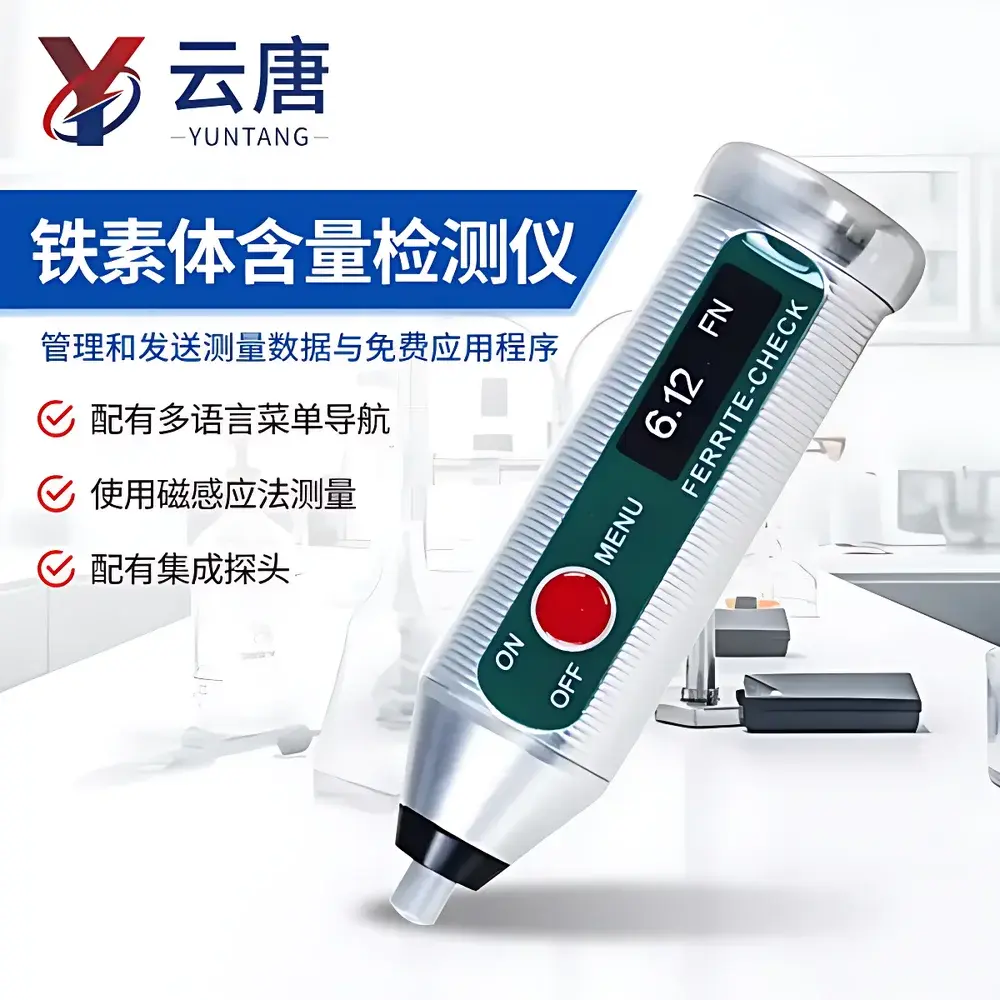
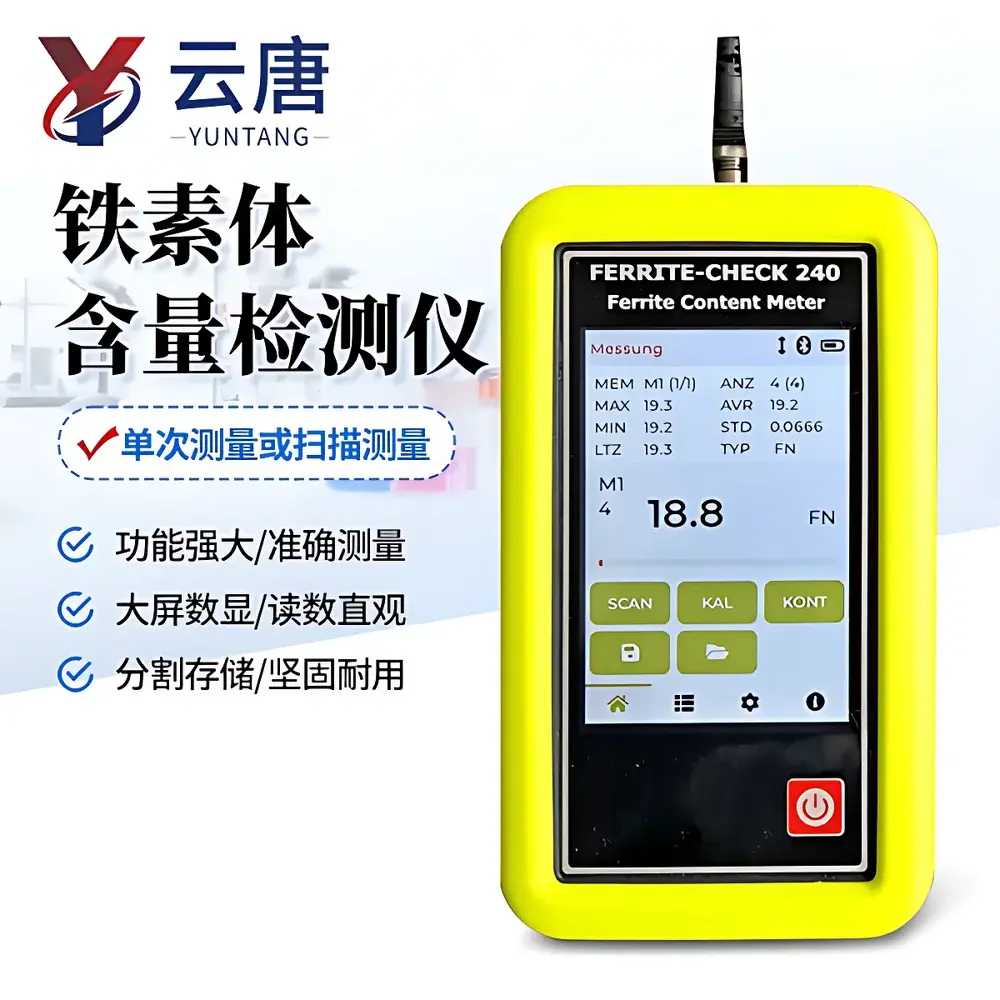
Yuntang FERRITE-CHECK 240 Portable Ferrite Content Meter
| Brand | Yuntang |
|---|---|
| Origin | Shandong, China |
| Manufacturer Type | Manufacturer |
| Region of Origin | Domestic (China) |
| Model | FERRITE-CHECK 140 / FERRITE-CHECK 240 |
| Price Range | USD 4,200 – 5,350 |
| Measurement Principle | Magnetic Induction |
| Standards Compliance | DIN EN ISO 8249:2018, Basel Convention referenced for calibration traceability |
| Measurement Range | 0.2–100 Fe% / 0.2–140 FN |
| Resolution | 0.1 Fe% or FN |
| Accuracy | ±<5% of reading |
| Minimum Test Area | Ø2 mm |
| Operating Temperature | 0–50 °C |
| Display | 320×480-pixel color LCD touchscreen |
| Data Storage | 10,000 measurements (segmented) |
| Battery Life | ~25 h (3×AA alkaline) |
| Power Options | USB-C external supply |
| Dimensions | 150 × 85 × 35 mm |
| Weight | 320 g (with batteries) |
| Communication | Bluetooth 5.0 (Android/iOS/Windows), USB-C, SCPI-compliant remote interface |
| Software | Lima Connect (free Windows application with statistical analysis and graphical export) |
| Calibration Standards | Three NIST-traceable ferrite reference standards included |
| Language Support | English, German, French, Italian, Spanish |
| IP Rating | Not specified (rubberized protective sleeve provided) |
| Probe Type | Digital Ferrite-2000 sensor with high-sampling-rate digitization |
Overview
The Yuntang FERRITE-CHECK 240 is a handheld, battery-operated ferrite content meter engineered for precise, non-destructive quantification of delta-ferrite in austenitic stainless steels and duplex/super-duplex stainless steel weldments. It operates on the magnetic induction principle—measuring the perturbation of a high-frequency AC magnetic field induced in the test material by a miniature, temperature-compensated probe. This method is standardized under DIN EN ISO 8249:2018, which defines the relationship between magnetic response and volumetric ferrite content (expressed as Fe% or Ferrite Number, FN). The instrument is calibrated against three NIST-traceable reference standards, ensuring metrological integrity across its full measurement range of 0.2–100 Fe% (equivalent to 0.2–140 FN). Its compact architecture (150 × 85 × 35 mm, 320 g) and ruggedized rubber overmold make it suitable for shop-floor deployment, field inspection, and QA/QC audits in fabrication yards, pipe welding facilities, and offshore module construction sites.
Key Features
- Digital Ferrite-2000 probe with fully digitized signal path—eliminates analog noise and enables stable, repeatable readings even in electrically noisy industrial environments.
- High-resolution 320×480 color touchscreen LCD with intuitive icon-driven navigation and multilingual UI (English, German, French, Italian, Spanish).
- Two operational modes: single-point measurement for spot verification and continuous scan mode—ideal for profiling weld beads, HAZ zones, or heat-treated regions; automatically computes min/max/mean/standard deviation over user-defined series.
- SCPI (Standard Commands for Programmable Instruments) interface via USB-C enables integration into automated testing workflows and compliance with GLP/GMP data integrity requirements.
- Bluetooth 5.0 connectivity supports real-time wireless data streaming to Android, iOS, and Windows devices—facilitating immediate annotation, geotagging, and cloud upload during field inspections.
- Onboard storage for up to 10,000 measurements, organized in segmented batches for project-level traceability and audit-ready recordkeeping.
Sample Compatibility & Compliance
The FERRITE-CHECK 240 is validated for use on flat, curved, or slightly roughened surfaces of austenitic and duplex stainless steels—including ER2209, ER2553, 304L, 316L, and UNS S32205/S32750 base metals and weld deposits. Surface preparation requirements are minimal: removal of heavy scale, slag, or conductive coatings is recommended; polished or ground surfaces yield optimal repeatability (±<2% RSD). The device complies with DIN EN ISO 8249:2018 for ferrite measurement methodology and reporting. Calibration standards are certified traceable to NIST SRM 2793 (ferritic stainless steel reference materials), satisfying ISO/IEC 17025 clause 6.6 and supporting regulatory submissions under FDA 21 CFR Part 11 when used with Lima Connect’s audit-trail-enabled data export.
Software & Data Management
Lima Connect—a free Windows-based desktop application—provides full bidirectional communication with the FERRITE-CHECK 240 via USB or Bluetooth. It enables configurable report generation (PDF/CSV), statistical process control (SPC) charting (X̄-R, histograms), trend analysis across multiple weld passes, and overlay of measurement series onto CAD-derived weld maps. All exported datasets include embedded metadata: timestamp, GPS coordinates (if enabled via paired mobile device), operator ID, probe serial number, and calibration certificate expiry date—meeting ALCOA+ principles for data reliability. Remote firmware updates and parameter configuration (e.g., units, averaging window, alarm thresholds) are supported without hardware intervention.
Applications
- Weld procedure qualification (WPQ) per ASME IX and ISO 15614-1, verifying ferrite content in root, fill, and cap passes of duplex stainless steel piping systems.
- In-service inspection of pressure vessels, heat exchangers, and desalination plant components where excessive ferrite embrittlement or insufficient ferrite-induced cracking resistance must be ruled out.
- Quality gate validation prior to post-weld heat treatment (PWHT), ensuring baseline microstructure stability before thermal exposure.
- R&D laboratories assessing heat-affected zone (HAZ) ferrite redistribution during laser-GMAW hybrid welding trials.
- Third-party inspection agencies performing API RP 582-compliant corrosion-resistant alloy (CRA) verification audits.
FAQ
What is the difference between Fe% and FN units?
Fe% denotes volumetric ferrite percentage derived from metallographic correlation; FN (Ferrite Number) is an empirical scale defined in AWS A4.2M, where FN = 10 × √Fe%. The FERRITE-CHECK 240 reports both values simultaneously, with internal conversion validated per ISO 8249 Annex B.
Can the instrument measure through paint or thin non-conductive coatings?
No—coatings thicker than 50 µm or containing ferromagnetic pigments will distort the magnetic field and invalidate results. Surface cleaning to bare metal is required per ISO 8501-1 Sa 2½ prior to measurement.
Is probe calibration required before each use?
Daily zeroing using the supplied “zero block” is recommended; full recalibration against all three reference standards is required every 90 days or after mechanical shock, per ISO/IEC 17025 clause 7.7.2.
Does the device support GLP-compliant electronic signatures?
Lima Connect supports role-based user authentication and digital signature capture for critical measurements, fulfilling 21 CFR Part 11 §11.200(a) when deployed on validated Windows workstations.
What is the minimum curvature radius the probe can accommodate?
The Ferrite-2000 probe maintains accuracy on convex surfaces down to Ø25 mm radius; concave surfaces require custom fixture support to ensure consistent probe lift-off.