
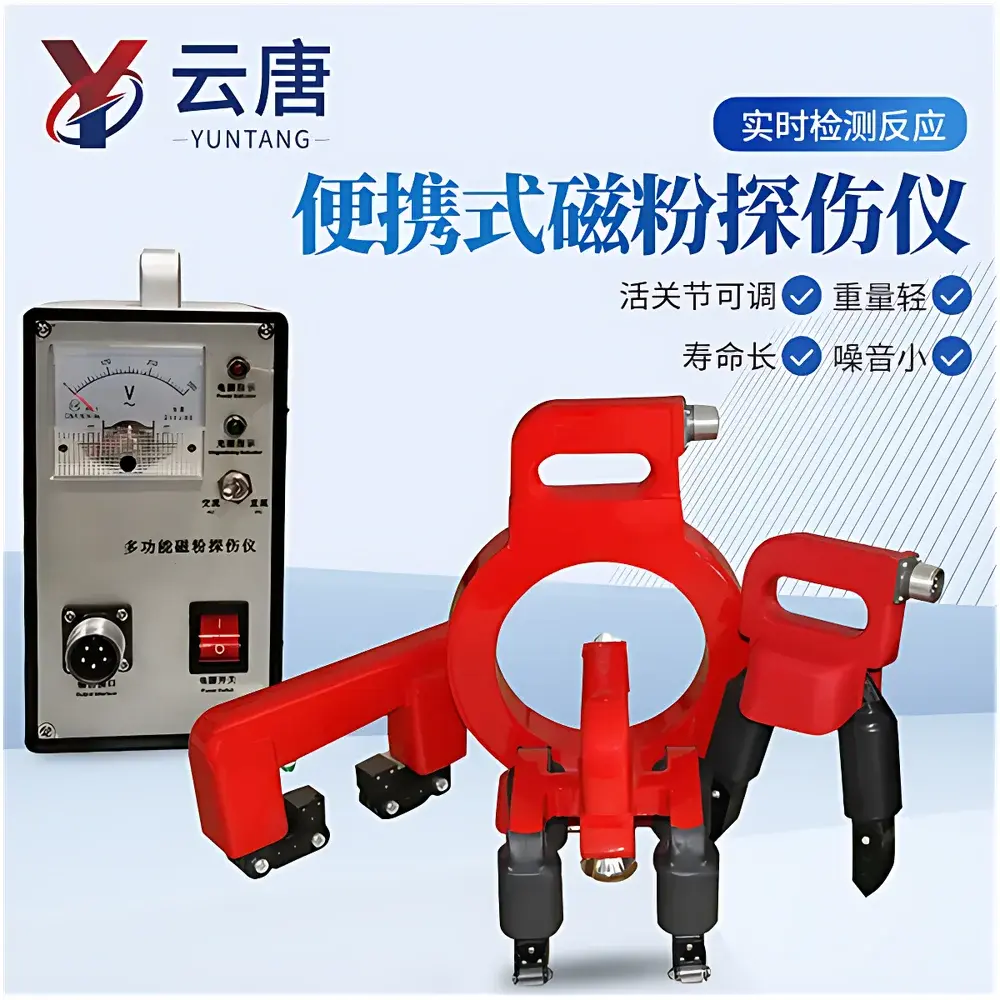
Yuntang YT-610C Portable Electromagnetic Yoke Magnetic Particle Inspection (MPI) Equipment
| Brand | Yuntang |
|---|---|
| Origin | Shandong, China |
| Manufacturer Type | Direct Manufacturer |
| Country of Origin | China |
| Model | YT-610C |
| Magnetization Modes | Circumferential (AC 0–2000 A, phase-controlled cutoff), Longitudinal (AC 0–24,000 AT, phase-controlled cutoff), Composite |
| Configuration | Portable, Handheld Yoke System |
| Magnetization Method | Dry Powder MPI |
| Circumferential Magnetizing Current | AC 0–2000 A, continuously adjustable with phase-angle control for precise demagnetization timing |
| Longitudinal Magnetomotive Force | AC 0–24,000 AT, continuously adjustable with phase-angle control |
| Inspection Cycle Time | ≤6 seconds per component |
| Residual Field After Demagnetization | ≤0.2 mT |
| Continuous Operating Duration | >4 hours |
| Input Voltage | AC 220 V ±10% |
| Output Voltage | AC 36 V (safety-isolated) |
| Output Current | >10 A |
| Lifting Power | ≥5 kg (AC), ≥18 kg (DC for optional probes) |
| Duty Cycle | 50% |
| Sensitivity Verification | Clear indication of ASTM E1444-compliant A1-30/100 shim test piece |
| Dimensions (H×W×D) | 230 × 160 × 120 mm |
| Weight | 5 kg |
| Probe Compatibility | Standard A-type yoke (adjustable pole spacing 0–250 mm), optional E-type (cross-yoke), D-type (high-lift yoke), O-type (circular coil, Φ150 mm, 1800 TA) |
Overview
The Yuntang YT-610C Portable Electromagnetic Yoke Magnetic Particle Inspection (MPI) Equipment is a compact, safety-engineered non-destructive testing (NDT) instrument designed for surface and near-surface discontinuity detection in ferromagnetic materials. It operates on the principle of induced magnetic flux leakage: when a localized magnetic field is applied via electromagnetic yoke or coil, surface-breaking cracks or subsurface flaws disrupt magnetic continuity, causing flux leakage that attracts ferromagnetic particles—either dry powder or wet suspension—forming visible indications under appropriate lighting. The YT-610C employs solid-state silicon-controlled rectifier (SCR)-based switching to deliver low-voltage AC output (36 V), eliminating high-voltage hazards while maintaining sufficient magnetomotive force for reliable flaw detection in field or shop-floor environments. Its design complies with fundamental requirements of ASTM E1444/E709 and ISO 9934-1 for magnetic particle testing methodology, including controlled current delivery, phase-angle interruption for residual field management, and reproducible lift force verification.
Key Features
- Triple-mode magnetization capability: independent selection of circumferential (0–2000 A), longitudinal (0–24,000 AT), and composite magnetization—enabling full coverage of complex geometries without repositioning.
- Phase-controlled AC current cutoff ensures precise timing of magnetic field collapse, critical for achieving consistent residual field levels ≤0.2 mT post-demagnetization—meeting ISO 9934-2 requirements for residual field limits in subsequent machining or assembly steps.
- Adjustable pole spacing (0–250 mm for standard A-probe) with articulated joint mechanism allows conformal contact on curved, angled, or irregular surfaces—including T-joints, fillet welds, and pressure vessel nozzles.
- Low-voltage isolation architecture (36 V output) satisfies IEC 61000-6-2 immunity and IEC 61000-6-4 emission standards for industrial environments; eliminates risk of arc flash or insulation breakdown in confined or wet locations.
- Robust thermal management enables >4 hours of continuous operation at 50% duty cycle—validated under ambient temperatures from –10 °C to +40 °C per MIL-STD-810G environmental testing protocols.
- Integrated lifting force verification (≥5 kg AC, ≥18 kg DC for optional probes) meets ASTM E1444 Annex A2 calibration requirements for yoke performance validation prior to each inspection shift.
Sample Compatibility & Compliance
The YT-610C is validated for use on carbon steels, low-alloy steels, ferritic stainless steels, and other ferromagnetic alloys commonly found in rail infrastructure, aerospace structural components, welded piping systems, and heavy machinery frames. It supports both dry powder application (for coarse surface inspection under white light) and fluorescent particle suspensions (under UV-A illumination ≥365 nm, 1000 µW/cm² minimum). All probe configurations—including optional E-type cross-yoke (110 mm pole spacing, ≥8 kg lift), D-type high-intensity yoke (60–220 mm spacing), and O-type circular coil (Φ150 mm, 1800 TA)—are traceably calibrated against NIST-traceable shims (A1-30/100) and lift force standards (N1/N2/N3 per ISO 9934-2). The system adheres to quality assurance documentation requirements under ASME BPVC Section V, EN 1369, and JIS Z 2301, with full audit trail support for GLP/GMP-regulated environments.
Software & Data Management
While the YT-610C is a hardware-centric analog/digital hybrid instrument without embedded firmware or cloud connectivity, its operational parameters are fully documentable within standardized NDT reporting frameworks. Each inspection cycle includes manual recording of magnetization mode, current/AT level, particle type, lighting condition (white light intensity ≥1000 lux or UV-A irradiance ≥1000 µW/cm²), and environmental conditions—structured to align with ASTM E1444 Section 10 reporting templates. Optional accessories—including LB-1040 handheld UV lamps and LB-4561 suspended UV floodlights—feature built-in radiometric calibration certificates traceable to NIST. For digital workflow integration, users may pair the YT-610C with third-party MPI data capture platforms (e.g., Olympus NDT Connect or Sonatest VeriScan) via external imaging modules and annotation tools compliant with ISO/IEC 17025 documentation integrity requirements.
Applications
The YT-610C delivers repeatable detection sensitivity for fatigue cracks, stress-corrosion cracking, lack-of-fusion in welds, and grinding burns across diverse sectors. In rail maintenance, it verifies axle integrity, brake shoe mounting brackets, and switch point rails under ASTM E3024 Level 2 acceptance criteria. In aerospace, it inspects landing gear welds, engine mount lugs, and turbine disk bolt holes per NAS 410 certification requirements. Within power generation, it screens boiler tube welds, steam drum nozzles, and valve body castings per ASME Section V Article 7. Its portability and low-voltage design make it suitable for offshore platform inspections, shipyard hull weld mapping, and remote pipeline girth weld verification where generator-based power sources or battery-operated alternatives are impractical.
FAQ
What standards does the YT-610C comply with for MPI procedure qualification?
It supports implementation of ASTM E1444, ISO 9934-1, EN 1369, and ASME BPVC Section V Article 7—provided operators follow documented procedures, perform daily lift force and sensitivity checks, and maintain calibration records per ISO/IEC 17025.
Can the YT-610C be used for wet fluorescent MPI?
Yes—when paired with compatible UV-A lamps (e.g., LB-1050 or LB-5031) and ASTM E1444-compliant fluorescent particles, provided ambient white light is <2 lux and UV-A irradiance at the surface exceeds 1000 µW/cm².
Is phase-controlled current cutoff necessary for all inspections?
It is mandatory for applications requiring controlled residual field reduction (e.g., components entering final machining or coating processes) and strongly recommended for repeatability in high-volume production audits per ISO 9934-2 Annex B.
How often must lift force be verified?
Per ASTM E1444 Section 7.3.2, lift force must be confirmed before first use each shift and after any impact or adjustment to probe articulation joints.
Does the YT-610C support DC magnetization?
The base unit delivers AC-only output; however, optional D-type and E-type probes are rated for DC lift force verification (≥18 kg DC), enabling dual-mode procedural flexibility when used with external DC power supplies meeting ASTM E1444 Annex A3 specifications.



