
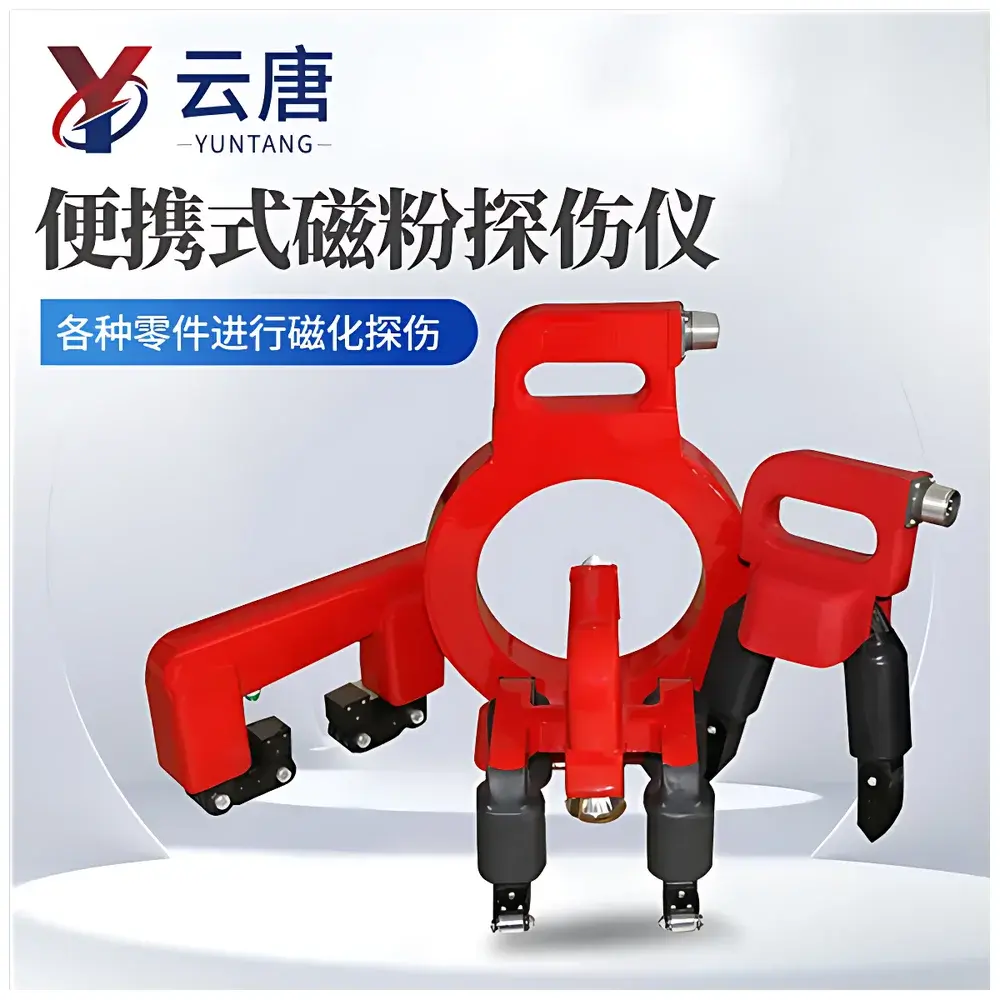
Yuntang YT-610C Portable Magnetic Particle Inspection (MPI) Equipment
| Brand | Yuntang |
|---|---|
| Origin | Shandong, China |
| Manufacturer Type | Direct Manufacturer |
| Country of Origin | Domestic (China) |
| Model | YT-610C |
| Magnetization Modes | Circumferential (AC 0–2000 A, phase-controlled cutoff), Longitudinal (AC 0–24,000 AT, phase-controlled cutoff), Composite |
| Inspection Cycle Time | ≤6 s per part |
| Residual Field After Demagnetization | ≤0.2 mT |
| Continuous Operating Duration | >4 h |
| Input Voltage | AC 220 V ±10% |
| Output Voltage | AC 36 V |
| Output Current | >10 A |
| Lifting Force | ≥5 kgf |
| Duty Cycle | 50% |
| Sensitivity | Clear indication of ASTM E1444/E709 A1-30/100 shims |
| Probe Configurations | Electromagnetic Yoke (adjustable pole spacing: 0–250 mm), Horseshoe Probe (0–160 mm), Circular Coil (Φ150 mm, 1800 TA) |
| Dimensions (L×H×W) | 230×160×120 mm |
| Weight | 5 kg |
Overview
The Yuntang YT-610C Portable Magnetic Particle Inspection (MPI) Equipment is a compact, low-voltage AC-powered system engineered for reliable surface and near-surface discontinuity detection in ferromagnetic materials. It operates on the fundamental principle of magnetic particle testing—inducing a controlled magnetic field in the test specimen and applying ferrous or fluorescent magnetic particles to visualize leakage fields at flaw sites. Unlike high-voltage or permanent-magnet systems, the YT-610C employs silicon-controlled rectifier (SCR)-based solid-state switching to deliver precise, phase-controlled magnetization currents, minimizing electromagnetic interference and ensuring repeatable field strength across inspection cycles. Its dual-mode capability—supporting both continuous (wet/dry particle application during magnetization) and residual (post-magnetization particle application) techniques—enables compliance with ASTM E1444, ASTM E709, ISO 9934, and EN 1369 standards. Designed for field and shop-floor deployment, it meets the safety requirements of IEC 61000-6-3 (EMC) and incorporates reinforced insulation and grounded 36 V output to mitigate electrical hazard risks in confined or conductive environments.
Key Features
- Triple magnetization flexibility: Independently selectable circumferential, longitudinal, and composite magnetization modes—each with real-time current/ampereturn adjustment and zero-crossing phase control for optimal field uniformity and minimized arc flash risk.
- Three interchangeable probe assemblies: Adjustable electromagnetic yoke (0–250 mm pole spacing), horseshoe probe (0–160 mm), and circular coil (Φ150 mm, 1800 TA)—enabling geometry-adaptive inspection of welds, castings, forgings, and complex-profile components.
- High-lift, low-voltage architecture: Delivers ≥5 kgf lifting force at 36 V AC output—ideal for aerospace fasteners, rail axle shoulders, and pressure vessel nozzles where high-voltage penetration is prohibited.
- Robust thermal management: Rated for 50% duty cycle with >4 hours of sustained operation under ambient temperatures up to 40 °C—validated via accelerated life testing per MIL-STD-810G Method 502.6.
- Fail-safe operational design: Integrated thermal cutoff, input voltage monitoring, and SCR overcurrent protection prevent component degradation during prolonged use or improper probe contact.
Sample Compatibility & Compliance
The YT-610C is validated for use on carbon steels, alloy steels, nickel-based alloys, and other ferromagnetic materials with permeability >300 µ₀. It supports both visible (dry powder, wet suspension) and fluorescent (UV-A compatible) particle media per ASTM E1382 and ISO 9934-2. The system complies with key regulatory frameworks including ASTM E1444-23 (Standard Practice for Magnetic Particle Testing), ASTM E709-22 (Guide for Magnetic Particle Testing), ISO 9934-1:2021 (Non-destructive testing — Magnetic particle testing — Part 1: General principles), and EN 1369:2019 (Founding — Magnetic particle inspection). Its low-voltage output and grounded chassis meet IEC 61010-1 safety requirements for portable electrical equipment used in industrial environments.
Software & Data Management
As a manually operated analog MPI system, the YT-610C does not incorporate embedded software or digital data logging. However, its standardized interface—featuring aviation-grade connectors and fixed-output timing—ensures full compatibility with third-party documentation workflows. Users may integrate inspection records into electronic quality management systems (eQMS) such as MasterControl or Veeva QMS using external digital cameras, calibrated UV-A irradiance meters (per ASTM E3022), and traceable calibration logs. All magnetization parameters (current, duration, mode) are manually recorded per ASNT SNT-TC-1A Level II procedure requirements, supporting full auditability under ISO 9001:2015 Clause 8.5.2 and FAA AC 120-116 Appendix B.
Applications
The YT-610C is routinely deployed across regulated manufacturing and maintenance sectors: weld inspection of ASME Section VIII pressure vessels; fatigue crack screening on aircraft landing gear and turbine disks; angular weld evaluation in ship hull fabrication; axle and crankshaft verification in automotive Tier 1 supply chains; and in-service inspection of rail infrastructure components per AREMA Manual for Railway Engineering Chapter 30. Its portability and low-voltage design make it especially suited for confined-space inspections—such as boiler tube sheet access ports or offshore platform structural nodes—where grounding integrity and operator proximity necessitate reduced electrical risk profiles.
FAQ
What magnetization methods does the YT-610C support?
It supports circumferential, longitudinal, and composite magnetization—all with adjustable AC current/ampereturn output and phase-controlled demagnetization.
Is the unit compliant with ASTM E1444?
Yes—the system meets all equipment performance criteria in ASTM E1444-23 Sections 6.2–6.4 for portable AC yoke and coil-based MPI devices.
Can it be used for residual magnetism testing?
Yes—its stable field decay characteristics and precise current cutoff enable reliable residual technique execution per ASTM E709 Section 8.2.
What safety certifications apply to this device?
It conforms to IEC 61010-1:2010 for electrical safety and IEC 61000-6-3:2019 for electromagnetic compatibility in industrial settings.
How is calibration verified?
Calibration is performed using certified lift test blocks (ASTM E1444 Annex A1) and Hall-effect gaussmeters traceable to NIST standards; documented per ISO/IEC 17025 requirements.



